 savingsspot.co.uk
 For decades, the familiar cobalt-blue signage of Boots has been a fixture of the British high street. While most of us drop into the chemist for a meal deal, a repeat prescription, or a bottle of suncream, the optical department upstairs—Boots Opticians—happens to be one of the most fertile grounds for consumer savings in the UK, provided you know how to navigate its tier systems.
Buying spectacles or contact lenses in the UK can produce extreme sticker shock. By the time you have paid for a private eye examination, chosen a designer frame, and added thinned, anti-scratch, anti-glare varifocal lenses, you can easily be staring down the barrel of a £400 invoice. However, because Boots operates at the intersection of a massive retail loyalty engine (the Advantage Card) and state-subsidised healthcare (the NHS), it offers unique “stacking” opportunities that standalone independent optometrists simply cannot match.
Whether you are a contact lens veteran, a parent trying to sort out specs for a clumsy toddler, or an over-60s shopper looking for clear reading vision, this guide breaks down the concrete ways to extract the maximum value out of Boots Opticians.
1. The Advantage Card Multiplier: Treating Eyewear like a Major Purchase
The single biggest mistake British consumers make at Boots Opticians is treating it as an entirely separate entity from the main Boots shop downstairs. Your Boots Advantage Card is your primary weapon for discounting optical care.
Standard retail spending at Boots earns you 3 points for every £1 spent (where each point equals 1p). Because prescription glasses are a high-ticket item, a single purchase can yield a massive point haul. If you spend £280 on a pair of branded frames with tailored lenses, you instantly accumulate £8.40 in store credit.
The “Mega Points” Booking Hack
Boots frequently runs weekend promotions offering something along the lines of “£10 worth of points when you spend £60 across the store” or “Triple Points on all transactions over £50”.
Most shoppers use these days to stock up on expensive face creams or electric toothbrushes. The savvy optical customer does this: they book their routine eye test two weeks in advance, ask the dispensing optician to put their chosen frames “on hold” in the drawer, and walk in to pay the final balance specifically on a Mega Points Saturday. Suddenly, that same £280 pair of glasses yields £25 to £35 in Advantage points, paying for your toiletries for the next two months.
2. Cracking the ‘2 for 1’ Code (Without Buying Rubbish)
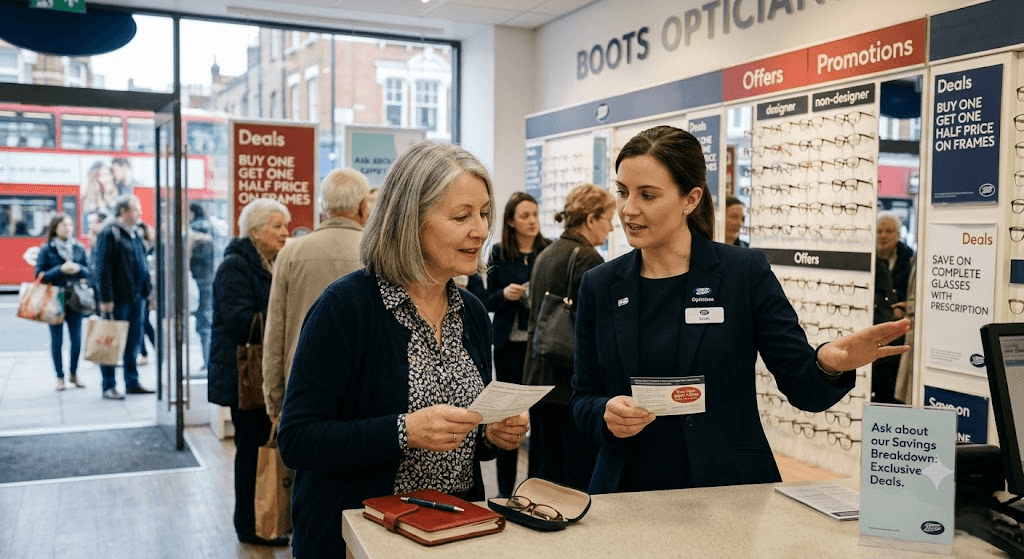
The “Buy One, Get One Free” or “2 for 1” offer is the oldest hook in the high-street optical playbook. Boots runs this offer almost perpetually, but the financial reality of it requires close reading.
At Boots, the 2-for-1 offer generally kicks in when you buy a pair of glasses from their £85 range or higher. The second pair comes from the same price range or a cheaper one. However, the basic offer only covers standard single-vision lenses. If you require varifocals, high-index (thinned) glass, or photochromic lenses, you will have to pay the lens upgrade supplement on the second pair.
How to win the 2-for-1
Do not use your second pair to buy a “slightly different coloured backup pair” that will sit in your glovebox gathering dust. Use the second pair to commission bespoke prescription sunglasses.
If you buy a primary pair of Ray-Ban clear daily glasses for £180, you can select a second stylish frame from the £180 tier for free. By paying the relatively minor standard tint fee (usually around £35 to £40), you have just secured a pair of high-end, custom-fitted prescription sunglasses that would cost you £200 to purchase independently. You have effectively turned a “free backup” into a crucial summer lifestyle asset.
3. The Contact Lens Rewards Plan: The High Street’s Best Kept Secret
If you wear contact lenses even two or three days a week, paying for them ad-hoc over the counter is burning money. The Boots Contact Lens Rewards Plan is arguably the most financially advantageous subscription model on the British high street, purely because of its secondary perks.
When you sign up to have your lenses delivered via Direct Debit, you are enrolled into a system that offers the following locked-in benefits:
- Free ongoing eye tests and contact lens check-ups: A private eye test at Boots usually costs around £25–£30. Lenses check-ups cost roughly the same. Under the plan, these are completely covered.
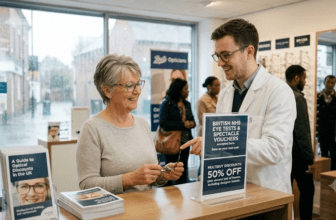
- 50% off all prescription glasses: This is the golden goose. As a scheme member, you get an unconditional half-price discount on glasses.
- 10% off Boots own-brand products downstairs: This applies automatically when you scan your Advantage Card at the normal pharmacy tills.
- Free replacement of torn or lost lenses: If you drop a monthly lens down the sink, you can pop into a branch and they will hand you a replacement blister pack for nothing.
The Cold Hard Math
Imagine you wear daily disposables that cost £30 a month (£360 a year). During that year, your routine eye test and lens check would normally cost you £55. You decide you want a pair of designer Tom Ford glasses for the evenings, priced at £310.
As a non-member, your total outlay for the year is £360 + £55 + £310 = £725.
As a Contact Lens Reward Plan member, your outlay is £360 (lenses) + £0 (tests) + £155 (half-price Tom Fords) = £515.
The subscription has literally saved you £210 in a single calendar year, effectively making your contact lenses cost just £12.50 a month in real terms.
4. Demystifying the NHS Optical Voucher System
Millions of people in Great Britain are legally entitled to financial assistance with their eye care, yet fail to claim it due to the confusing way NHS vouchers are presented. Boots Opticians holds a massive inventory of frames specifically designed to swallow these vouchers whole.
Who qualifies for a free NHS eye test at Boots?
You do not pay a penny for your eye examination if you meet any of the following criteria:
- You are aged under 16, or aged 16–18 and in full-time education.
- You are aged 60 or over.
- You have been diagnosed with diabetes or glaucoma.
- You are aged 40 or over and have a mother, father, sibling, or child with glaucoma.
- You receive Income Support, Income-based Jobseeker’s Allowance, or qualify via an NHS Tax Credit Exemption Certificate.
The “Top-Up” Strategy
If you qualify for NHS help, you will be issued an optical voucher categorized by a letter (Band A through Band H, depending on the strength of your prescription). A standard Band A voucher is worth roughly £39, whereas a Band H voucher (for extreme prescriptions) can be worth over £215.
Many consumers believe an NHS voucher restricts them to the “NHS wire frames” sitting in the budget corner of the shop. This is false. An NHS voucher is simply a cash voucher. You can take a Band A voucher, pick up a pair of £150 Mulberry frames, hand the voucher to the Boots cashier, and ask them to apply it as a part-payment. You will only pay the £111 difference.
5. The Over-60s “Double Dip”
Turning 60 in the UK triggers an automatic right to free NHS eye tests. However, Boots attempts to capture the senior market by aggressively discounting the hardware as well.
Boots Opticians maintains a permanent Over-60s promotion which offers 20% off your first pair of glasses or prescription sunglasses (providing they are chosen from the £85 range or above).
The strategy here is the Double Dip: you book your free, state-funded NHS eye test, get your prescription printed out, take it to the floor, select a frame with the 20% Boots senior discount, and then pay for it using an Advantage Card that has been loaded with an app-based “Point Booster” offer. For retirees requiring complex bifocals or varifocals, this sequence turns an intimidating £350 bill into a highly manageable ~£280 charge, backed by a pocketful of loyalty points.
6. Workplace DSE Vouchers: Making Your Boss Pay
Under the UK’s Health and Safety (Display Screen Equipment) Regulations 1992, if you are a habitual user of a computer screen for the purposes of your job, **your employer is legally obliged to pay for your eye test**.
Furthermore, if the optometrist discovers that you require glasses specifically and solely for the distance at which you sit from your monitor (usually 50–60cm), the employer must pay for a basic pair of spectacles.
Boots Opticians is tied into all the major UK corporate eyecare voucher networks, including Edenred and Smart Employee Eyecare (SEE). Ask your HR department for a DSE voucher before you book. When you arrive at Boots, present the voucher at the reception desk. It covers the £25 test fee instantly, and if the optician writes “VDU use only” on the script, Boots will map that corporate voucher directly against their entry-level frame ranges, letting you walk out with zero out-of-pocket expense.
7. The Lens Menu: Upgrades You Need vs. Upgrades You Can Skip
The true cost of glasses at Boots rarely comes from the frame; it happens at the dispensing desk when the assistant walks you through the “Protect Plus” lens menu. Being savvy means knowing which lens coatings hold genuine merit for UK living, and which are pure retail margin.
Buy: Anti-Glare / Scratch Resistant (Boots Protect Plus)
At roughly £30–£40 extra, this is non-negotiable for British drivers. The UK spends six months of the year bathed in low-angle winter glare, damp tarmac, and high-intensity LED car headlights. A standard, non-coated plastic lens scatters this light, causing massive nighttime halation. The anti-reflective coating pays for itself in road safety.
Skip: Blue Light Filters (Boots Protect Plus Blue)
Priced at a further premium, blue-light filtering lenses claim to reduce digital eye strain and protect sleep cycles. The College of Optometrists (the UK’s professional scientific body) has explicitly stated that there is no high-quality evidence that blue light from computer screens causes eye damage. If your eyes hurt at work, it is almost certainly due to uncorrected dry eyes or sitting too close to the screen, not blue light. Save your money.
Calculate: High-Index (Thinned) Lenses
If your prescription sits between -2.00 and +2.00, do not let an assistant upsell you to 1.67 index “thinned” lenses. Standard CR-39 plastic is already more than thin enough for those parameters. However, if your prescription crosses the -4.50 threshold, pay the premium. Putting an un-thinned -5.00 lens into a delicate wire frame results in a thick, distorted “milk bottle” aesthetic that ruins the geometry of the glasses.
Summary Checklist: Your Pre-Visit Action Plan
Before you step through the glass doors of a Boots Opticians branch, run through this quick human checklist to ensure you leave with the best possible deal:
- Check your NHS age/health status: Are you eligible for a completely free test?
- Interrogate your HR department: Request a DSE Eyecare voucher if you look at a spreadsheet for a living.
- Open the Boots App: Go to the “Offers” tab and manually click “Load to Card” on any point-multiplying promotions.
- Audit your sunglasses: Bring your current favorite designer sunglasses with you; ask the optician if they are suitable for a “re-glaze” rather than buying a brand-new frame.
- Time the till: If buying high-end varifocals, ask to pay the balance on a scheduled Boots Advantage Points event weekend.