 savingsspot.co.uk
In an era where economic challenges and rising living costs frequently dominate the daily news cycle, households across the United Kingdom are increasingly seeking innovative ways to stretch their budgets. Amidst this financial pressure, a powerful and highly effective strategy has re-emerged from the grassroots level: community deals. By pooling resources and leveraging collective buying power, neighbourhoods are discovering that they can secure significant discounts on everything from household essentials to renewable energy installations. This shift is not merely a temporary reaction to inflation; it represents a fundamental change in how we view consumerism, placing mutual support and local solidarity at the heart of our purchasing decisions.
The concept of community deals taps into a rich British heritage of cooperative movements, but it has been thoroughly modernised for the digital age. Today, a community deal can be organised in minutes via a local WhatsApp group, a neighbourhood Facebook page, or a dedicated community forum. The premise is brilliantly simple: while an individual consumer holds very little bargaining power against massive suppliers, a united group of fifty or a hundred households can negotiate highly favourable terms. This article delves deeply into the mechanics of community deals, exploring the sectors where they are most effective, the hidden benefits they offer, and how you can initiate a collective purchasing scheme in your own local area.
The Heritage and Evolution of Collective Purchasing
To truly understand the modern phenomenon of community deals, it is helpful to look back at the origins of collective consumer action. The United Kingdom is the historic birthplace of the cooperative movement, tracing its roots back to the Rochdale Pioneers in 1844. These early visionaries understood that by banding together to buy basic goods like flour, oatmeal, and sugar, they could bypass exploitative middlemen and ensure both fair prices and high quality. They established a set of principles based on democratic control and mutual benefit that still resonate powerfully today.
While the high street has evolved drastically since the Victorian era, the core philosophy of the Rochdale Pioneers is experiencing a digital renaissance. Modern community deals operate on the exact same premise of collective bargaining, but they are supercharged by internet connectivity. Instead of physical town hall meetings, today’s organisers use online polls and spreadsheets to aggregate demand. This technological leap has massively reduced the administrative burden of organising group purchases, allowing schemes to scale up rapidly and seamlessly across postcodes.
Key Sectors Where Community Deals Thrive
Community deals are incredibly versatile and can be applied to almost any sector of the economy. However, certain areas have proven exceptionally well-suited to the collective buying model, yielding the highest financial returns for participants.
Heating Oil and Energy Clubs
In rural parts of the UK, where many properties are not connected to the national gas grid, heating oil is a vital but volatile commodity. Heating oil clubs have become one of the most successful examples of community deals. By grouping together, entire villages can order tens of thousands of litres of oil at once. Suppliers are highly motivated to offer steep discounts for these bulk orders because it drastically reduces their logistical costs; a single tanker can deliver to an entire street in one trip, rather than making multiple journeys across the county over several weeks. Furthermore, regional government initiatives frequently support solar panel group-buying schemes. These “solar together” projects allow hundreds of homeowners to purchase and install solar photovoltaic panels collectively, bringing the individual cost down by up to thirty percent.
Groceries and Wholefoods
The rising cost of the weekly supermarket shop has led to a boom in neighbourhood food cooperatives. Rather than relying entirely on massive retail chains, small groups of neighbours are establishing direct accounts with wholesale food distributors. Through these community deals, participants buy staple, long-life goods—such as rice, pasta, oats, tinned tomatoes, and cleaning supplies—in bulk catering sizes. A small team of volunteers then decants and divides these bulk purchases into household-sized portions. Not only does this method slash the price per kilogram, but it also allows communities to access higher quality, often organic, produce that might otherwise be prohibitively expensive.
Broadband and Connectivity
Internet connectivity is no longer a luxury; it is a fundamental utility. Yet, many rural and semi-rural communities in Britain still suffer from sluggish broadband speeds. When traditional telecom giants refuse to upgrade local infrastructure due to a perceived lack of profitability, communities have begun to strike their own deals. By guaranteeing a specific number of sign-ups, neighbourhoods have successfully negotiated with alternative network providers (alt-nets) to lay hyperfast fibre-optic cables in their area. These community deals often result in faster internet speeds at highly competitive monthly rates, bypassing the stagnation of national monopolies.
The Hidden Dividends: Beyond Financial Savings
While the primary motivation for joining a community deal is almost always financial, the secondary benefits are frequently what keep these initiatives running long-term. The positive ripple effects of collective purchasing extend far beyond household bank accounts, enriching the social and environmental fabric of the local area.
Strengthening Social Cohesion
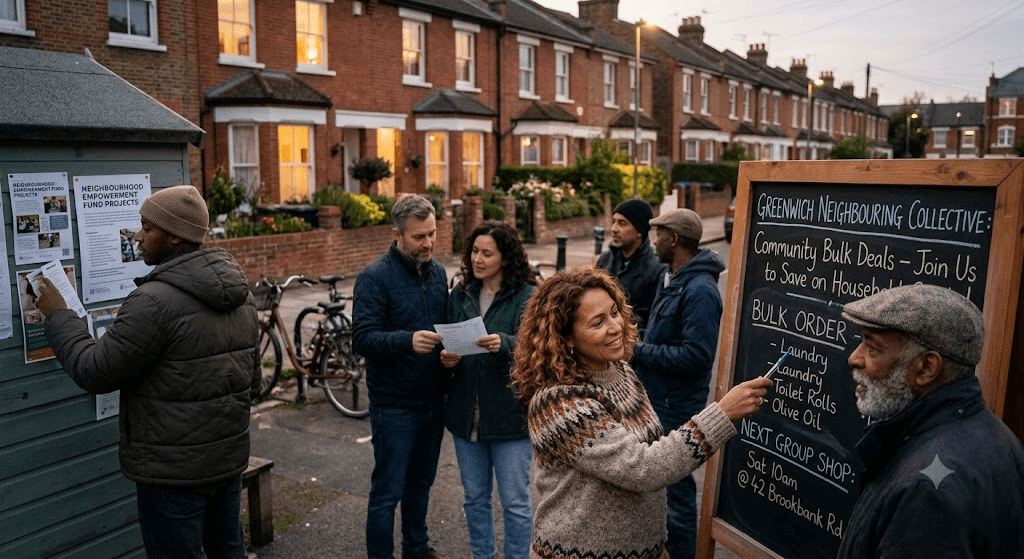
We are currently living through an epidemic of loneliness and social isolation. The modern lifestyle often dictates that we drive to a large out-of-town supermarket, use a self-checkout till, and return home without speaking to a single person. Community deals actively disrupt this isolating pattern. The logistics of group buying require interaction. Whether it is a quick chat at the local parish hall while collecting a share of wholesale groceries, or coordinating a heating oil delivery on a community message board, these schemes force neighbours to communicate. Over time, these brief transactional interactions blossom into genuine friendships, creating a robust local support network and a deeply ingrained sense of belonging.
Significant Environmental Impact
Community deals represent a substantial win for the environment. When a neighbourhood coordinates its purchasing, it inherently reduces carbon emissions associated with transport. Instead of thirty separate courier vans driving down a single street to deliver individual parcels throughout the week, a single consolidated delivery is made. Furthermore, bulk buying drastically reduces single-use plastic packaging. Purchasing a twenty-kilogram paper sack of rice to split among neighbours eliminates the need for dozens of small, unrecyclable plastic pouches. In an age where consumers are increasingly anxious about their ecological footprint, collective buying offers a practical, tangible way to live more sustainably.
A Step-by-Step Guide to Establishing a Community Deal
Reading about the benefits of community deals is one thing, but setting one up requires a blend of enthusiasm, organisation, and local knowledge. If you are inspired to harness the collective buying power of your own neighbourhood, here is a clear pathway to getting started.
- Gauge Local Interest: Do not approach suppliers until you know you have the numbers to back up your negotiations. Start small. Drop a message into your local community WhatsApp group or post on a neighbourhood forum like Nextdoor. Propose a specific, easily understandable deal—for instance, a bulk order of firewood for the winter, or a collective purchase of organic dry goods.
- Establish a Core Committee: While community deals are democratic, they require dedicated administration. Form a small group of two or three reliable volunteers to manage the logistics. This prevents burnout and ensures that tasks like gathering funds, contacting suppliers, and organising distribution are handled efficiently.
- Approach Suppliers with Confidence: Once you have a firm commitment from a specific number of households, contact suppliers. Be clear about your status as a community buying group. Explain that you represent a concentrated block of consumers offering a single, large-volume order with minimal marketing or acquisition costs for their business. Ask directly for their best trade or wholesale price.
- Implement Transparent Financial Systems: Trust is the currency of any community initiative. It is vital to separate the group’s funds from personal bank accounts where possible, or use highly transparent digital payment pools. Always collect the money upfront before placing the order with the supplier to protect the organisers from being left out of pocket.
- Organise a Seamless Distribution: Plan the delivery day meticulously. If you are splitting bulk food, ensure you have accurate weighing scales, clean scoops, and that participants know to bring their own reusable containers. If it is a delivery of goods like compost or firewood, designate a highly accessible, central drop-off point where neighbours can collect their share safely.
Navigating Potential Pitfalls
While the advantages are abundant, it is crucial to approach community deals with a pragmatic mindset. Organisers must be prepared to navigate certain challenges to ensure the longevity of the scheme.
One of the most common pitfalls is volunteer fatigue. If the entire administrative burden falls on a single individual month after month, the scheme will inevitably collapse when that person needs a break. To combat this, successful groups rotate responsibilities, ensuring that the work of coordinating orders and managing distribution is shared equitably among participants. Additionally, storage can become an unexpected headache. If a supplier delivers a massive pallet of goods, it needs to be broken down and distributed rapidly before it dominates someone’s garage or hallway. Setting strict collection windows for participants is a simple but vital rule.
Finally, there is the challenge of quality control. When buying in bulk or switching to wholesale suppliers, the community is taking a collective risk on a product. It is highly advisable to request samples or place a smaller “test order” before committing the group’s funds to a massive purchase. Open communication is key; if a batch of goods is not up to standard, the community must agree beforehand on how to handle returns or complaints with the supplier.
Looking to the Future
As the economic landscape remains uncertain, the appeal of community deals is only set to grow. These initiatives represent a beautiful synergy of traditional community spirit and modern logistical efficiency. They empower individuals by reminding them that they are not merely passive consumers at the mercy of global supply chains and corporate pricing structures. By reaching out to the people living right next door, we can reclaim control over our purchasing power.
Ultimately, a community deal is about much more than shaving a few pounds off a monthly bill. It is an investment in the local area. It champions resilience, fosters genuine human connection, and proves that when a neighbourhood stands together, everyone prospers. Whether you start by splitting a sack of flour with three neighbours or negotiating a village-wide energy contract, the journey towards collective purchasing is one well worth taking.