
 savingsspot.co.uk
 Anyone tasked with organising an event in the United Kingdom—whether it is an annual corporate summit in central London, a bespoke charity gala in Manchester, or a sprawling family gathering in the Cotswolds—quickly confronts the same sobering reality: venue hire consumes an eye-watering percentage of the available budget. In an era of fluctuating hospitality costs, high energy tariffs, and relentless demand, the standard “rack rate” of event spaces can feel prohibitively high.
However, the listed price of an event venue is rarely the final price. The UK hospitality sector operates on a strict model of perishable inventory. An unbooked function room on a Thursday night represents permanently lost revenue for the operator; it cannot be boxed up and sold the following week. By understanding the commercial pressures venue managers face, mastering the rhythm of the British events calendar, and knowing precisely which levers to pull, you can unlock exceptional venue deals that keep your balance sheet firmly in the green.
1. Deconstructing the Quote: Look Beneath the Headline Figure
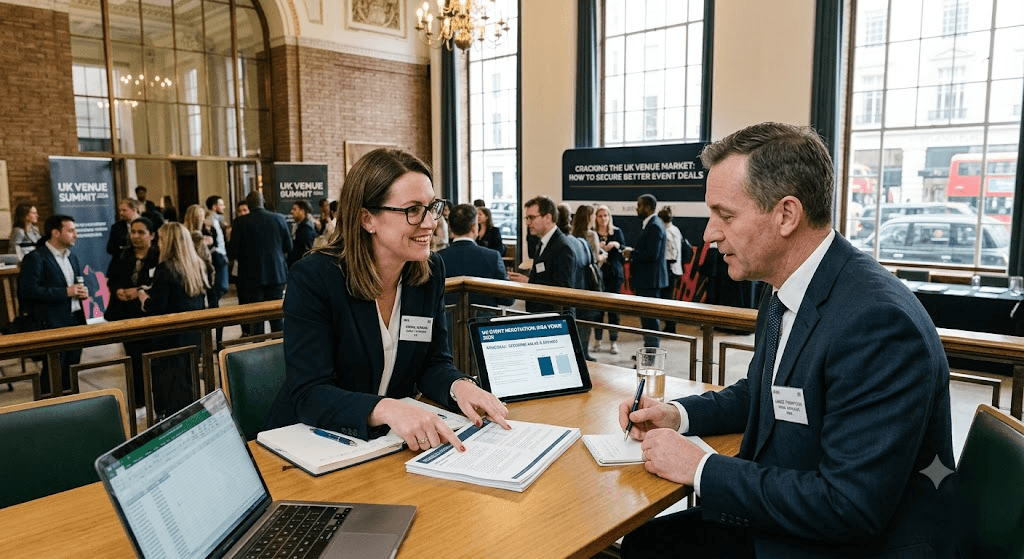
Before entering any negotiation, you must learn to speak the language of UK venue pricing. Novice planners often make the mistake of comparing raw hire figures without examining the underlying structural costs. British venues generally package their spaces in one of three ways:
- Dry Hire: You are paying strictly for the four walls. Every single chair, fork, uplighter, and security guard must be sourced and brought in externally. While the initial quote looks remarkably cheap, the secondary logistical costs almost always destroy your savings unless you own your own infrastructure.
- Wet Hire / Minimum Spend: Extremely common in London pubs, boutique hotels, and urban cocktail bars. There is zero room hire fee, provided your guests spend a pre-agreed threshold across the bar and catering. For social gatherings, networking evenings, or casual Christmas parties, this is the gold standard of venue deals.
- Day Delegate Rate (DDR): The standard corporate package, priced per person. It bundles the main room, basic AV equipment, Wi-Fi, two tea and coffee breaks, and a working lunch.
When assessing a deal, the very first question you must ask the venue coordinator is: “Is this figure inclusive or exclusive of VAT?” A surprise 20% addition to an invoice at the contract-signing stage has killed countless well-planned budgets. Furthermore, scrutinise the service charge. Many high-end UK venues automatically append a 10% to 12.5% discretionary service charge to the total food and beverage bill. Negotiating this down to 5%, or requesting it be rolled into the headline rate, is an instant, frictionless way to secure a better deal.
2. The Science of the British Calendar
In the events industry, flexibility is your greatest currency. If your event date is set in stone, your negotiating leverage drops to near zero. If you can be agile by just three or four days, the financial discounts can be immense.
The “Shoulder Day” Shift
The traditional corporate working week in the UK has shifted fundamentally. With hybrid working models cementing Tuesdays, Wednesdays, and Thursdays as the core “in-office” days, Thursday evening has become the absolute peak time for corporate drinks, dinners, and product launches. Consequently, venue managers are frequently left with totally empty spaces on Mondays and Tuesdays. Offering to host a mid-sized conference on a Tuesday rather than a Thursday can instantly trigger a 15% to 20% discount on the space.
Exploiting Distressed Inventory
In the commercial airline industry, last-minute seats drop in price to fill the cabin; venues operate similarly, though they rarely advertise the fact. If a venue suffers a major client cancellation six weeks out from a date, the sales director goes into immediate damage control. They have already rostered staff, heated the building, and budgeted for that revenue. If you approach venues with a ready-to-go event and a short lead time (typically 4 to 8 weeks), ask explicitly: “Do you have any late-release dates or cancelled slots you are looking to fill at a preferential rate?” You will frequently be handed their premium suite for the price of their basement boardroom.
The August and January Slumps
The UK practically shuts down for corporate gatherings during August (due to the six-week school summer holidays) and January (post-Christmas fiscal recovery). If you are hosting an internal company kick-off or a multi-day summit, pushing it from the first week of February back into the third week of January will yield the most aggressively discounted DDR rates of the entire calendar year.
3. Hidden Gems: Overlooked UK Venue Categories
When searching for deals, the standard instinct is to open a search engine and look at major hotel chains or purpose-built convention centres. Because these venues carry massive, permanent marketing overheads, their baseline prices are inherently inflated. Pivoting your search toward alternative British real estate unlocks massive value.
University and College Campuses
The UK possesses some of the most striking historic and modern architecture in the world, tucked away inside its higher education institutions. From the wood-panelled dining halls of Oxford, Cambridge, and Durham to the cutting-edge, tiered lecture theatres of the Russell Group universities in Leeds, Manchester, and Edinburgh, these spaces sit largely dormant during the long summer vacation (late June to mid-September) and the extended Easter break. Because their primary revenue stream is tuition, their commercial event hire rates are highly competitive, and the built-in audio-visual infrastructure is usually world-class.
City Livery Halls and Civic Guildhalls
In cities like London, Bristol, York, and Norwich, historic Guildhalls and ancient Livery Companies own magnificent, heavily under-utilised halls. Many of these are administered by historic charitable trusts rather than commercial conglomerates. Because they do not answer to private equity shareholders demanding massive quarterly profit margins, their hire rates are frequently grounded in covering operational preservation costs rather than extracting maximum possible market value.
Sporting Stadia During the Off-Season
Premier League football grounds, county cricket clubs, and Premiership rugby stadiums are architectural monoliths designed to move thousands of people safely. On non-match days, their massive glass-fronted hospitality suites sit entirely empty. Look at cricket grounds between October and March, or football stadiums on mid-week afternoons. They offer massive square footage, excellent motorway transport links, and hundreds of free on-site parking spaces—an absolute rarity in modern UK cities.
4. The Four Golden Rules of Venue Negotiation
Once you have found the right space, the way you conduct the conversation dictates the final price on the contract. British commercial etiquette dictates a certain cadence; overly aggressive, combative low-balling tends to make venue coordinators put their guards up and stubbornly defend their rate card. Instead, deploy these four sophisticated tactics:
Rule 1: Trade Concessions, Never Just Beg for Discounts
If a venue quotes £5,000 for a room hire, and you simply reply, “Can you do it for £3,500?”, the answer will almost certainly be a polite no. You have given them no commercial incentive to devalue their product. Instead, change the geometry of the deal. Say: “Our budget for the space is strictly £4,000. However, to make up the £1,000 difference for you, we will commit to pre-ordering 45 bottles of your mid-tier house wine right now, and we will sign the contract within 48 hours.” You have traded an intangible concession (room hire discount) for a high-margin tangible (beverage sales) and administrative speed.
Rule 2: Offer Favourable Cash Flow Terms
Cash flow is the absolute lifeblood of the hospitality trade. Standard corporate payment terms often dictate a 10% to 20% deposit upon signing, with the balance paid 14 to 30 days prior to the event. If your business holds healthy liquidity, offer to pay 70% or even 80% upfront upon the immediate signing of the contract in exchange for a 10% reduction in the total bill. For an independent venue owner, an immediate, non-refundable injection of guaranteed cash is an extraordinarily tempting proposition.
Rule 3: Use the “Soft Hold” as a Barometer
When you enquire about a date, ask the coordinator to place a “soft hold” (a provisional, non-binding reservation) on it. Say nothing more for five business days. If the coordinator does not call or email you to say, “We have another party looking at this date, do you wish to confirm or release?”, you instantly learn a vital trade secret: the venue’s diary is completely empty for that week. You now hold the absolute upper hand in the final pricing discussion.
Rule 4: Multi-Event Bundling
If you represent an enterprise or agency that hosts a summer party, a Q3 strategy retreat, and a large Christmas dinner, do not source them as three isolated transactions. Approach a single boutique hotel group or a multi-site venue operator and offer them the entire package. Sinking three guaranteed dates into a venue group’s calendar in a single afternoon gives you the extreme leverage required to demand a custom, heavily reduced group rate across the board.
5. Navigating UK Compliance to Protect Your Savings
A brilliant venue deal ceases to be a deal if hidden statutory costs blindside you three weeks before the doors open. Ensure the following UK-specific regulatory clauses are clearly ironed out in the written agreement:
- Temporary Event Notices (TENs): If your event involves serving alcohol or playing amplified music past the venue’s standard licensed hours (which is frequently 11:00 PM in residential London boroughs), an application must be made to the local borough council for a TEN. Ensure the contract explicitly states that the venue will handle the paperwork and absorb the statutory fee.
- Mandatory SIA Security Ratios: Local authority licensing laws dictate that events over a certain capacity serving alcohol must provide Security Industry Authority (SIA) registered door supervisors—typically at a strict ratio of 1 per 75 or 100 guests. Clarify immediately whether this cost is swallowed by the venue’s standard operational overhead, or if it will be invoiced to you as an extra line item at £25 to £35 per hour, per guard.
- The PPL/PRS Trap: Performing Right Society (PRS) and Phonographic Performance Limited (PPL) licences are legally required to play recorded or live music in any public commercial space in the UK. Ensure the venue holds a comprehensive blanket licence; if they do not, you as the event organiser can be hit with a painful retrospective invoice from the licensing bodies for the DJ set you hosted.
A Final Word on the “Partnership” Mindset
Ultimately, securing the finest event venue deals in Great Britain relies entirely on reframing the psychological nature of the transaction. Step away from viewing the venue as an uncompromising landlord trying to squeeze your budget, and treat the event sales manager as an ally trying to hit their monthly corporate sales target. When you can articulate how your booking solves their operational problems—whether by filling a notoriously quiet Tuesday, boosting their high-margin bar revenue, or providing them with a reliable, zero-drama client—the inflated price tags will inevitably start to shrink.