 savingsspot.co.uk
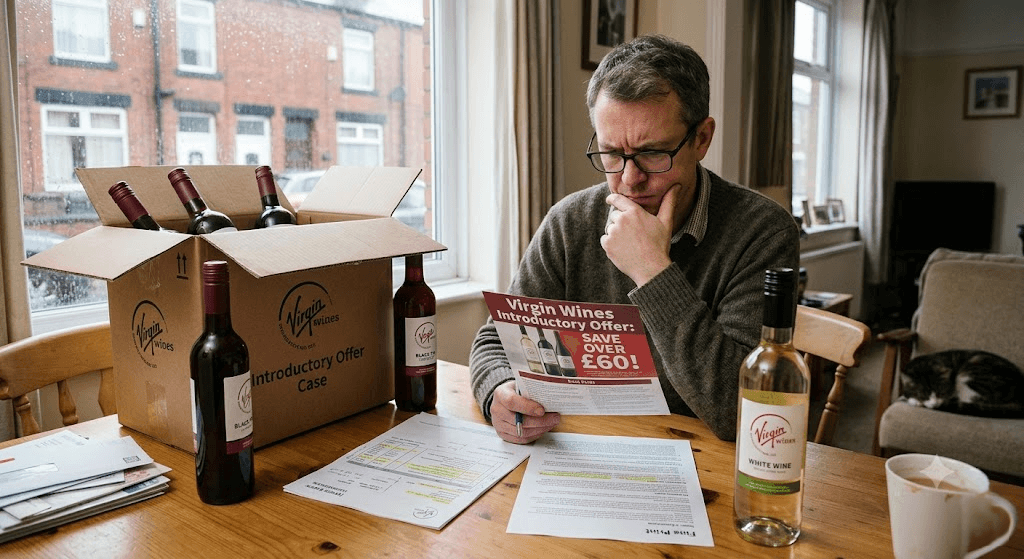
 We have all seen them. They drop out of the centre of your Sunday newspaper, sit inside your Amazon delivery parcels, or arrive as a glossy voucher alongside a HelloFresh flyer. The pitch is almost always identical: “Claim £50 off your first case of Virgin Wines,” usually accompanied by a picture of twelve glistening bottles and a pair of high-end Dartington Crystal glasses.
For the British wine drinker accustomed to navigating the chaotic, yellow-stickered aisles of the local supermarket, the proposition feels almost too generous to be true. Twelve bottles of boutique wine delivered to your doorstep for roughly £5.50 a bottle? In an era of escalating UK alcohol duty, it feels like a mathematical impossibility.
So, what is the reality? Is the Virgin Wines introductory offer the ultimate cheat code for stocking your wine rack, or is it a carefully engineered funnel designed to lock you into a costly monthly subscription? Having unpacked the boxes, read the terms and conditions, and tested the cancellation process, this is the unvarnished truth about how the offer actually operates.
How the Introductory Offer Actually Works
When you redeem a Virgin Wines voucher or click an introductory link online, you are not simply buying a standalone box of wine. You are agreeing to a trial of one of their two flagship membership programmes: **WineBank** or the **Discovery Club**.
The vast majority of introductory promotions funnel you into **WineBank**. This is the distinction that catches most first-time buyers off guard, so it pays to understand the mechanics immediately.
The standard welcome package usually looks like this:
- The Wine: 12 bottles (your choice of all-red, all-white, or a 50/50 mixed case).
- The Price: Usually £59.99 to £69.99 (discounted from a stated “retail value” of roughly £130–£150).
- The Sweeteners: Free express home delivery, plus a free gift (frequently two Dartington Crystal stemless glasses or a bottle of standard-issue Prosecco).
The moment you click ‘Checkout’, you receive your heavily discounted wine. However, the fine print dictates that 28 days later, your account will make its first automated direct debit contribution into your new WineBank account. If you treat the purchase as a one-off transaction and ignore the welcome emails, you will look at your bank statement a month later and wonder why Virgin Wines has just taken £25 out of your account.
The Elephant in the Room: Decoding “WineBank”
To judge whether the introductory offer is worth it, you have to decide whether you actually like the WineBank model. Ironically, once understood, WineBank is actually one of the most consumer-friendly subscription models in the UK retail sector—it just suffers from a widespread failure of public comprehension.
Unlike traditional wine clubs (such as Laithwaites or Sunday Times Wine Club), WineBank **does not automatically ship you a case of wine every quarter**.
Instead, it acts as a digital piggy bank for your drinking habits:
1. You agree to save a set amount of money into your Virgin Wines account every month (the default is usually £25, though you can adjust this down to £15 or up to £100).
2. For every £5 you deposit, Virgin Wines deposits an extra £1 of “interest” into your account. This represents a guaranteed **20% bonus** on your cash.
3. Your money simply sits there accumulating. If you deposit £25 a month for four months, you will have contributed £100 of your own money, but your usable account balance will say **£120**.
4. You spend that balance whenever you want, on whatever you want. If you want to blow the entire £120 on three bottles of high-end vintage Champagne for Christmas, you can. If you want to buy a 16-bottle case of Australian Shiraz in July, you can.
Crucially, WineBank members receive **free express delivery** on all orders, regardless of the order value. When you factor in that standard UK wine couriers charge between £4.99 and £7.99 for shipping, the combination of the 20% cash top-up and the scrubbed delivery fees makes the ongoing ecosystem genuinely lucrative—provided you actually drink a dozen bottles of wine every few months.
What is the Wine Actually Like?
A common cynicism directed at wine clubs is that their “RRPs” (Recommended Retail Prices) are entirely fictional. Skeptics argue that a bottle listed at £11.99 by a wine club is actually a £5.50 supermarket wine wearing a fancy bespoke jacket.
The truth regarding Virgin Wines sits somewhere in the nuanced middle.
Virgin Wines operates on an **independent winemaker model**. They do not buy massive, industrially produced oceans of wine and slap a sticker on it. Instead, they act as an upfront funding partner for boutique, family-run vineyards across the globe—particularly in South Australia, the Languedoc-Roussillon region of France, Mendoza in Argentina, and the Western Cape of South Africa.
Because these wines are bottled exclusively for Virgin Wines, you cannot cross-reference their prices at Sainsbury’s or Waitrose. However, when judged purely on liquid quality against standard UK high-street equivalents, the tiering breaks down as follows:
The Reds
This is where Virgin Wines consistently punches above its weight. Because of their deep historic ties to Australian winemakers (look out for names like *Steve Grimley* or *Brio* on the labels), their heavy, warm-climate reds are exceptionally good. If you enjoy rich, jammy Barossa Valley Shiraz, peppery Argentine Malbecs, or smooth Spanish Garnachas, the introductory case will feel like an absolute steal.
The Whites
The white selection is generally more safe than daring. You will receive very clean, highly drinkable Marlborough Sauvignon Blancs, crisp Italian Pinot Grigios, and zesty South African Chenin Blancs. They are thoroughly crowd-pleasing, though serious white Burgundy or complex Riesling enthusiasts may find the introductory white cases slightly one-dimensional.
Three Lesser-Known Perks of the Ecosystem
If you take the introductory offer and decide to stick around for a few months, there are three hidden mechanisms built into the platform that the initial marketing flyers rarely highlight.
to type *”Please cancel my account”* to a customer service agent via Live Chat 28 days from now.
1. The “No Quibble” Guarantee is Fully Real
Most retailers offer a refund policy that requires you to pack up a broken product, print a label, and stand in a queue at a local Evri drop-off shop. Virgin’s wine guarantee operates entirely on trust. If you open a bottle of their wine, pour a glass, and genuinely dislike it, you log into your account, click the bottle in your order history, hit “I didn’t like this,” and **the cost of the bottle is instantly credited back to your account balance**. You do not send the open bottle back. You pour it down the sink (or give it to a less discerning neighbour).
2. The Virgin Red Points Synergy
If you are a UK resident who collects **Virgin Points** (the currency used for Virgin Atlantic flights, Virgin Trains ticketing, or Virgin Experience Days), link your accounts immediately. You earn points on every single pound you spend on wine, and they frequently run promotional multipliers where buying a specific seasonal case drops 2,000 to 3,000 Virgin Points into your flying account.
3. You Get an Actual Human “Wine Advisor”
Once you are an active member, you will eventually receive a phone call from Norwich or Bolton. This isn’t a cold-calling scam; it is your assigned personal Wine Advisor. If you take the time to talk to them for five minutes and say, *”I loved the heavy Australian Shiraz, but that French Merlot tasted like battery acid,”* they will permanently tag your profile. Future mixed cases generated for your account will automatically filter out the profiles you hate.
The Exit Strategy: How Easy is it to Cancel?
This is the ultimate litmus test of any subscription service. A fantastic introductory offer becomes a terrible deal the moment a company forces you to navigate a labyrinth of dark UX patterns to leave.
Can you buy the £59.99 introductory case, take the free glasses, drink the wine, and cancel your WineBank account before they take a single £25 direct debit?
**Yes. Absolutely.**
However, Virgin Wines employs one classic retention hurdle: **you cannot cancel your membership via a simple toggle switch inside your online dashboard.**
To shut the account down, you have to do one of two things:
1. **Call them** on `0343 224 1001` (Monday to Friday, 9:00 am to 5:30 pm).
2. **Use the Live Chat** facility on their website during office hours.
When you speak to the representative, they will routinely follow a retention script. They will offer to lower your monthly deposit to £10, or offer to “pause” your account for six months. If you simply reply: *”No thank you, I just want to close the account completely,”* they will process it instantly. You will receive a confirmation email within two minutes.
Crucial Consumer Tip: If you cancel your WineBank account while you still have cash sitting inside it, **Virgin Wines will refund 100% of the raw cash you put in back to your debit card**. You will, however, forfeit any of the free “20% bonus interest” sitting in the account at the time of closure.
The Supermarket vs. Virgin Wines Math Test
To settle the debate of whether you should redeem the voucher sitting on your kitchen table right now, let us run a strictly objective fiscal comparison based on standard 2026 UK pricing.
Imagine you want twelve bottles of “Friday Night” standard wine (something better than basic table plonk, sitting in the £8.50 to £10.50 bracket at Tesco or Sainsbury’s).
- The Supermarket Route: 12 bottles @ £9.00 average = **£108.00**. You carry them home in the boot of your car.
- The Virgin Intro Route: 12 bottles @ £5.40 average = **£64.80**. Delivered to your door, plus two glasses worth roughly £15.00.
On the introductory purchase alone, **you are financially up by over £43.00**, even before counting the glassware. You have effectively acquired six bottles of wine entirely for free.
Frequently Asked Questions
Can I use an introductory voucher if someone else at my address has used one before?
Technically, Virgin Wines enforces a strict “one introductory offer per household” rule in their terms and conditions to stop flatshares rolling over cheap wine infinitely. However, if the new customer uses a completely different first name, surname, distinct email address, and a separate bank card, the automated checkout system almost universally passes the order through.
What happens if a bottle arrives smashed inside the cardboard?
Because wine is exceptionally heavy, courier drops happen. If your box arrives showing a tell-tale purple damp patch at the bottom corner, accept the delivery, take a quick smartphone photo of the box, and open Live Chat. Customer services will not ask you to fish out the broken glass; they will instantly credit your account or dispatch a replacement bottle free of charge.
Is Virgin Wines actually owned by Sir Richard Branson?
No, not anymore. The company was founded by the Virgin Group in 2000, but was sold to Direct Wines in 2005, and later underwent an independent management buyout in 2013. Today, it is a publicly traded company on the London Stock Exchange (AIM:VINO). They simply pay a licensing royalty to the Virgin Group to utilise the famous red logo and brand ethos.
Can I choose the specific bottles in my introductory case?
No. The introductory cases are pre-packed in massive distribution warehouses in order to keep the operational costs—and therefore the introductory price—as low as possible. You can only dictate the macro style: All Red, All White, or Mixed.
The Final Verdict: Who is this actually for?
The Virgin Wines introductory offer is a genuine, high-value transaction, but its utility depends entirely on which of two consumer archetypes you fall into.
**You should take the offer instantly if:** You are someone who enjoys trying new grape varieties, hosts occasional dinner parties, and views a £25 monthly direct debit not as an annoying bill, but as a clever automated sub-account that ensures you always have a fantastic bottle of Malbec ready when a friend drops by unannounced.
**You should throw the voucher in the recycling bin if:** You only drink Pinot Grigio once every three weeks, have a terrible memory for managing online direct debits, or experience severe social anxiety at the thought of having