 savingsspot.co.uk
 There is a specific, quiet satisfaction known only to the modern British bargain hunter: the moment you paste a string of capital letters into a little checkout box, hit ‘Apply’, and watch the total drop by twenty quid. In the UK, Groupon remains one of the most wildly popular platforms for securing a cheap afternoon tea in York, a discounted MOT in Birmingham, or a boutique spa day in the Scottish Borders. Yet, an astonishing number of people still click “Buy Now” at the listed base price.
If you are paying the advertised price on Groupon UK, you are effectively paying a voluntary tax. The platform’s entire business model is constructed around the psychology of the “double-discount”—the initial markdown offered by the merchant, followed by the promotional code applied by the savvy buyer. Getting your hands on a working Groupon discount code in the UK isn’t a matter of blind luck; it is an exact science. Here is the definitive guide to outsmarting the checkout algorithm.
The Invisible Rulebook of Groupon UK Pricing
Before trawling the internet for promo codes, you have to understand how Groupon’s dynamic pricing engine treats your browser. Much like budget airlines, Groupon tracks user intent. If you look at a £50 track-day driving experience in Leicestershire three times in one afternoon without buying it, the system knows you are hooked.
When you eventually go to hunt for a voucher code and return to the site, you might find the base price has subtly ticked up to £55, effectively swallowing the 10% discount you just spent twenty minutes trying to secure. To combat this, always practice the “Clean Slate” rule:
- Never browse for deals logged into your primary Groupon account. Use an Incognito/Private window.
- Only log in at the precise moment you are ready to apply the code and check out.
- If a price jumps the moment you log in, clear your browser cache, switch from your home Wi-Fi to your mobile 5G data (changing your IP address), and re-open the link.
The Big Five: Sourcing Legitimate UK Voucher Codes
We have all experienced the purgatory of generic coupon aggregator websites. You click a button that promises “30% OFF ALL LOCAL DEALS”, a bizarre pop-up window opens, and the code generated is a generic phrase like GROUPON30 that instantly returns a red “Invalid Promo Code” error. To save your sanity, stick strictly to the five viable pipelines for UK codes.
1. The “Abandoned Basket” Trapdoor
This is arguably the most reliable way to force Groupon’s automated marketing software to hand you a bespoke, single-use discount code. The setup requires patience, but the hit rate is exceptionally high.
Find the experience you want to buy—let’s say a two-course meal for two at a gastropub in Bristol. Log into your account, add the deal to your basket, and navigate all the way to the final payment screen. Do not put your card details in. Simply close the tab and walk away.
Groupon’s automated retention sequence will trigger. Within 2 to 6 hours, you will usually receive an email titled something along the lines of “Did you leave something behind?”. Ignore it. Roughly 24 to 48 hours later, the second automated nudge arrives, and this one almost universally carries a unique, non-transferable 15% or 20% discount code designed to close the sale.
2. The Modernized “Welcome” Loophole
Historically, the oldest trick in the British consumer playbook was creating a fake email address (e.g., [email protected]) to trigger the standard new-customer welcome discount. Groupon got wise to this. In 2026, their UK fraud-detection algorithm cross-references three distinct data points to verify a “new” user:
- The email address.
- The physical billing postcode.
- The unique 16-digit Primary Account Number (PAN) of the debit or credit card being used.
If you use a fresh email address but pay with the exact same Monzo card you used on your old account last November, the system will strip the welcome promo code off at the final millisecond of authentication. If you want to use a fresh “Welcome” code legitimately, you must use a completely unlinked payment method—such as a partner’s card, a secondary digital bank card (like a Revolut disposable virtual card), or a standard PayPal account that hasn’t been bound to Groupon previously.
3. The Verified Student and NHS Portals
If you are a UK university student, or you work for the NHS, emergency services, or armed forces, stop looking at standard voucher websites immediately. Groupon maintains hardcoded, permanent API integrations with both UNiDAYS and the Blue Light Card network.
The standard baseline discount through these portals sits at 10% off Local experiences. However, during “dead zones” in the retail calendar—specifically mid-February, late April, and mid-October—Groupon quietly bumps the UNiDAYS and Blue Light Card affiliate rates to 20% or even 25% for 48-hour flash windows. Keep the UNiDAYS app installed on your phone purely for the push notifications regarding these specific spikes.
4. The App-Only Infrastructure
Groupon heavily penalizes desktop users. It costs them significantly more money to re-acquire your attention via Google search ads on a laptop than it does to ping a push notification directly to your smartphone’s lock screen. Because of this, the most lucrative sitewide codes are almost strictly ring-fenced for the iOS and Android applications.
Codes such as APP20 or MOBILE15 will routinely fail if typed into a Safari desktop browser, but will instantly validate inside the app. Furthermore, the app features a hidden “Deal of the Day” banner at the very bottom of the home interface that frequently houses 4-hour hyper-local promo codes tailored to the GPS coordinates of your phone.
The Pro-Tier Art of “Code Stacking”
In retail economics, “stacking” refers to the act of forcing two different promotional mechanics to trigger on a single transaction. While Groupon’s internal software explicitly forbids applying *two* typed voucher codes to one basket, you can routinely stack an internal promo code with an external Cashback Gateway.
Before you buy anything on Groupon UK, open a new tab and log into either TopCashback UK or Quidco. Both platforms treat Groupon as a tier-one merchant, offering anywhere from 4% to 12% cash back on the total basket value.
The sequence must be executed in this exact order to work:
- Clear your browser cookies.
- Open TopCashback or Quidco, search “Groupon”, and click the tracked link to open the retailer.
- Put your desired deal into the basket.
- Apply your working Groupon discount code (e.g., a 20% off Local code) in the promo box.
- Complete the purchase.
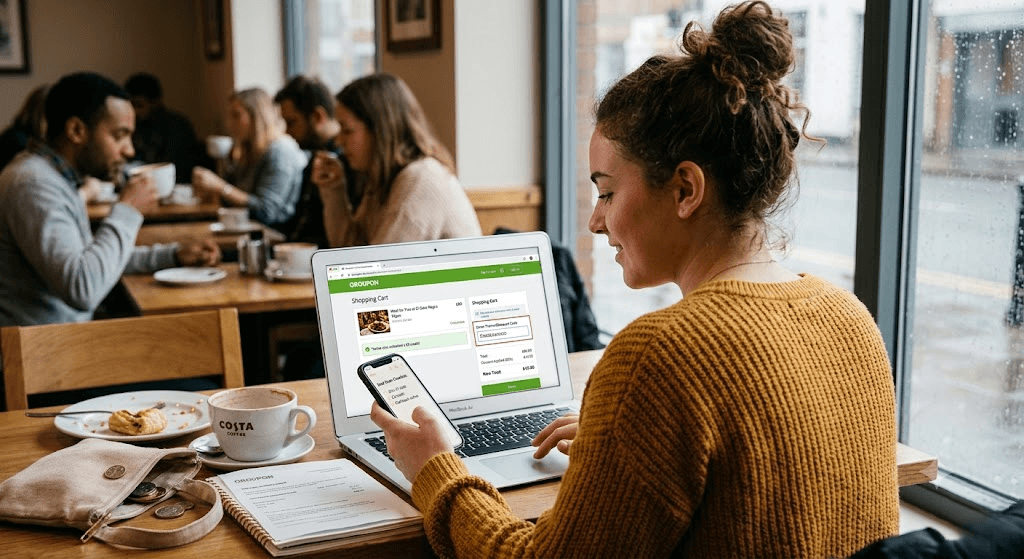
The Golden Caveat of Cashback: When you use an unauthorized promo code—meaning a code you found on a random forum that TopCashback themselves haven’t officially listed on their portal—the tracking pixel will frequently reject the cashback claim upon review. If TopCashback is offering 8% back, and they list a code for “15% off local”, use *that* specific code. You will end up with a combined real-world discount of roughly 21.8%, fully tracked and paid out into your UK bank account a few weeks later.
Navigating the Three Pillars: Where Codes Flex and Where They Fail
Groupon UK categorizes its inventory into three distinct silos. Your success rate with promo codes depends entirely on which silo your item sits inside.
Pillar A: Local Experiences (The Goldmine)
This includes dining, haircuts, massages, escape rooms, car valeting, and family days out. Promo codes work here 85% of the time. Why? Because Groupon doesn’t own the gastropub in Bristol or the salon in Leeds; they simply take a massive commission (often 50%) from the local merchant for bringing them the customer.
When Groupon issues a “20% off Local” code, they are usually eating that 20% out of their own commission margin to secure the turnover. Because the local business owner still gets their agreed baseline cut, the deals remain live and the codes apply frictionlessly.
Pillar B: Groupon Getaways (The Landmine)
This covers hotel stays, glamping pods, and packaged holidays. This silo behaves very strangely with promo codes. If you are booking a simple room-only stay at a country manor in the Cotswolds, standard travel discount codes (e.g., TRAVEL15) will frequently attach.
However, if the getaway includes a flight, a ferry crossing, or a third-party ticketing integration (such as a “Hotel stay + West End Theatre ticket” package), promo codes will be hard-locked out of the transaction. Third-party margins are simply too thin for Groupon to absorb a 15% hit.
Pillar C: Groupon Goods (The Mirage)
This is the physical product marketplace—mattress toppers, refurbished iPhones, garden furniture, and giant tubs of laundry detergent. You should almost never use a promo code to buy physical goods on Groupon.
The “Goods” section relies heavily on a retail concept known as *RRP anchoring*. A non-stick frying pan set will be advertised as “RRP £130, Today £29.99!”. You apply a 10% discount code, bringing it down to £26.99, and feel like a master of commerce. If you open a fresh tab and paste the exact model number into Amazon UK or Google Shopping, you will almost invariably find the standard, non-discounted everyday retail price of that pan set across the UK is… £24.99.
Treat Groupon Goods with extreme skepticism. Use the platform for what it is genuinely brilliant at: local human services and regional British leisure.
Why Your Code is Saying “Invalid”: The Microscopic Print
Nothing spikes the heart rate quite like finding a code that should work, only to be met with the crimson banner of rejection. When a Groupon UK code bounces, it is almost always down to one of four specific sub-clauses tucked away in the deal’s fine print.
1. The “Promo Code Excluded” Stamp
Merchants who have already priced their service at absolute cost-floor can ask Groupon’s account managers to place an embargo on their listing. Before you spend time hunting for a code, scroll down to the “Fine Print” tab on the deal page. Look at the very last line of text.
If you see the phrase: “Promotional codes cannot be applied to this deal,” abandon the hunt instantly. No code on earth, not even an internal customer service override voucher, will attach to that specific SKU.
2. The “Maximum Discount” Illusion
This is the most common mathematical trap buyers fall into. You receive an email boasting: “25% OFF YOUR NEXT LOCAL PURCHASE!”. Excited, you put a £250 helicopter piloting lesson in your basket, expecting a massive £62.50 reduction. You apply the code, and the price drops by just £20.
Look at the asterisk in the promotional email. It will say: *25% off Local deals, up to a maximum discount of £20.
To work out the absolute ceiling of efficiency for any capped UK promo code, divide the maximum cash discount by the percentage expressed as a decimal. For a “20% off up to £20” voucher, the calculation is:
£20 / 0.20 = £100
This tells you that any spend up to £100 will receive the full, unadulterated 20% discount. For every single pound you spend over £100, the true overall percentage value of your discount begins to dilute.
3. The “Gifting” Lockout
If you tick the box that says “Give as a gift” during the checkout process, Groupon’s system will immediately void 90% of standard promotional codes. The platform does this to prevent digital reselling, where users would buy up discounted voucher PDFs using 25% off codes and flip them on Facebook Marketplace or eBay at face value.
The Fix: Simply buy the voucher for yourself as a standard purchase using your discount code. Once the PDF voucher arrives in your email inbox, open it, check there is no printed buyer name on the redemption barcode (there almost never is for local deals), and print it out to stick inside a birthday card.
The “Customer Service Credit” Strategy
If you are a regular user of Groupon in the UK, things will occasionally go wrong. A restaurant will change its ownership and refuse to honor a voucher; a local car wash will shut down its premises; an activity center will be fully booked for the next six months.
When you contact Groupon UK’s live chat to request a statutory refund, the automated assistant (and the human operatives) will always offer you a choice: a return to your original payment card, or a refund rendered in Groupon Credits.
Always take a moment to calculate your upcoming social calendar before answering. Because it keeps the cash sitting inside Groupon’s merchant accounts, customer service operatives are empowered to offer a “sweetener” to get you to accept platform credit. It is standard practice for them to offer you 110% to 115% of your original spend if you take it as credit.
If a £60 meal voucher goes sideways, accepting £69 in instant Groupon credits—which can then be spent on a different deal *while still applying a standard promo code* at the checkout—turns a mild consumer inconvenience into a net-positive financial trade.
Summary Checklist for the Savvy UK Shopper
Before you ever hand over your hard-earned pounds on the platform, subject your screen to this final five-second mental audit:
- Is the fine print clean? Verify the deal doesn’t explicitly bar promotional codes.
- Am I in the right browser? Make sure you aren’t leaking your browsing history to the dynamic pricing engine.
- Have I checked the mobile app? Ensure there isn’t an app-exclusive code beating the desktop rate.
- Have I opened a tracking portal? Route the final click through Quidco or TopCashback to scrape back the secondary margin.
- Is the code capped? Do the quick math to ensure your basket size isn’t blowing past the voucher’s maximum discount ceiling.
The UK High Street is tough enough on the wallet as it is. Treat Groupon codes less like a digital lottery, and more like a standard set of digital tools. If you use the right tool on the right deal, you should never have to look at a green check-out button without seeing the price slip backwards first.