savingsspot.co.uk
There is a distinct, universally recognised sense of Friday evening defeat: you open the fridge, expecting the comforting chill of a crisp Sauvignon Blanc or a four-pack of your favourite craft IPA, only to find half a jar of mayonnaise and an out-of-date yogurt. Historically, resolving this required a miserable march to the local corner shop, where you would be forced to hand over an extortionate sum for a dusty bottle of warm Pinot Grigio.
Those days are over. The British digital alcohol delivery market has quietly evolved into one of the most hyper-competitive retail sectors in the world. Because digital storefronts don’t have to pay premium high-street business rates, they fight for your custom using the only weapon that matters: margin-shredding discounts. However, navigating this landscape without getting caught by “app-tax” delivery charges requires a bit of tactical know-how. Here is how to play the UK alcohol delivery market like a pro.
1. Mastering the Supermarket ‘25% Off Six’ Rhythm
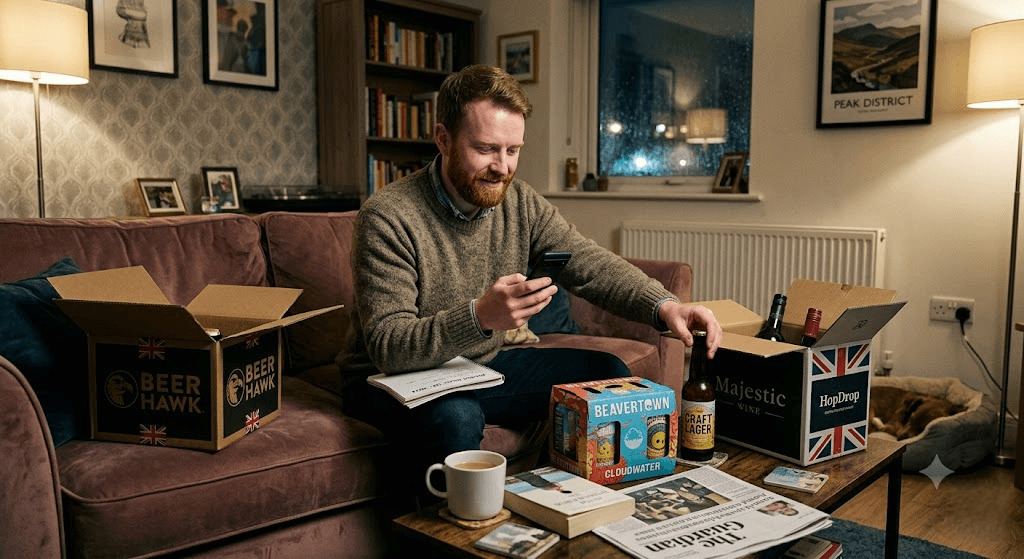
If your goal is to stock up the wine rack or prepare for a garden party, standard weekly grocery shopping is the most inefficient way to buy alcohol. Instead, you need to sync your purchasing habits to the great British supermarket pendulum.
Tesco, Sainsbury’s, Asda, and Waitrose operate on a near-identical, unspoken promotional calendar. Roughly two to three weeks prior to any major Bank Holiday, the Easter weekend, or the mid-November run-up to Christmas, the legendary “Buy 6 Bottles, Save 25%” trigger goes live. What most casual shoppers fail to realise is that this discount stacks directly on top of existing individual bottle promotions.
For example, if a bottle of Rioja is reduced from £10 to £7.50 on a standard Clubcard or Nectar price, buying six of them triggers the extra 25% reduction at the digital checkout. Your £10 bottle of wine suddenly arrives on your doorstep for £5.62.
The Insider Strategy: Supermarket delivery slots for Bank Holiday weeks get booked out 14 days in advance. To exploit the wine discount without paying a £7 peak-time delivery fee, book a Tuesday or Wednesday evening “flexi-slot” two weeks in advance. The wine will keep perfectly fine in the cupboard until the weekend, and you will have paid £1.50 for the delivery.
2. Deconstructing the Specialist Wine Merchants
Once you graduate past the standard supermarket offerings, the online specialist merchants—most notably Majestic Wine, Laithwaites, and Naked Wines—offer much higher quality liquid per pound spent, provided you understand their pricing psychology.
Take Majestic Wine as the prime example. Every bottle on their website displays two wildly different figures: a terrifyingly high single-bottle price, and a much more reasonable “Mix Six” price. Buying three bottles of premium wine from Majestic is a mathematical error. If you only actually want three bottles of high-end Malbec, you should manually pad your digital basket out with three £5.99 bottles of their basic house white. Because hitting the six-bottle threshold slashes the price of the three expensive bottles, the total basket cost will frequently drop lower than if you had bought the three expensive bottles alone.
Then there is the famous Naked Wines £75 voucher. Anyone who has ever ordered a package from Amazon or a HelloFresh recipe box in the UK has had one of these cardboard vouchers fall out of the packaging. It is not a scam, but it is a strictly mapped-out customer acquisition funnel. You use the voucher to buy a £115 case of wine for £40.
The catch sits in the small print: checking out automatically enrols you as a “Naked Angel”, authorising a recurring £40 monthly direct debit into a virtual piggy bank. Hacking this is simple: redeem the voucher, accept the vastly discounted delivery, set a reminder on your phone for 48 hours later, and log into your account settings to hit “Pause Membership”. You keep the introductory discount; they absorb the loss.
3. Beating the ‘App Tax’ on On-Demand Deliveries
We have all been there: it is 9:15 PM on a Saturday, the ice bucket is empty, the guests are still talking, and somebody opens Deliveroo, Uber Eats, or Getir. Hitting “Order” in this scenario is where the average British consumer loses the most money.
On-demand apps apply a triple-layer penalty to late-night alcohol: an inflated unit price (a £22 bottle of gin sits at £29.50 on the app), a “small order” fee, a standard delivery fee, and a percentage-based service fee. By the time the rider arrives at your door, you have paid £41 for standard Gordon’s.
To use on-demand delivery responsibly, adopt these three workarounds:
- Target ‘Dark Stores’, not local off-licences: When searching the apps, scroll past the independent corner shops and look strictly for *Tesco Whoosh*, *Sainsbury’s Chop Chop*, or *Ocado Zoom*. Because these are fulfilled directly from automated regional distribution hubs, their baseline retail prices are pegged much closer to normal shop-floor RRP.
- Exploit the ‘Household Carousel’: On-demand grocery platforms survive on user growth metrics. If there are two or more adults living in your house, you should never pay full price for an app delivery. Rotate who creates the account. A “£15 off your first £25 grocery order” promo code turns an emergency round of drinks into a genuine bargain.
- Watch for Snappy Shopper Penny Deals: If you live outside of Zone 1 London, download the homegrown app *Snappy Shopper*. To capture market share from Uber, they routinely run local “1p Bundles”, offering a four-pack of cider or a large bottle of Pepsi and a bag of crisps for literally one penny, with a £1.50 delivery charge.
4. Sourcing Top-Shelf Spirits via the ‘Clearance’ Underbelly
Supermarkets view premium spirits—aged single malts, small-batch rums, and artisanal tequilas—as slow-moving luxury stock, meaning they rarely offer meaningful discounts on them. If you want a bottle of Lagavulin 16 or Woodford Reserve delivered, you have to look at the UK’s dedicated liquidators.
Your primary digital bookmark should be the “Offers” tab on **Master of Malt**. Because Master of Malt acts as a major wholesale supplier to the UK bar and pub trade, they hold immense volumes of stock. When a distillery changes its bottle shape, tweaks its label design, or over-produces a seasonal batch, Master of Malt buys the “discontinued” run and quietly lists it on their clearance page at 30% to 40% off.
Secondly, do not ignore **Amazon UK**, which is quietly the most volatile alcohol merchant in Europe. Amazon’s pricing algorithm automatically crawls the web to undercut competitors. If John Lewis puts a high-end cognac on sale for 15% off at midnight, Amazon’s software will instantly drop their price to match or beat it by 5:00 AM. Use the free web tool *CamelCamelCamel* to set price-drop alerts on your favourite premium spirits; you will routinely catch top-tier bottles hitting “all-time low” prices for 6-hour windows.
5. The Subscription Box ‘Churn & Return’ Dance
The UK craft beer and artisanal spirit market is flooded with subscription boxes (Beer52, Craft Gin Club, Flavourly). Their business model relies entirely on human inertia: they give you your first box at a massive loss, praying you will forget to cancel the £39/month rolling charge.
You can drink exceptionally well by simply refusing to be inert.
With introductory offers like “8 Craft Beers for the £5.95 cost of postage”, take the deal. The day the box arrives, log into the portal to cancel the subscription. In 90% of cases, the website’s automated retention software will intercept your cancellation click with an immediate pop-up: *”Wait! Have your next box for 50% off.”* Take the second box at half price, and *then* finalize the cancellation. Within four to six months, their marketing department will automatically email you a “We miss you” link containing another free trial.
6. The Regional Trap: How UK Geography Dictates Your Bill
It is impossible to be a smart online shopper in Great Britain without understanding the fierce legal divide regarding **Minimum Unit Pricing (MUP)**.
If you live in England, retailers can legally sell alcohol as a “loss leader”—pricing it cheaper than bottled water to lure you onto their website. However, if your delivery postcode starts with an ‘EH’ (Scotland) or a ‘CF’ (Wales), the digital checkout is legally obliged to intervene.
In Scotland, the law mandates a strict price floor of 65p per unit of alcohol (raised from 50p in September 2024); in Wales, the floor sits at 50p per unit.
If an online merchant advertises a deal of “24 cans of 5% lager for £15”, an English customer will check out at £15. The moment a Scottish customer puts their delivery address in, the website’s algorithm will instantly recalculate the basket, overriding the discount and forcing the price up to the legal floor of roughly £31.20.
The workaround for Scottish and Welsh buyers: When shopping online, ignore high-ABV bulk deals entirely—the law makes them impossible to win. Instead, use your digital vouchers specifically on high-end, lower-ABV premium products (such as 11% organic wines or 4.2% session ales). Because MUP targets the *pure volume of alcohol*, a lower-percentage artisan drink gets hit far less severely by the digital tax calculator at checkout.
7. The Ultimate 5-Step Checkout Protocol
Before you hit “Confirm Payment” on any British alcohol delivery site, run your shopping basket through this quick mental checklist to squeeze the final few drops of value out of the transaction:
- Pass it through TopCashback: Never visit a drink retailer’s site directly. Open a cashback portal first. Sites like Virgin Wines, The Whisky Exchange, and Master of Malt routinely offer between 6% and 12% cash back for clicks routed through these portals.
- Check the ‘Basket Padder’ threshold: If your total sits at £46 and the site charges £4.99 for delivery on orders under £50, do not pay for the delivery. Search the site for a £4.50 miniature bottle of Baileys or a premium tonic water. You will tip the basket over the free delivery line, effectively getting the extra item for free while saving 49 pence.
- Test the ‘Ghosted Cart’ trigger: If you are buying from an independent UK brewery or boutique gin distillery, put the items in your cart, enter your email address at step one of the checkout, and then close the browser tab. Roughly 70% of Shopify-hosted UK merchants have an automated recovery email scheduled to hit your inbox 20 hours later saying: *”Did you leave something behind? Use code COMEBACK10 for 10% off your basket.”*
- Inspect the ‘Gift Box’ trap: Many high-end spirit distributors automatically pre-select a £3.00 “Premium Cardboard Presentation Tube” option at the cart stage. Unless it is an actual birthday present for your father-in-law, click the drop-down menu and downgrade it to “Standard Eco Packaging”.
- Pay via a 1% Debit Card: Route the final payment through a Chase UK current account debit card or an American Express cashback card to scrape the final 1% return off the grand total.
The days of paying inflated convenience prices for your weekend drinks are entirely optional. The UK possesses the most aggressively contested online beverage market on the planet; by combining the predictable rhythms of supermarket logistics with smart voucher discipline, you can ensure that the best bar in town is always the one sitting in your own kitchen.