 savingsspot.co.uk
 There is a distinct, quiet tragedy in walking down a UK supermarket aisle, grabbing a standard bottle of mid-tier Rioja at eye level, and paying the full £12 sticker price. In the modern British retail landscape, paying the recommended retail price (RRP) for a bottle of wine delivered to your door is essentially a voluntary tax. Between introductory loss-leaders, subscription algorithms, credit card cashback stacks, and warehouse clearance sales, the UK online wine market is a buyer’s paradise—provided you know how to navigate the digital vineyard.
Whether your evening tipple is a crisp Marlborough Sauvignon Blanc, a brooding Barolo, or a low-intervention Pet-Nat from Sussex, getting it delivered to your doorstep at a 20% to 50% discount is not a matter of extreme couponing; it is simply a matter of strategic ordering. Here is the definitive, insider’s masterclass on securing the best wine delivery discounts across Great Britain.
1. The Anatomy of the “First Case” Loss-Leader
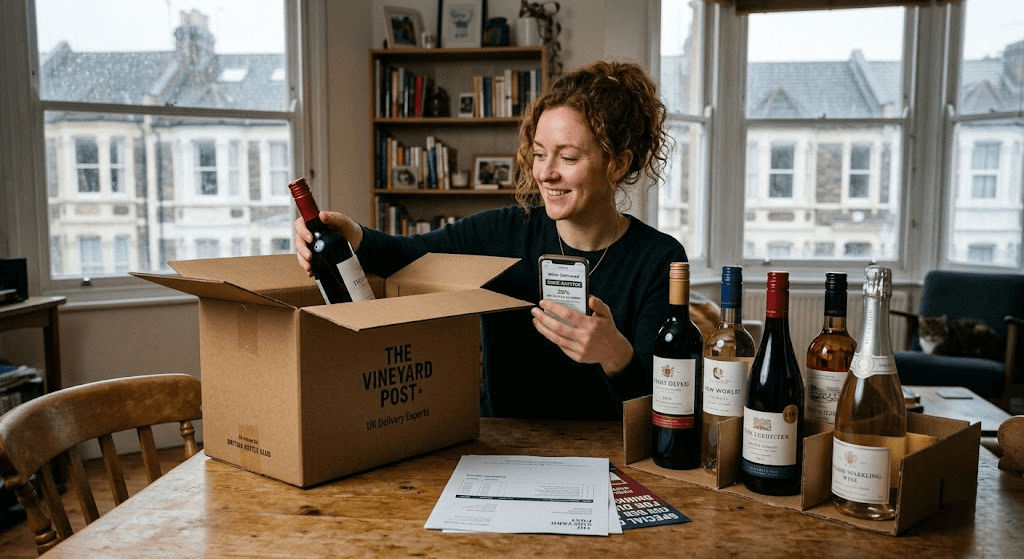
If you have ever ordered a pair of shoes, a meal kit, or a hardback book online in the UK, you have inevitably shaken a glossy piece of card out of the packaging offering you “£50 off your first case of wine”. Companies like Virgin Wines, Naked Wines, and Laithwaites rely heavily on these customer acquisition vouchers.
To use these properly, you have to look at them through the eyes of a venture-capital-backed marketing department. The merchant is actively willing to lose money on your first twelve bottles in the mathematical hope that you will forget to cancel the rolling subscription that automatically follows.
How to maximise the introductory voucher:
- Inspect the baseline pricing: A voucher offering “£40 off a £90 case” sounds magnificent until you realise the case contains six bottles of mass-produced table wine that would cost £5.50 each in a local corner shop. Always cross-reference the specific bottles in an introductory case against independent community review platforms like Vivino before checking out.
- Look for the ‘No Obligation’ fine print: The gold standard of introductory wine discounts is the bespoke “one-off” trial. If the voucher forces you into a bi-monthly ‘Discovery Club’, check their cancellation policy immediately. Thanks to stringent UK consumer protection laws, the vast majority of these merchants now feature a mandatory, one-click ‘Pause or Cancel’ button inside your online account portal.
- Set a digital tripwire: If you use an introductory voucher that enrolls you in a wine plan, do not trust your memory. The moment the checkout completes, open your phone’s calendar and set an alert for 21 days later titled: “Decide on Wine Club.”
2. Mastering the Supermarket “25% Off Six” Dance
For the non-committal drinker, the rotating 25% off six bottles promotion held by the major UK multiples—Waitrose, Tesco, Sainsbury’s, Marks & Spencer, and Asda—is the most reliable discount engine in the country. However, treating this as a simple physical shopping exercise leaves money on the table.
The true savings occur when you move this transaction to their online delivery portals and apply the principle of basket stacking.
The Art of the “Filler Bottle”
Imagine you have five exceptional bottles of Cru Bourgeois Bordeaux sitting in your online grocery trolley, totalling £110. You only actually want five. However, because the 25% discount strictly triggers at bottle number six, adding a single £5.50 bottle of basic cooking Chenin Blanc will instantly knock £28.87 off your total basket subtotal. You have effectively been paid £23.37 to take a sixth bottle of wine.
Stacking with First-Timer Grocery Slots
Supermarkets frequently offer heavy cash incentives to capture new online grocery delivery accounts (for example, “£15 off your first £60 shop at Sainsbury’s”).
- Wait until a 25% off wine weekend goes live on the retailer’s site.
- Fill your digital trolley with six high-margin bottles. Fine Champagne, vintage Port, or top-tier Burgundy offer the absolute highest pound-for-pound savings during a 25% event.
- Apply the general “First Grocery Order” promotional code at the final payment screen.
Because the supermarket checkout software treats the 25% wine promotion as an automated product adjustment, and the £15 voucher as a total-tender discount, they almost universally stack. This drops premium, name-brand bottles well below their standard wholesale cost.
3. The Secret Economy of “Bin Ends”
In the UK wine trade, a “bin end” is the polite industry term for an orphan bottle. When an online merchant transitions from the 2022 vintage of a specific New Zealand Pinot Noir to the newly arrived 2023 vintage, they cannot mix the two SKUs on the same digital storefront. If they have 38 bottles of the 2022 left sitting in a bonded warehouse in Tilbury, those bottles are taking up physical pallet space that costs them daily rent.
They will aggressively slash the price of those specific bottles purely to clear the warehouse floor.
Where to hunt for UK Bin Ends online:
Do not rely on the standard ‘Offers’ tab on a merchant’s homepage. These are frequently populated by high-margin wines that were artificially marked up for 28 days specifically so they could be legally “discounted” to their normal price. Instead, hunt for the dedicated clearance URLs:
- The Wine Society: Their ‘Last Chance’ section is legendary among British oenophiles. Because the Society operates as a mutual cooperative owned by its members rather than a profit-maximising corporation, their bin ends are genuinely sold at the bare cost of clearance.
- Majestic Wine: Majestic operates a dynamic “Mix Six Clearance” digital tier. When browsing their site, go to the main wine matrix and filter specifically by “Stock Clearance”. You will routinely uncover £19 bottles of niche South African Syrah or obscure Spanish Godello knocked down to £9.49 simply because the vineyard changed its front label design.
4. The Post-2023 Alcohol Duty Hack: Shop by ABV
To be a truly sophisticated discount hunter in the UK today, you have to understand the Treasury. In August 2023, the UK Government fundamentally overhauled the alcohol excise duty system, moving away from broad volume categories to a strict “tax by strength” model.
Under the current regime, the duty paid on a bottle of wine scales directly with its Alcohol By Volume (ABV) percentage. A heavy 15% Californian Zinfandel incurs a significantly higher tax charge at the UK border than a light 11.5% German Riesling or a cool-climate Pinot Noir.
Because online retailers operate on tight, fixed cash margins, their ability to offer deep percentage discounts on high-ABV wines has been severely kneecapped by the taxman. Conversely, their margins on lower-ABV wines (10% to 12.5%) remain extremely elastic.
When using an online wine shop’s search tool, set the ABV filter to a maximum of 12.5%. You will notice an immediate, dense concentration of “Buy 2 Get 1 Free” badges and 30% price drops clustered inside this specific bracket. You are no longer just getting a discount from the merchant; you are systematically opting out of the highest tiers of UK alcohol duty.
5. The Big Three: Which Delivery Model Saves You the Most?
If you want to graduate from ad-hoc voucher hunting and set up a steady, reliable pipeline of discounted wine, you must choose your merchant’s structural model carefully. The UK delivery market is dominated by three totally different business philosophies:
The Crowdfunder: Naked Wines
The Concept: You act as an “Angel” by depositing £25 (or more) into your Naked account every month. This money sits in a digital wallet that you can spend whenever you wish. In exchange for giving the company upfront liquidity to fund independent winemakers across the globe, you get “up to 33% off” the listed retail prices.
The Verdict: It offers exceptional value if you love New World styles, heavy fruit profiles, and the back-stories of individual winemakers. Because you are buying bespoke labels produced exclusively for Naked, you cannot price-check the bottles on Google. The real discount is captured in the £11 to £14 range; their £12 “Angel Price” bottles genuinely drink like £16 to £18 supermarket equivalents.
The Mutual Cooperative: The Wine Society
The Concept: You pay a one-off £40 fee to become a lifetime shareholder (of which £20 is instantly credited back to your account to spend on your first order). There are no rolling direct debits, no minimum monthly spends, and zero sales calls.
The Verdict: Pound-for-pound, this is the most mathematically sound way to buy wine in the United Kingdom. Because they do not have private equity backers demanding a 15% annual yield increase, their baseline retail markup is intensely suppressed. A £9.50 bottle of the Society’s own-label White Burgundy would easily sit at £14.99 on a standard commercial e-commerce site. Furthermore, they offer free UK delivery on any order—even a single bottle.
The High-Street Hybrid: Majestic Wine
The Concept: The traditional ‘Mix Six’ pricing model. Buy any six bottles across the entire website, and the per-bottle price instantly drops by anywhere from £2 to £7.
The Verdict: Majestic’s online delivery model is engineered for hosting. If you try to buy two bottles of wine from them, it is an eye-wateringly expensive website. If you are ordering 12 to 24 bottles for a summer barbecue or a wedding, their “Lock It In” subscription options or standard mixed-case tiers offer the most transparent, high-volume discounts on the market.
6. Advanced Strategy: The “Triple Dip” Checkout Stack
Once you have selected your wine, tracked down a bin end, and hit your 25% promotional threshold, you are still only halfway through the transaction. Never click “Authorise Payment” until you have run your basket through the Triple Dip protocol.
- The Cashback Portal: Open a separate browser window and log into TopCashback or Quidco. Search for your chosen wine merchant. It is entirely normal to find an offer for “10% exclusive cashback on all valid online sales” or a flat “£15 back on a £65 spend for new customers”. Click through their tracked link to refresh your basket.
- The Banking App Incentive: Open your smartphone banking app (specifically American Express, Lloyds, Halifax, or Monzo). Navigate to the ‘Merchant Offers’ tab. Banks regularly partner with wine deliverers to offer statement credits, such as “Spend £100 at Virgin Wines, get £20 back”. Click “Activate” on the offer.
- The Point Yield: Pay for the transaction using a reward-yielding credit card, such as the British Airways American Express, to secure Avios points on the final debit.
By applying a Triple Dip to a standard promotional case, an order that originally showed a retail value of £130 can easily result in a net out-of-pocket cost of roughly £64.
7. Defeating the “Cardboard Tax” (Delivery Logistics)
The fastest way to destroy an online wine discount is to carelessly swallow a £7.99 shipping charge. Wine is heavy, fragile, and sensitive to ambient temperatures; UK couriers charge a heavy premium to handle it, and merchants pass that logistical friction directly onto your bill.
To wipe out delivery fees entirely, you must respect **The Law of Twelve**.
Standard wine shipping boxes in the UK are manufactured as double-walled corrugated cardboard pods specifically engineered to hold 3, 6, or 12 bottles. If you order seven bottles of wine, the merchant has to use a 12-bottle box filled with five empty, inflated plastic airbags. Because their volumetric shipping cost remains the same, they will refuse to waive your delivery fee.
Furthermore, the “Free Next-Day Delivery” threshold for almost every major UK merchant sits rigidly between £75 and £100. If your basket sits at £69 and the site is trying to charge you £7.99 for shipping, **do not pay the shipping**. Go back to the search bar, look up a crisp £8.50 bottle of Muscadet, and add it to the cart. Your total spend will go up by 51 pence, but you will have gained an entire bottle of wine.
The Golden Rule of the Digital Cellar
The fundamental rule of buying wine online in Great Britain is wonderfully simple: **Treat your wine rack like a dry goods pantry, never an emergency tap.**
The person who pays the highest possible price for wine in the UK is the consumer who realises at 6:30 PM on a Friday that they have nothing to pair with their takeaway, and orders a single £18 bottle of Malbec via Deliveroo. By purchasing your wine 14 days before you actually intend to pull the cork, riding the supermarket discount waves, raiding the bonded warehouse bin-ends, and letting the UK Treasury’s ABV rules work in your favour, you ensure that every glass poured in your home tastes twice as expensive as it actually was.