 savingsspot.co.uk
 There is a unique, quiet heartbreak known only to the modern maker: falling head over heels for a proposed project, tallying up the cost of the required raw materials, and realising the finished piece will cost three times more to make than it would to buy ready-made on the high street. In the United Kingdom, where the creative hobby sector is worth over £3 billion annually, the cost of top-tier yarn, artist-grade pigments, quality linen, and branded cutting machinery can quickly transform a relaxing weekend pastime into a source of financial anxiety.
However, paying the recommended retail price (RRP) for craft supplies is entirely optional. The British retail landscape—from the digital high street to regional industrial estates—is packed with systemic loopholes, clearance cycles, and circular economies. Whether you are a knitter, a papercrafter, a sewist, or a resin sculptor, mastering the art of the ‘craft deal’ requires pivoting away from passive shopping and adopting the mindset of a strategic procurement officer.
1. Mastering the Major UK Craft Multiples
When most Britons need a pot of Mod Podge or a circular knitting needle, their first instinct is to head to an out-of-town retail park to visit Hobbycraft, or click onto Wool Warehouse. While these giants have the highest standard overheads, they also offer some of the easiest institutional discounts to capture if you know how their systems operate.
The Hobbycraft Club ‘Zero-Spend’ Hack
Most loyalty schemes require you to spend hundreds of pounds to see a five-pound return. The Hobbycraft Club operates on a different metric: customer retention. Upon signing up, and again on your registered birthday every year, the app issues a £5.00 digital voucher. Crucially, this voucher has no minimum spend. If you walk into a store and pick up a £4.80 pack of fine-tip embroidery needles, scan your app at the till, your total will be £0.00. Savvy makers coordinate their household’s sign-ups to ensure a steady trickle of free small notions throughout the calendar year.
The Works: The Multi-Buy Sweet Spot
The Works is frequently dismissed by serious artists as a purveyor of children’s slime kits and cheap paperback thrillers, but their back-of-store art aisles are a sleeper hit for structural basics. Their permanent ‘3 for £5’ and ‘2 for £10’ mix-and-match offers on stretched cotton canvases, MDF blank plaques, and box frames offer the lowest cost-per-square-inch ratio in the UK for substrate materials. If you are practicing heavy-impasto acrylic work or testing pouring mediums, doing so on a £1.66 canvas from The Works saves you from ruining a £15 Loxley canvas.
2. The Digital Underground: The Power of the ‘Destash’
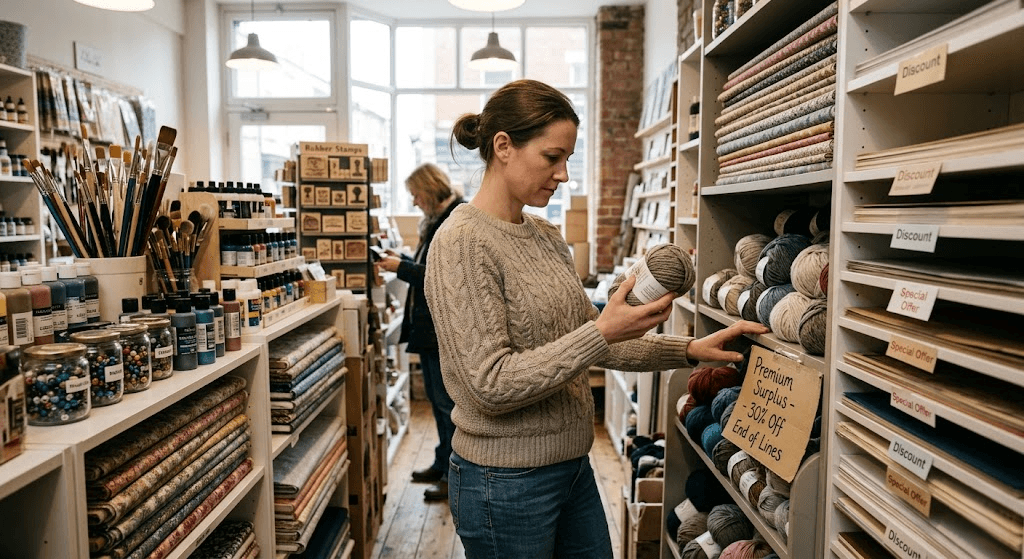
In the crafting lexicon, a “destash” is the golden ticket. Crafters are, by nature, optimistic hoarders; we buy materials for hypothetical future versions of ourselves who have 48-hour days. When a crafter decides to pivot from watercolours to tufting, or simply needs to reclaim a spare bedroom, they destash. Because the seller is motivated by space retrieval rather than profit margins, high-end supplies are routinely sold at 40% to 70% below RRP.
Navigating Vinted for Craft Supplies
While originally built for second-hand fast fashion, Vinted has quietly become the premier UK marketplace for surplus craft goods. Because the platform charges the *buyer* a small protection fee rather than stinging the seller with heavy listing commissions, sellers list items much cheaper than they do on eBay.
To find the real bargains, avoid generic searches. Use highly specific brand terminology in the search bar:
- Instead of searching “wool”, search “Rowan Felted Tweed lot” or “Stylecraft Special DK bundle”.
- Instead of “card making stuff”, search “Sizzix Thinlits bundle” or “Spellbinders clearance”.
- Always check the seller’s “Wardrobe”. If they are destashing one ball of surplus merino wool, there is a very high chance they have ten more unlisted balls sitting in a plastic tub behind them; message them directly to ask for a custom bundle.
The eBay “Job Lot” Typo Hunt
On eBay, your best friend is human error. Many people tasked with clearing out a relative’s loft do not know the difference between a high-end Cricut Maker 3 and a generic laminator. Set up permanent saved searches with email alerts for the following syntax: (craft, haberdashery, art, sewing) (joblot, bundle, stash, massive). Furthermore, search for common misspellings of expensive branded tools, such as “Crikut”, “Sizix”, or “Bernina sewing machine” listed simply as “old electric sewing machine”.
3. High Street Sleeper Hits and The “Middle Aisle”
You do not need to be in an art shop to buy art supplies. Some of the most durable crafting implements sit in aisles designed for bricklayers, mechanics, and budget grocery shoppers.
The Supermarket Specialbuy Cycle
Aldi’s “Specialbuys” and Lidl’s “Middle of Lidl” operate on a strict, semi-predictable annual rotation. Twice a year (usually October and March), both chains drop their dedicated haberdashery and yarn events. Aldi’s in-house brand, So Crafty, offers double-knitting (DK) acrylic yarn in 400g value balls that work out to roughly £1.25 per 100g—a price point that even dedicated budget digital outlets struggle to match.
More importantly, keep an eye out for Lidl’s occasional drops of the SilverCrest sewing machine. Priced hovering around the £80–£90 mark, this machine is an open secret among UK seamstresses; it features a heavy-duty internal metal frame capable of punching through three layers of raw denim, vastly outperforming entry-level plastic machines from major names that cost twice as much.
Hardware Stores for Studio Hardware
If you buy a set of five “artist’s palette knives” from a fine art boutique, you will part with £20. If you walk into a Screwfix, Toolstation, or a large B&Q and buy a set of “spring-steel filling knives” or “plasterer’s spatulas”, you will pay roughly £4.50 for tools made of superior, more flexible steel. The same rule applies to heavy-duty storage: ignore pastel-coloured “craft caddies” and purchase stackable, cantilevered Stanley or DeWalt fishing-tackle/screw organisers.
4. The Secret Network: UK Community Scrapstores
Perhaps the most under-utilised resource in the British crafting ecosystem is the National Scrapstore Network. Operating as registered charities, these regional warehouses exist to intercept clean, non-toxic industrial waste before it reaches a landfill, redirecting it to schools, community groups, and individual creative members.
Scattered from the Work and Play Scrapstore in Tooting to Orinoco in Oxfordshire and Bristol Children’s Scrapstore, these facilities operate on a volume-based pricing model. For an annual membership fee (usually between £5 and £15 for an individual), you can walk into the warehouse and fill a standard wire shopping basket or a black bin liner with materials for a nominal fee of £3 to £7.
What constitutes “industrial scrap”?
- End-of-line massive cardboard presentation tubes (perfect for structural armatures).
- Off-cuts of high-end, fire-retardant upholstery velvet and pure wool tweed from commercial furniture manufacturers.
- Surplus reels of metallic foil, Mylar sheeting, and high-grade Perspex offcuts.
- Cones of deadstock weaving yarn from commercial textile mills.
5. Timing the Market: The Crafter’s Fiscal Calendar
In retail, desperation dictates the discount. To get the best prices from standard digital and physical retailers, you must align your buying habits with their stock-holding pressure points.
The January “Guilt” Window
The second and third weeks of January are the optimum time to buy second-hand crafting technology. Thousands of well-meaning partners purchase high-end digital cutting machines, expensive floor looms, or top-tier airbrushing compressors as Christmas presents. By January 15th, the recipient has realised they do not have the time, the software aptitude, or the spatial capacity for the hobby. Marketplaces become flooded with “Opened – Never Used” boxed machinery, often driving second-hand prices down by 35% across the board as sellers compete for quick cash to pay off December credit card bills.
The Post-Christmas Papercraft Dump
On December 27th, physical retailers experience an immediate psychological aversion to anything coloured forest green, crimson, or speckled with gold. High street stationers like Paperchase (via Tesco), WHSmith, and local garden centres instantly mark down premium cardstock, metallic gel pens, wax seal kits, and luxury ribbons by 70%. A savvy papercrafter buys their entire upcoming year’s supply of neutral base card during the post-Christmas clearance, ignoring the printed Santa motifs and focusing purely on the GSM weight and raw material quality of the discounted stock.
6. Four Golden Rules for the Savvy Maker
To ensure you don’t end up spending money just for the sake of a yellow clearance sticker, embed these four internal checks into your buying routine:
1. Calculate the ‘True Metre’ Cost
Never look at the price tag of a ball of wool or a bolt of fabric; look at the unit breakdown. A 50g ball of luxury yarn priced at £4.00 looks cheaper than a 150g cake of the same fibre priced at £9.50, but the former costs £8.00 per 100g, while the latter costs £6.33 per 100g. Always use your smartphone calculator to divide the price by the metre, the gram, or the millilitre before putting it in your basket.
2. Practice “Basket Ghosting”
If you are shopping with an independent UK online craft retailer (such as a bespoke fabric printer or an independent yarn dyer), log into your account, place the items you want into your digital shopping basket, and close the browser tab. Do not check out. Approximately 60% of modern e-commerce platforms have an automated trigger set to fire 24 to 48 hours later, sending an email to your inbox reading: “Did you forget something? Use code COMEBACK10 for 10% off your basket.”
3. Exploit Amazon’s “Ugly Box” Market
When buying high-end branded tools like a Dremel rotary tool, a Cricut EasyPress, or a Daylight Company magnifying lamp, never click ‘Add to Basket’ immediately. Look directly beneath the Buy button for the small text that reads: “Save with Used – Like New” (Amazon Resale). In 90% of cases regarding craft hardware, the item itself is pristine and untouched; the “damage” was a forklift tearing the outer cardboard display box in a warehouse in Leicestershire, instantly wiping £30 off the retail value.
4. Form a Local Purchasing Syndicate
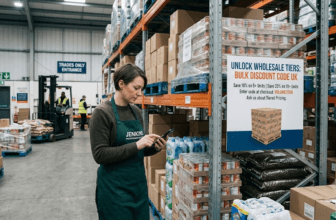
Wholesale craft suppliers—such as those supplying raw paraffin wax, bulk unbleached calico, or raw soap bases—offer profound price breaks once an order hits the £150 or £200 threshold. If you operate in isolation, you will never trigger these tiers. Use local Facebook community groups or regional sub-Reddits to find three other makers in your postcode who use the same base mediums. By combining your quarterly orders into a single wholesale purchase delivered to one driveway, you can bypass the consumer retail markup entirely.
Ultimately, a tight budget should never be viewed as the enemy of the creative process. Historically, some of the most profound artistic movements were born out of a strict limitation of resources. By treating the acquisition of your supplies as an exercise in lateral thinking, you not only protect your bank balance, but you inject a layer of resourcefulness into your work that money simply cannot buy.