 savingsspot.co.uk
 We have all stood in front of an overflowing wardrobe, looked at the tangled sea of fabric, and uttered the universal morning lie: “I have absolutely nothing to wear.”
In years gone by, fixing that problem was easy. You walked down the high street, popped into a fast-fashion giant, handed over a tenner, and walked out with a new top. But the modern British retail landscape has shifted. The cost of living has made us all look twice at our bank balances, and the cheap t-shirt that loses its shape after two spins in the Hotpoint is no longer a bargain—it is just an expensive waste of time.
Looking effortlessly put-together on a shoestring budget doesn’t require a six-figure salary; it requires a strategy. From decoding the hidden algorithms of second-hand apps to mapping the country’s most lucrative charity shop postcodes, here is the insider’s guide to securing high-quality, affordable clothes in the UK.
The Digital High Street: Mastering the Resale Apps
We are living in the golden age of the digital rummage. The stigma of second-hand clothing has entirely evaporated, replaced by the smug satisfaction of telling someone, “Thanks, I got it for four quid online.” However, navigating platforms like Vinted, Depop, and eBay requires a specific tactical approach.
1. Use the “Typo Goldmine” Hack
When people upload items to resale apps in a rush, they make spelling mistakes. A seller who lists a piece as “Burbury”, “Livi Jeans”, or “Ralph Laren” will miss the standard search algorithms entirely. Because nobody is viewing their listing, nobody is bidding or offering. Type those common misspellings into your search bar manually; you will frequently find pristine designer staples sitting there with zero interest and rock-bottom price tags.
2. The Power of the “Polite Bundle”
On Vinted, the postage fee is the ultimate dealbreaker—paying £3.49 to ship a £3 top makes no mathematical sense. Instead, find a seller who has one item you like, and click “Shop well with others” or view their profile. If you can find three or four everyday essentials (plain t-shirts, gym gear, standard denim) in their wardrobe, use the Bundle feature to request 30% off the lot. Sellers are almost always desperate to clear space and avoid making four separate trips to an Evri drop-off locker. They will almost certainly accept.
3. Pivot your Search to “Mid-Tier Durables”
Do not go onto second-hand platforms to buy fast fashion. A second-hand top originally from an ultra-cheap online retailer will arrive already stretched and bobbled. Instead, use your saved searches to hunt specifically for mid-tier, high-durability high-street names: COS, Arket, Whistles, Marks & Spencer (specifically the Autograph range), and Uniqlo. Getting an Arket heavy-weight cotton t-shirt for £8 second-hand is a vastly superior financial play to buying a flimsy £6 brand-new one.
Decoding the UK Charity Shop Map
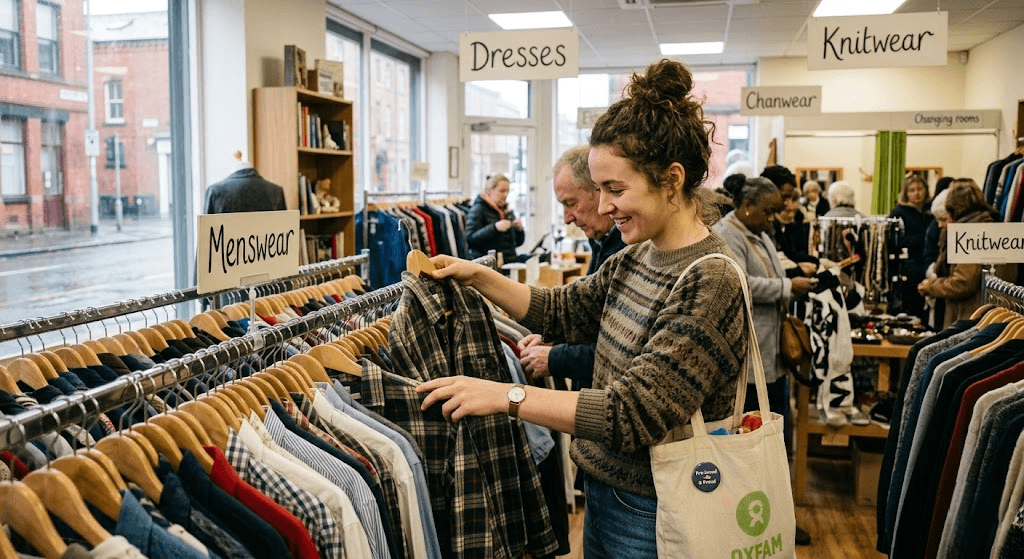
British charity shops are an institution, but treating them like a lucky dip is an amateur’s game. To find genuine quality, you have to understand the “Geography of Giving.”
Charity shops process the donations of the immediate surrounding postcodes. Therefore, shopping in a heavily populated student city will yield endless rails of discarded neon fancy-dress outfits and fast-fashion clubbing tops. To find the real treasure, you need to travel to the commuter belts, affluent market towns, and well-heeled retirement hubs.
- The Golden Triangles: Places like Wilmslow in Cheshire, Harrogate in North Yorkshire, or Richmond and Hampstead in London. The local Oxfam or British Heart Foundation stores in these areas routinely carry donated Mulberry bags, Barbour wax jackets, and pure cashmere jumpers.
- The Tuesday Morning Rule: Most people do their household decluttering over the weekend. On Monday, the charity shop volunteers sort, steam, and price those black bin bags. By Tuesday morning, the absolute best of the weekend’s haul hits the shop floor. If you walk in on a Saturday afternoon, you are looking at the picked-over bones of the week.
- Seek out the “Boutiques”: Several major charities have re-branded specific branches as “Boutique” or “Vintage” stores (such as the Red Cross vintage shops or Shelter’s boutique in King’s Cross). While the prices are slightly higher than a standard charity shop, the curation is done for you—saving you three hours of flicking through scratchy 1990s acrylic cardigans.
The Secret World of High Street Overstock
What happens to the 40,000 summer dresses a major department store didn’t manage to sell by September? They don’t put them in a landfill, and they don’t keep them in the stockroom. They sell them to overstock liquidators.
The “De-Branded” Websites
Websites like Everything5Pounds.com or SecretSales operate as digital clearance houses. A massive percentage of the stock on these sites is genuine, brand-new surplus from major British high-street names (Next, River Island, Topshop, and Marks & Spencer). To protect the prestige of the high-street brand, the liquidators are legally required to snip the woven brand tag out of the back of the neck before shipping it to you. If you don’t care about a missing two-inch piece of polyester at the back of your collar, you can buy £45 high-street trousers for a fiver.
The Official eBay Outlet Hubs
Many shoppers do not realise that the UK’s biggest brands run their own quiet, unpublicised clearance stores directly inside eBay. If you search for the “Marks & Spencer Official Outlet”, “Superdry Outlet”, or “Schuh Imperfects” on eBay, you are buying directly from the brand’s own warehouse. The stock is marked down by up to 70% simply because it was a return, has a damaged cardboard box, or was the display model in a shop window.
Conquering TK Maxx Like a Professional
Walking into a large TK Maxx without a plan is a guaranteed recipe for sensory overload and a mild headache. The shop is intentionally designed to make you feel like you have to hunt. To beat the system, memorize the internal coding.
Look at the printed price tag on any garment. In the top right-hand corner, you will see a small, single-digit number. This is the “Department Code”:
- Code 1: This is standard, mass-produced stock. It is often clothing manufactured specifically for TK Maxx under licensed brand names. It’s fine, but it isn’t a miraculous bargain.
- Code 2: Genuine unsold overstock from recognized high-street brands.
- Code 7: The Holy Grail. Code 7 means “Packaway” or “Designer overstock”. This is an authentic piece of high-end runway fashion that was packed away in a warehouse three years ago and has now been released to the shop floor at an 80% discount.
Furthermore, ignore the main aisles and head straight to the clearance rails at the back. Look specifically for the Yellow Stickers (the standard markdown) and the ultra-rare Red Stickers. A red sticker means the store manager has been told to get the item out of the building at all costs; you can routinely find £80 trousers reduced to £3.00 purely because they are an awkward size 6 or an unusual shade of lime green.
The Art of the British Car Boot Sale
While the internet has digitized the bargain hunt, nothing will ever truly replicate the raw, chaotic energy of a damp field in the home counties at 7:00 AM on a Sunday morning. The car boot sale remains the absolute cheapest place to buy clothes in the United Kingdom.
To win a car boot sale, you have to choose your persona: the Early Bird or the Vulture.
The Early Bird (6:30 AM): You arrive with a torch while the sellers are still untying the bungee cords on their boots. This is the only time you will secure genuine vintage Levi’s, 1980s band tees, or high-end outdoor wear before the professional Depop resellers grab them.
The Vulture (12:15 PM): You arrive just as the sky starts to drizzle and the sellers are looking at their trestle tables with a deep, existential dread of having to pack it all back into the Nissan Qashqai. Walk up to a stall with a five-pound note in your hand, point to a rail of clothes, and ask: “How much for the whole rail?” Nine times out of ten, the seller will hand you a black bin bag and tell you to take the lot.
The “Cost-Per-Wear” Mindset: Re-defining “Cheap”
The final step in building an affordable wardrobe is a psychological one: we have to stop confusing the word cheap with the word valuable.
Imagine two different purchases:
Garment A is a £7.00 acrylic jumper bought from a trendy smartphone app. It arrives smelling faintly of vinegar. You wear it once, it traps your body heat like a greenhouse, and after its first 30-degree wash, it develops roughly four thousand tiny fabric bobbles and shrinks to the size of a tea towel. You throw it away.
Your Cost Per Wear: £7.00.
Garment B is a £28.00 second-hand 100% Merino Wool jumper bought on Vinted. It breathes naturally, doesn’t hold onto sweat, and requires washing only once every four wears. You wear it twice a week for two winters straight (roughly 60 wears).
Your Cost Per Wear: £0.46.
True affordability sits inside the composition tag. When you pick up a piece of clothing, flip the side-seam label over before you look at the price tag. If the fabric is listed as 100% Polyester, Acrylic, or Nylon, put it back on the rail—it is a financial trap disguised as a bargain. If it says Cotton, Linen, Wool, Viscose, or Lyocell, you are looking at an item that will actually honor the money you spent on it.
The £10 “Wardrobe Resurrection” Kit
You don’t always need to buy cheap clothes; sometimes you just need to make your cheap clothes look expensive. For the price of a standard pub lunch, you can buy three household items that will double the lifespan of your current wardrobe:
- An Electric Fabric Shaver (£7.50): This hand-held battery device features a tiny rotating blade behind a metal mesh. Run it over a tired, fuzzy jumper, and it instantly shaves off the friction-bobbles, returning the knitwear to a smooth, shop-bought finish in four minutes.
- A Pod of Dylon Machine Dye (£6.00): Black jeans and navy t-shirts do not wear out; they just turn a miserable, chalky grey. Buy a single pod of “Intense Black” machine dye, throw three pairs of faded jeans into the washing machine with it, and hit 40 degrees. You have just bought three ‘new’ pairs of jeans for two pounds each.
- A Bottle of White Standard Vinegar (£1.20): Forget expensive chemical fabric softeners, which actually coat your clothes in a micro-layer of silicone that traps stale sweat. Put half a cup of cheap white vinegar into the softener drawer of your washing machine. It strips out old detergent residue, kills the bacteria that causes the “damp clothes smell”, and softens the fibres naturally.
Looking stylish in Britain today isn’t a test of your wealth; it is a test of your resourcefulness. Step away from the blinding strip-lighting of the fast-fashion checkout, embrace the thrill of the secondary market, and start dressing like the smartest person in the room.