 savingsspot.co.uk
 In an era where the average British consumer is subjected to an estimated 4,000 digital advertisements every single day, digital fatigue is no longer a marketing buzzword—it is a measurable consumer reality. We have mastered the art of the subconscious ‘ad-blind’ scroll. Yet, when a heavy, textured, beautifully finished piece of print lands on a doormat or gets handed to us across a shop counter, the thumb stops. The eyes linger. The brain engages.
Print has not been killed by the internet; rather, it has been promoted. It has evolved from a cheap utility for mass, scattergun messaging into a premium, high-retention medium of trust. For businesses operating across the United Kingdom, mastering the modern print ecosystem is no longer about finding the cheapest place to run off a thousand A5 flyers; it is about understanding the tactile psychology of the physical world.
The Neuroscience of the Printed Page
To understand why physical printing holds such immense value for modern brands, one must look to neurology. A milestone study conducted by the UK’s Royal Mail MarketReach, alongside neuroscientists, monitored the brainwaves of consumers as they interacted with both physical mail and digital equivalents. The findings were profound: tangible materials left a much deeper emotional footprint in the brain.
Physical print triggers what behavioural economists call the Endowment Effect. The moment an individual holds a physical object in their hand, their brain subconsciously begins to assign a sense of ownership to it. A digital banner ad flickers out of existence the second you scroll past it; a bespoke, 350gsm silk-coated brochure sits on a coffee table in Surrey or a boardroom desk in Manchester for three weeks.
Decoding the GSM Scale: What Your Paper Says About You
One of the most common pitfalls for SMEs purchasing print services is treating paper as a passive canvas rather than an active participant in their brand’s voice. In the UK printing industry, paper weight is measured in GSM (Grams per Square Metre). Choosing the wrong GSM can instantly undermine an otherwise brilliant piece of graphic design.
- 80–100 gsm: The territory of standard office copiers and internal utility print. Using this for outward-facing customer marketing whispers: “We did this on a budget.”
- 130–170 gsm: The sweet spot for high-volume takeaway menus, festival schedules, and standard promotional leaflets. It holds colour well, folds cleanly, and offers a sensible balance between unit cost and respectable presentation.
- 200–250 gsm: The ‘light card’ threshold. This weight stands up under its own steam. It is the gold standard for premium magazine covers, exhibition hand-outs, and durable real estate prospectuses.
- 300–400 gsm+: The heavyweight division. Reserved for luxury business cards, high-end VIP event invitations, and presentation folders. When a customer takes a 400gsm card, the rigidity conveys stability, premium quality, and permanence.
The Big Three: Choosing the Right Press Technology
When you submit a PDF to a commercial UK print house, it will generally be routed to one of three primary technologies. Knowing which one suits your project will save your marketing budget thousands of pounds.
1. Digital Printing (The Speed King)
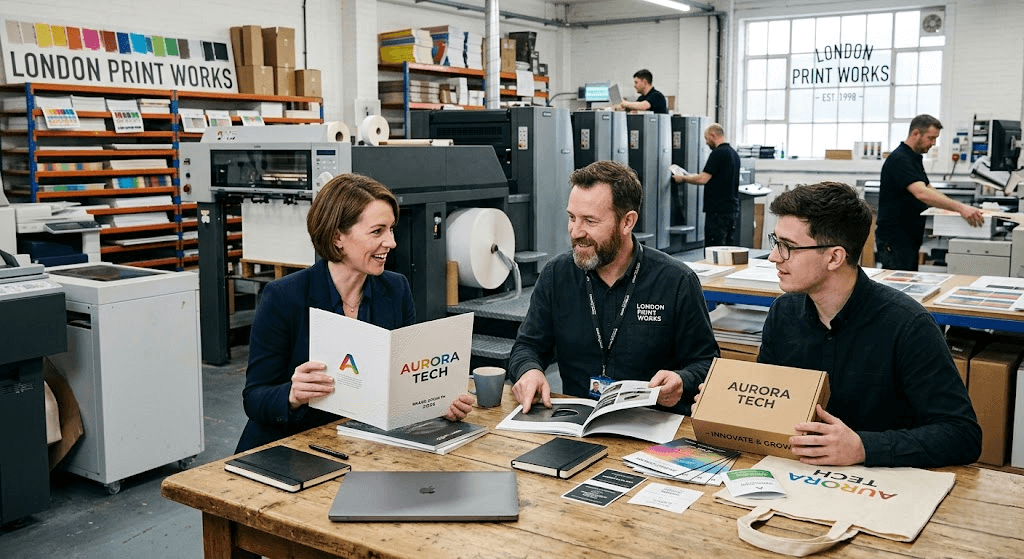
Digital presses operate much like a giant, hyper-advanced version of your office laser printer, using electrostatic rollers to apply toner directly to the paper. Because there is no manual setup required to create physical printing plates, digital is the undisputed champion of the short run. If you need 200 personalised invitations delivered to a London venue by tomorrow afternoon, digital printing is your only viable route. However, its per-unit cost remains relatively static; printing 10,000 flyers digitally offers very little economy of scale.
2. Lithographic Printing (The Heavyweight Champion)
Lithographic (or ‘litho’) printing is the traditional, centuries-old master of the trade, brought up to date with computer-to-plate technology. It relies on the simple chemical principle that oil and water do not mix. The image is burned onto an aluminium plate, covered in wet ink, transferred onto a rubber blanket, and finally pressed into the paper.
The setup costs for litho are high because a human operator has to mount the plates and calibrate the massive press. However, once the machine is rolling at 15,000 sheets per hour, the unit cost falls off a cliff. If you are printing a 64-page product catalogue for a nationwide distribution of 20,000 copies, lithographic print will beat digital on price, colour depth, and image sharpness every single time.
3. Large Format (The Showstoppers)
Utilising wide-roll inkjet technology, large format printing handles everything that won’t fit inside a standard printing press: retail window graphics, PVC PVC-free exhibition banners, site hoardings, and vehicle wraps. The modern leap forward in large format is UV-curable ink; the press emits a burst of ultraviolet light instantly behind the print head, drying the ink onto non-porous surfaces like Foamex, Dibond (aluminium composite), or acrylic in a fraction of a second.
The Hidden Gem: The UK’s Risograph Revival
While mainstream business relies on digital and litho, a fascinating sub-culture has exploded across the UK’s creative hubs—from Glasgow’s Merchant City to Bristol’s Stokes Croft: the Risograph.
Originally manufactured in Japan in the 1980s as a cheap, high-speed internal duplicator for schools and churches, the ‘Riso’ has been reclaimed by modern graphic designers. It functions like a mechanical screen printer; the machine creates a wax stencil wrapped around a drum of liquid ink. It prints one colour at a time, using vibrant, semi-translucent soy-based inks that cannot be replicated by standard CMYK toners—including electric neon pinks, vivid burnt oranges, and metallic golds.
Because the paper passes through the machine multiple times for different colours, the alignment (registration) is almost never 100% perfect. This results in a quirky, charmingly imperfect, retro aesthetic. For independent British brands, artisan coffee roasters, and boutique record labels, a Riso-printed zine or product insert acts as an instant badge of authentic, handcrafted cool.
Pre-Press Best Practices: Don’t Fall at the Final Hurdle
Talk to any commercial printer in Birmingham or Leeds, and they will tell you the same story: 70% of artwork submitted by first-time clients gets rejected at the pre-press stage due to basic setup errors. To ensure your artwork moves from screen to paper without costly hold-ups, enforce these three golden rules:
The RGB to CMYK Trap
Your computer monitor displays light using an additive colour model: Red, Green, and Blue (RGB). When you combine all three at full intensity, you get pure white light. Print, however, relies on a subtractive model: Cyan, Magenta, Yellow, and Key/Black (CMYK). Ink absorbs light; when you mix CMYK together, you get a muddy, dark brown.
If you design a flyer in RGB mode using a hyper-vibrant, glowing lime green, the commercial printing press will attempt to translate that into CMYK. The result will be a dull, muted forest green. Always design your artwork in CMYK from the very first click, or request a physical “wet proof” if brand-accurate Pantone spot colours are strictly required.
Respect the 3mm Bleed
Commercial guillotines slice through stacks of 500 sheets of paper at once. Even with laser-guided precision, the paper can microscopically shift by a millimetre during the cut. If your background image stops exactly at the edge of the A4 page on your screen, that microscopic shift will leave your finished flyers with a glaring, highly unprofessional white hairline edge along one side.
To fix this, extend your background artwork 3mm beyond the final trimmed size on all four sides. This safe margin is known as the ‘bleed area’ and gets sliced away into the recycling bin, leaving your artwork looking seamless.
Convert All Text to Outlines
You may have spent £150 licensing a gorgeous, bespoke typography font for your headline. However, if the prepress computer at the printing factory does not have that exact font file installed in its system directory, it will automatically substitute it with standard Arial or Times New Roman, ruining your layout instantly. Before exporting your final print PDF, select your text and hit ‘Convert to Outlines’ (or ‘Convert to Curves’). This transforms your editable text into fixed vector shapes that will print identically on any machine in the world.
The UK Print VAT Quirk: What You Need to Know
Navigating the UK’s Value Added Tax system is notoriously tricky, but understanding its rules regarding print can instantly stretch your marketing budget by 20%. Under current HMRC guidelines, the printed word enjoys a highly unique tax status.
In general, **books, booklets, brochures, pamphlets, and standard leaflets are Zero-Rated for VAT**. This means you pay 0% tax on the print invoice.
However, the taxman applies a very strict test regarding the *function* of the print. The moment your flyer is designed to be kept and used for another purpose, it crosses the line into **Standard Rated (20%) VAT**. For example:
- An A5 leaflet advertising a new restaurant opening: 0% VAT.
- The exact same A5 leaflet, but containing a small box at the bottom that says “Fill in your name and email to enter our prize draw”: 20% VAT (it is now classed as a form).
- A flyer that states “Bring this voucher with you for 10% off your main course”: 20% VAT (it is now classed as a ticket/token).
When designing printed collateral for a British audience, keep your call-to-actions digital (e.g., “Scan this QR code to claim your 10% discount”) rather than printed vouchers, and you will legally keep that 20% tax inside your own bank account.
The Green Print Revolution: Erasing the Guilt
For decades, the print industry carried a heavy public relations burden regarding deforestation. Today, the modern UK printing sector is one of the most circular, highly regulated, and sustainable industries in the domestic economy.
When sourcing a British print partner, look past vague “eco-friendly” badges and look for concrete, verifiable supply chain certifications:
- FSC® Certification: The Forest Stewardship Council stamp guarantees that the pulp used to create the paper was sourced from sustainably managed European forests where, on average, three new trees are planted for every single one harvested.
- Carbon Balanced Print: Offered in partnership with bodies like the World Land Trust, this scheme calculates the exact carbon output of your print job—from the harvesting of the wood to the delivery van reaching your door—and offsets it by preserving high-conservation-value tropical rainforests.
- Vegetable-Based Inks: Historically, commercial inks relied on heavy mineral oils derived from petroleum. Almost all top-tier UK litho printers have now migrated to 100% vegetable-based inks (utilising linseed, soy, or corn oils). These release drastically fewer Volatile Organic Compounds (VOCs) into the atmosphere and make the de-inking process during paper recycling significantly more energy-efficient.
Choosing the Right UK Print Partner
The UK print market is broadly split into three tiers, and matching your company to the right tier is vital for operational harmony:
1. The Online Aggregators: Huge, highly automated factories (often based in Yorkshire or the Midlands) operating via slick e-commerce portals. They gang thousands of different customer jobs onto massive sheets of paper to keep costs rock bottom. They are fantastic for standard, low-risk items like standard business cards or promotional flyers. However, customer service is largely ticket-based; if your artwork has a subtle transparency issue, the automated rip-software will likely print it anyway without warning you.
2. The Local High Street Printer: Your regional print shop. What you lose in unit-cost economy, you gain in human oversight. If you have an urgent, complex job or need to physically test the snap and fold of five different paper stocks before committing to a £2,000 spend, building a relationship with a local print manager is invaluable.
3. The Specialist Print Management House: For medium-to-large enterprises, managing print across 50 different retail sites is a logistical nightmare. Print management agencies don’t necessarily own the printing presses; instead, they act as master brokers, utilising a vetted network of trade-only printers across the UK to route your packaging to a carton specialist, your manuals to a web-offset specialist, and your window vinyls to a large-format specialist, managing the quality control centrally.
Physical print offers something the digital realm never can: absolute permanence. In a digital marketing landscape defined by ephemeral, fleeting noise, investing in high-end, thoughtful, tactile print is the ultimate statement of confidence a British brand can make to its market.