
Mastering the UK Luxury Brand Sale: Where, When, and How to Acquire Designer Pieces for Less
 savingsspot.co.uk
 There is a lingering myth within the upper echelons of fashion that true luxury never goes on sale. For decades, the narrative suggested that the world’s most prestigious heritage houses would rather incinerate their surplus stock—a practice now rightfully restricted by modern sustainability legislation—than allow their coveted silhouettes to be tagged with a red clearance sticker. Yet, for the discerning British shopper, the luxury sale is not a myth; it is a quietly orchestrated, highly strategic sport.
Whether you are hunting for a timeless Burberry trench coat, a classic Mulberry Bayswater tote, or a pair of handcrafted Northamptonshire brogues, the United Kingdom possesses one of the most sophisticated off-price luxury ecosystems in the world. However, successfully navigating it requires stepping away from the chaotic trolley-dashes of the High Street and adopting the mindset of a curator. To secure genuine high-end provenance without paying the full retail premium, one must master the unwritten calendar, the secret physical postcodes, and the digital backchannels of British luxury retailing.
The Golden Calendar: Decoding British Sale Seasonality
Timing is the single most critical factor in high-end acquisition. Unlike fast-fashion retailers who rely on perpetual, rolling discounts to shift synthetic stock, the luxury market adheres to a remarkably rigid, traditional fiscal calendar. There are two monumental clearance windows in the UK, flanked by a handful of “quiet” promotional periods.
The Summer Event (Late June to July)
The summer markdown is arguably the most fruitful window for the sartorial investor. Kicking off quietly in mid-June, this sale is designed to clear out the Spring/Summer ready-to-wear collections to make way for the heavy, higher-margin Autumn/Winter woollens and outerwear arriving in August. Because summer tailoring and lightweight Italian silks carry less physical bulk, the percentage drops here tend to be more aggressive, frequently hitting 50% to 60% off by the second week of July.
The Winter Event & Boxing Day (Late December to January)
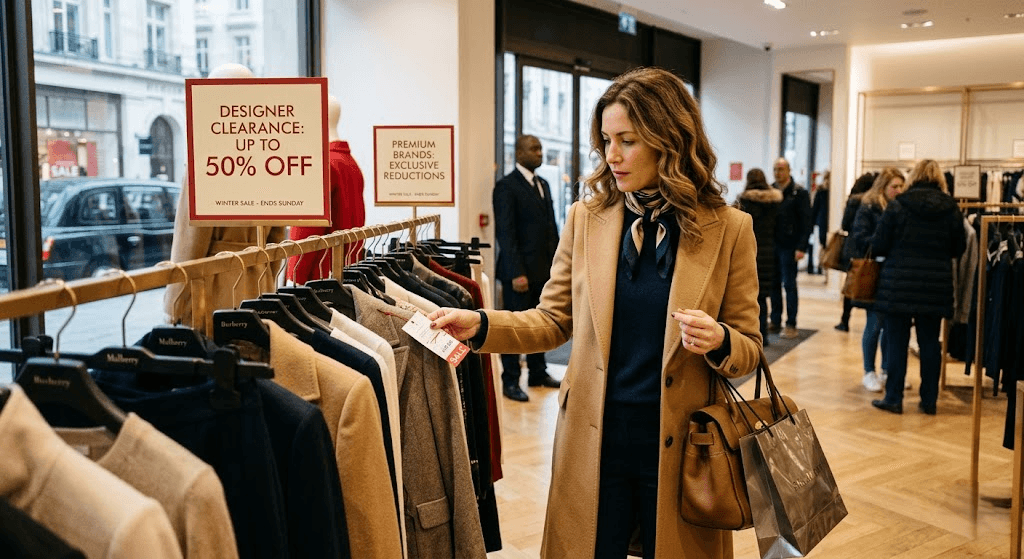
While the British High Street erupts into a frenzy on the morning of December 26th, the luxury sector plays a longer, more elegant game. The iconic department stores of Knightsbridge and the West End will launch their winter reductions immediately after Christmas, but the true connoisseur waits for the “Final Reductions” window in the third week of January. This is the moment when heavy investment pieces—shearling coats, cashmere overcoats, and structured leather goods—are dropped to their absolute floor price to clear the stockrooms before the February fashion weeks.
The “Yellow Banner” Phenomenon: Selfridges and Quiet Reductions
It is worth noting the psychological language of the British luxury sale. Take Selfridges, for example. You will rarely see the word “Sale” plastered across the neo-classical pillars of their Oxford Street flagship. Instead, look for their signature canary-yellow signage bearing the phrase “The Selfridges Selection” or “Seasonal Reductions”. In the luxury sphere, semantics matter; a “reduction” maintains the dignity of the garment, whereas a “clearance” cheapens the house.
The Physical Titans: Conquering Britain’s Great Department Stores
Online shopping offers frictionless speed, but nothing matches the tactile reassurance of inspecting the stitching on a discounted Loewe bag in person. Britain’s historic department stores remain the epicentres of premium markdowns.
Harrods (Knightsbridge)
The Harrods Winter Sale is an institution embedded in British cultural history. While the famous opening-day queues featuring live entertainment have been scaled back in the digital age, the physical event remains paramount. The golden rule of the Harrods sale is to bypass the chaotic ground-floor perfume and accessory halls entirely. Take the Egyptian escalator straight to the International Designer floors. Furthermore, signing up for the Harrods Rewards programme is non-negotiable; members are routinely granted access to “Preview Days”, allowing them to secure 30% off mainline items a full weekend before the general public is let through the brass doors.
Harvey Nichols (Knightsbridge & Edinburgh)
Located just down the road from its more sprawling neighbour, Harvey Nichols offers a far more curated, digestible sale experience. Their buyers have a historic reputation for championing avant-garde European and emerging British talent. If you are looking for discounted pieces from labels like Jacquemus, Dries Van Noten, or Zimmermann, “Harvey Nics” offers superior stock levels and far more civilised fitting rooms during the peak July and January rushes.
Liberty London (Regent Street)
Stepping into Liberty’s mock-Tudor atrium during sale season feels less like a retail transaction and more like rummaging through the attic of a remarkably wealthy, eccentric great-aunt. Liberty is the undisputed king of the niche luxury sale. This is the place to hunt for discounted Acne Studios knitwear, artisanal Japanese selvedge denim, and the store’s own iconic Tana Lawn cotton sleepwear.
The Digital Empire: Britain’s Best Premium Off-Price Platforms
For those who prefer to conduct their hunting from the comfort of an armchair, the UK digital landscape has evolved far beyond the chaotic, unverified auctions of early-2000s eBay. Today, a network of sanctioned, highly polished digital outlets moves the world’s overstock.
- THE OUTNET: The sister site to Net-A-Porter, this platform is the undisputed gold standard for discounted womenswear in the UK. Because of its parent company’s immense buying power, The Outnet receives direct, pristine past-season stock from over 350 brands, including Victoria Beckham, Dolce & Gabbana, and Chloé. Keep a close eye on their “Just Dropped” tab on Monday mornings.
- BrandAlley: Operating on a private members’ club model (requiring a basic email sign-up), BrandAlley hosts time-sensitive “flash sales” lasting between four and seven days. It is an exceptional resource for British heritage brands, frequently hosting 60% off clearances for Mulberry leather goods, Hackett tailoring, and Aspinal of London travel accessories.
- Secret Sales: Once a standard clearance aggregator, this UK-based platform has successfully pivoted into a direct digital concession stand. High-end brands plug their surplus inventory directly into the site, meaning your discounted Gucci sunglasses or Paul Smith brogues are dispatched directly from the brand’s own warehouses, guaranteeing 100% authenticity.
- Flannels: Owned by the Frasers Group, Flannels has aggressively disrupted the UK luxury market by opening physical footprint stores in under-served regional cities and running a hyper-aggressive digital pricing strategy. If you are seeking luxury streetwear—such as Stone Island, C.P. Company, Balenciaga, or Palm Angels—Flannels routinely offers the sharpest price matches in the country.
The Brick-and-Mortar Pilgrimage: British Designer Outlets
There is a distinct difference between a standard retail park and a sanctioned luxury village. In the UK, the outlet model has been elevated to an art form, drawing international tourists and domestic collectors alike.
Bicester Village (Oxfordshire)
No article on British luxury discounting can ignore Bicester Village. Statistically one of the most visited locations in the United Kingdom by non-EU tourists, this mock-Oxfordshire hamlet houses over 150 designer boutiques. You will find standalone outposts for Dior, Celine, Saint Laurent, and Prada.
However, an amateur visits Bicester on a Saturday afternoon in July; this results in three-hour parking queues and picked-over rails. The master strategist visits on a Tuesday morning at 9:00 AM, having pre-booked hands-free shopping via the Bicester Village app. Furthermore, true insiders know to look for the “Private Sale” flags twice a year, where registered app users receive an additional 20% off the already marked-down outlet tags at the till.
The “Made for Outlet” Warning
When shopping at UK luxury outlets, one must exercise rigorous product literacy. You must learn to distinguish between mainline excess (a garment born on the runways of Milan or Paris that simply failed to sell at full retail) and factory-line stock (products manufactured by the brand specifically, and cheaply, to be sold exclusively at outlet villages).
To spot the difference, inspect the interior care labels. Many Italian mega-brands use specific numerical codes or an unadorned white tag for their factory-line items, whereas their true mainline surplus will retain the heavy, woven, branded silk tags of the primary boutiques. If a luxury leather tote at an outlet feels suspiciously stiff or lacks the heavy brass hardware of its High Street counterpart, you are likely looking at a piece engineered for the discount rack, not a genuine bargain.
The Undercover Circuit: London Sample Sales
If you reside within the M25, or are willing to board an early morning train to the capital, the ultimate tier of off-price shopping is the London Sample Sale. Historically reserved for fashion editors, stylists, and friends of the designers, these events have been democratised by digital ticketing platforms like Chicmi and Arlettie London.
Held in nondescript brick warehouses in Shoreditch, or rented subterranean ballrooms in Mayfair (such as The Music Room on South Molton Lane), sample sales are the wild west of luxury. Brands use them to liquidate showroom samples, press prototypes, and minor factory seconds at eye-watering discounts—often between 75% and 90% off the Recommended Retail Price (RRP).
To survive a London sample sale, one must adopt specific etiquette:
- Dress for speed: Communal changing rooms are the norm. Wear unbuttoned outerwear, slip-on shoes, and close-fitting base layers (like a bodysuits or fine knitwear) so you can try on a blazer or a trench coat directly in the middle of the room without undressing.
- Check the “Sharpie Mark”: To prevent entrepreneurial shoppers from buying discounted stock and returning it to a flagship store for a full cash refund, staff will often draw a thick black marker line through the interior woven brand label. Ensure this mark has not bled through to the exterior silk or pale wool of the garment.
- Inspect the mechanics: Because these items may have been worn by models on catwalks or handled by dozens of buyers in Paris showrooms, inspect every single tooth of the zippers, the security of the button threads, and the base corners of leather bags for scuffs.
The Pre-Loved Revolution: Authenticated Secondary Markets
In contemporary British fashion culture, the stigma surrounding second-hand clothing has completely evaporated. Driven by environmental consciousness and a desire for archival uniqueness, the “pre-loved” market operates as a permanent, year-round luxury sale.
Platforms like Vestiaire Collective and the UK-founded Hardly Ever Worn It (HEWI) have put rigorous digital authentication processes in place. When shopping these platforms for a bargain, filter your searches specifically by the condition tag “Never Worn, With Tags”. High-net-worth individuals routinely miss the standard 14-day boutique return windows for impulse purchases; consequently, they offload brand-new, boxed items onto these secondary platforms at an immediate 20% to 30% markdown just to recoup their capital.
For a physical pre-loved experience, take a walk down Cheval Place in Knightsbridge. This quiet street is home to legendary consignment boutiques like Pandora Dress Agency and Sellier Knightsbridge. It is an open secret that the wealthy residents of the surrounding garden squares drop off their single-wear gala gowns and surplus Hermès accessories here on a weekly basis.
Five Commandments for the Luxury Sale Investor
To ensure your hard-earned pounds are converted into genuine wardrobe heritage rather than expensive buyer’s remorse, memorise these five principles before entering any sale environment:
1. Completely Ignore the Original RRP
Retailers use the “Anchor Pricing” psychological trick to make you feel intelligent. Seeing a price tag slashed from £1,800 to £900 triggers a dopamine rush that obscures rational thought. Cover the original price with your thumb and look strictly at the £900. Ask yourself: “If this item was released today as a brand-new, full-price product for £900, would I hand over my card?” If the answer is no, you are purchasing the discount, not the garment.
2. Calculate the “Cost Per Wear” Equation
A £150 neon-green sequined party dress worn once costs £150 per outing. A £600 charcoal-grey Max Mara wool coat worn 150 times over five winters costs £4 per outing. Always deploy your sale capital into the “boring” foundations of a wardrobe: camel knitwear, black leather loafers, unlined dark blazers, and weather-proof outerwear.
3. Know Your Consumer Rights Inside Out
There is a widespread misconception in Britain that sale items cannot be returned. Under the UK Consumer Contracts Regulations, if you buy a sale item online, you possess the exact same legal right to cancel the order within 14 days and receive a full cash refund as you do with full-price goods. However, if you buy a sale item in-store at a physical boutique, the retailer is under no legal obligation to offer a refund for a change of mind; they are entirely within their rights to offer a strict “Exchange or Credit Note Only” policy. Always ask the sales assistant at the till to clarify their specific markdown return terms.
4. Beware the Siren Song of the “Aspirational Size”
Purchasing a pair of Christian Louboutin heels a half-size too small, or an unyielding selvedge denim jacket a size too tight simply because it was reduced by 70%, is a universal rite of passage—and a universally terrible financial decision. A luxury item that causes physical discomfort will sit in the dark corners of your wardrobe mocking you. If it does not fit beautifully in the shop, leave it on the hanger.
5. Prioritise Hardware Over Canvas
When inspecting discounted accessories, look past the famous logos and look directly at the metal. Luxury is defined by the weight and plating of its hardware. Cheap, hollow zippers that catch, lightweight alloy buckles, or poorly plated brass that shows signs of tarnishing under the shop lights are the loudest giveaways of an inferior product, regardless of the brand name stamped onto the leather.
The Smart Collector’s Mindset
Ultimately, navigating the British luxury brand sale transforms the act of shopping from a passive, consumerist habit into an active exercise in taste, discipline, and financial prudence. True luxury is not defined by how much money you can visibly demonstrate you have spent; it is defined by the longevity, craftsmanship, and quiet confidence of the objects you choose to carry with you through life.
By approaching the UK’s seasonal shifts, department store clearouts, and digital backrooms with the cold, calculating eye of an archivist, you ensure that the designer pieces you acquire are not just fleeting triumphs of a Tuesday afternoon, but permanent, treasured cornerstones of your personal style.