
Smart UK Stationery Shopping: How to Secure Premium Pens, Paper, and Office Supplies for Less
 savingsspot.co.uk
 There is an undeniable, almost universal satisfaction that comes with acquiring fresh stationery. Whether it is the crisp, unbroken spine of a high-gsm dotted notebook, the flawless glide of a brand-new fine-nib fountain pen, or the visual harmony of a colour-coded filing system, analogue tools continue to hold our affection even in an increasingly digital world. However, as any dedicated stationery enthusiast or budget-conscious office manager knows, premium paper products and writing instruments can quickly command a small fortune.
For British consumers, the high street and the digital marketplace offer an absolute labyrinth of pricing structures. A notebook that costs fifteen pounds in a boutique London shop might be sourced for a fraction of that price if you know where to look, when to shop, and how to apply the right retail strategies. This comprehensive guide delves into the mechanics of securing substantial stationery discounts across the UK, ensuring you never have to pay full recommended retail price (RRP) for your desk essentials again.
1. The UK Stationery Sales Calendar: Timing is Everything
Much like the fashion or electronics industries, the UK stationery market operates on a highly predictable promotional cycle. Aligning your major purchases—whether restocking a home office or preparing for a new academic year—with these key retail windows is the simplest way to guarantee an immediate reduction of 20% to 50%.
The “Back to School” Rush (Late July to Mid-September)
While explicitly marketed at parents and students, the late summer “Back to School” promotional period is the single best time for anyone to buy everyday stationery in bulk. During these weeks, major retailers like supermarkets, WHSmith, and Ryman engage in fierce price wars. This is the optimal window to purchase essential, high-volume items: multipacks of Pukka Pads, dependable ballpoint pens (such as Bic or Papermate), correction tape, ring binders, and pocket calculators. Retailers frequently run “Buy One Get One Free” (BOGOF) or “3 for 2” offers across their entire foundational ranges.
Post-Christmas and January Clearances
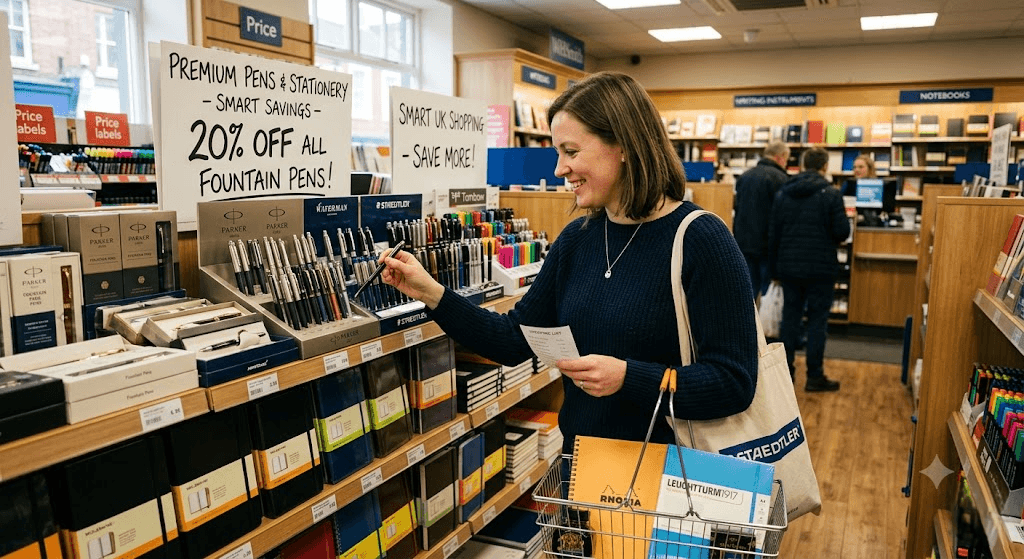
If your tastes lean towards premium academic diaries, leather-bound planners, or luxury boxed pen sets, January is your prime hunting ground. Retailers are desperate to clear out dated stock (such as 12-month diaries that began on January 1st) alongside surplus holiday gift sets. High-end brands and department stores like John Lewis, Selfridges, and specialist stationers routinely slash prices on luxury goods by up to 70%. A dated diary bought on January 10th functions identically to one bought on December 20th, but retains only a fraction of the price tag.
End of Financial Year (March to April)
For those buying on behalf of a small business, or simply looking for heavy-duty office infrastructure (archival storage boxes, shredders, reams of printer paper, and thermal label printers), the close of the UK financial year is critical. B2B and commercial suppliers like Viking Direct and Euroffice run aggressive tax-year-end clearance events to encourage businesses to use up their remaining annual capital allowances.
National Stationery Week (Typically May)
A uniquely British celebration, National Stationery Week sees independent stationers, major high street chains, and bespoke online creators join forces to celebrate written media. Across this week, brands heavily promote their products using exclusive discount codes, limited-time bundle deals, and social media giveaways. Subscribing to your favourite brands’ newsletters just before May ensures you receive these ephemeral discount codes directly to your inbox.
2. High Street Heroes and Stealthy Supermarket Sweeps
While online shopping offers vast variety, the UK high street still harbours incredible stealth discounts if you step away from traditional bespoke stationers and look toward alternative retail environments.
The TK Maxx and Homesense “Red Sticker” Aisle
TK Maxx and its sister store, Homesense, are arguably the UK’s greatest hidden secrets for luxury stationery. Their business model relies on acquiring surplus stock, overruns, and past-season items directly from premium manufacturers. If you browse their often-disorganised stationery shelves, you can routinely unearth elite brands such as Moleskine, Leuchtturm1917, Rhodia, and Kate Spade New York at 50% to 60% below RRP. Furthermore, if you learn to spot their clearance “red stickers” (which see massive markdowns in January and August), you can pick up professional-grade art markers, Italian leather journals, and boxed thank-you cards for mere pennies.
The Supermarket Absorption: Tesco and Paperchase
Following the administration of beloved high-street staple Paperchase, Tesco officially acquired the brand’s intellectual property. Today, you can find dedicated Paperchase concessions inside larger Tesco Extra stores across Great Britain. Because these ranges are now tied to Tesco’s broader retail ecosystem, they are subject to “Clubcard Prices”. Savvy shoppers who scan their Tesco Clubcard can frequently access exclusive reductions, saving up to a third off vibrant, design-led notebooks, innovative pencil cases, and seasonal wrapping paper.
The Works: Unbeatable Base Pricing
If your priority is functional volume or crafting materials rather than high-end brand prestige, The Works offers some of the lowest baseline prices in the country. Their permanent “Multibuy” mechanics (frequently 3 items for £5 across paperbacks, canvas boards, and notebook packs) make them an essential stop. To maximise discounts here, always sign up for their “Together Rewards” loyalty card, which earns points on every transaction and occasionally dispatches bespoke 20%-off vouchers to existing members.
3. Mastering Specialist Online Retailers and Niche Importers
For those seeking Japanese stationery (renowned for its superior paper engineering and flawless ink flow), calligraphy supplies, or specific fountain pen nibs, standard high-street shops rarely suffice. Sourcing these online requires a different set of discounting tactics.
Cult Pens: The Enthusiast’s Hub
Now a subsidiary of WHSmith, Cult Pens remains the UK’s definitive online destination for serious writing instruments. While their standard prices are competitive, their promotional stacking is where true value lies. Cult Pens frequently runs brand-specific discount weekends (for example, 10% off all Lamy or Kaweco products). To secure the absolute lowest price:
- Always check their dedicated “Clearance” tab before checking out; they regularly dump discontinued barrel colours or older packaging iterations at cost price.
- Wait for “Fountain Pen Day” (celebrated globally on the first Friday of November), during which they release blanket discount codes across their entire inventory.
- Utilise their free delivery thresholds. Adding a low-cost item (like a single gel pen refill) to tip your basket over the free shipping limit is often cheaper than paying the standard postage fee.
The Art of the “Imperfect” or “Wabi-Sabi” Sale
Several boutique British stationery retailers, such as The Journal Shop and London Graphic Centre, host periodic “Imperfect” or “Seconds” sales. Because stationery enthusiasts are notoriously meticulous, retailers cannot sell products with minor aesthetic defects—such as a slightly dented notebook corner, a scratched pen clip, or a squashed presentation box—at full price. These items are functionally pristine but are offloaded in dedicated online clearance drops at 40% to 50% off. Following these retailers on Instagram is the most reliable way to catch these drops, as they typically sell out within hours.
Automating Amazon UK Price Drops
Amazon stocks an immense array of global stationery brands, but their pricing algorithms fluctuate wildly on a daily basis. A pack of Tombow Dual Brush Pens or a Parker Sonnet fountain pen might vary in price by as much as £20 over a 30-day period. Never buy premium stationery on Amazon at impulse value. Instead, use free tracking tools like CamelCamelCamel or Keepa. By inputting the specific URL of the stationery item you desire and setting a target price threshold, you will receive an immediate automated email alert the moment Amazon’s algorithm drops the price to match your budget.
4. Discount Stacking: Vouchers, Cashback, and Concessions
To elevate yourself from a casual bargain hunter to a master of stationery procurement, you must learn the art of “stacking”—combining multiple disparate discount mechanisms on a single transaction.
Cashback Portals (Quidco and TopCashback)
Before navigating to any commercial stationer (such as Viking, Staples, Ryman, or WHSmith), you should make it a strict habit to click through a UK cashback portal first. Retailers pay these portals a commission for driving traffic to their sites, which is then passed back to your bank account as a cash refund. During promotional periods, cashback rates for office suppliers can spike to 10% or even 15% for new customers. When combined with an internal on-site clearance sale, your net expenditure drops drastically.
Professional and Academic Concessions
Stationery retailers are unusually generous when it comes to occupational discounts, recognizing that students, teachers, and key workers are their highest-lifetime-value demographics.
- Students and Academics: Platforms like UNiDAYS and Student Beans offer permanent 10% to 15% discount codes for Cult Pens, Paperchase (online), Ryman, and Muji. Always register with your `.ac.uk` email address.
- Blue Light Card Holders: If you work within the NHS, Emergency Services, Social Care, or Armed Forces, your Blue Light Card is a potent weapon. High street stationers like Ryman offer a substantial 10% to 15% reduction at the till upon presentation of the physical card, which can often be applied on top of existing in-store promotions.
5. The Long-Term View: Embracing Refills and Group Buys
Securing a discount is not merely about paying less at the point of initial checkout; it is about reducing the total cost of ownership over your writing lifetime. Single-use plastics and disposable notebooks represent a terrible return on investment.
The Economics of Refillable Systems
Investing in a high-quality, refillable writing instrument—such as a durable Lamy Safari fountain pen, a retro-styled Kaweco Sport, or an all-metal Rotring mechanical pencil—requires a higher initial outlay. However, the recurring cost of bottled ink or proprietary refill cartridges is exponentially lower than continuously buying disposable rollerballs. A standard £10 bottle of fountain pen ink contains enough fluid to refill a pen hundreds of times, bringing your cost-per-page down to a microscopic fraction of a penny.
The same logic applies to paper. Adopting a discbound system (like Atoma or William Hannah) or a standard six-ring binder (such as Filofax) allows you to purchase unbranded, bulk reams of premium loose-leaf paper to refill your existing leather cover, entirely bypassing the markups associated with bound luxury notebooks.
Syndicated Wholesale Purchasing
Finally, if you have a specific, unwavering brand loyalty—for instance, if you refuse to write on anything other than 80gsm Rhodia dot grids or Blackwing natural pencils—consider forming a purchasing syndicate with colleagues, fellow students, or members of online UK stationery forums. Many commercial B2B distributors will happily open accounts for sole traders or private syndicates provided a minimum order value (usually between £100 and £200) is met. By pooling your capital and buying direct from the distributor in case quantities, you entirely eliminate the standard retail markup, securing wholesale pricing for your personal desk.