 savingsspot.co.uk
 When most travellers picture a budget hotel in the United Kingdom, their minds conjure up a rather bleak, nostalgic image: a tired mattress, a kettle with a suspiciously short lead, and a view of a multi-storey car park in a damp provincial town. For years, Britain carried a reputation as an expensive destination where cheap meant dismal, and luxury required a second mortgage.
The modern reality is entirely different. Over the last decade, the UK’s budget accommodation sector has undergone a quiet revolution. Driven by fierce domestic competition and a boom in “staycations”, the gap between a three-star independent hotel and a modern budget chain has shrunk to almost nothing. Today, booking cheap hotels in the UK doesn’t mean sacrificing a good night’s sleep—it simply requires mastering the unwritten rules of the British booking ecosystem.
1. Master the “Big Two” (Because the Aggregators Won’t Show Them)
If you start your search for UK hotels exclusively on third-party booking giants like Booking.com, Expedia, or Agoda, you are instantly locking yourself out of roughly 50% of the country’s best budget inventory. Why? Because the United Kingdom’s two largest budget hotel chains operate a strict “direct-only” distribution model.
The Premier Inn Strategy
Premier Inn is the behemoth of British comfort. Their model is built on standardisation: a custom-made Hypnos mattress, blackout curtains, and a firm “Good Night Guarantee” (if you don’t sleep well due to something in their control, they refund the room). Because they do not pay commissions to online travel agencies, you will only find their rates on their official website or app.
To get the best out of Premier Inn, you need to understand their pricing algorithm, which operates similarly to budget airlines like easyJet:
- The Flex vs. Standard vs. Non-Flex Tier: Always check the price gap between these three. “Non-Flex” rates are non-refundable and must be booked at least 14 days in advance, but they routinely sit 25% to 35% cheaper than the standard rate.
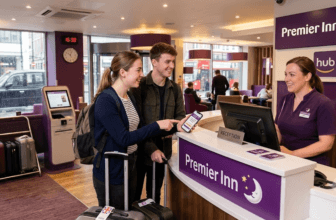
- Look for “Hub by Premier Inn”: If you are travelling to London or Edinburgh, filter specifically for their sub-brand, Hub. These are ultra-compact, digitally controlled, Japanese-inspired pod rooms. The square footage is small, but the real estate is prime (Covent Garden, Westminster, Soho) and the prices are frequently under £80 a night in the capital.
- The Sunday Drop: Premier Inn algorithms heavily penalise Friday and Saturday nights, but treat Sunday nights like a fire sale. If you can shift a weekend trip to a Saturday-to-Monday schedule, your total basket price will often drop by a third.
The Travelodge Playbook
Travelodge is Premier Inn’s grittier, historically cheaper rival. While their base rooms are more utilitarian, their recent “budget-luxe” refits have made them a genuinely comfortable place to crash.
The secret to Travelodge is the Saver Rate release window. Travelodge drops its £35 to £49 rooms in massive, unannounced batches—usually 10 to 11 months in advance of the travel date, or early on Friday mornings when their revenue managers adjust weekend projections. Furthermore, if you are travelling as a family or a group of three, Travelodge is the undisputed king of cheap UK hotels; their standard family rooms include a double bed and two pull-out single beds at zero extra cost per person.
2. Unlock Britain’s Hidden Budget Network
Once you look past the purple and blue neon signs of the high-street chains, the UK possesses three unique tiers of accommodation that foreign visitors and even seasoned Brits routinely overlook.
University Halls of Residence
This is arguably the single greatest travel hack in the United Kingdom. British universities possess some of the most historic, centrally located real estate in the country. During the academic holidays—specifically the month of April, and from early July to late September—the students vacate, and these campuses turn into makeshift public hotels.
Via dedicated portals like UniversityRooms.com, you can book a modern, en-suite single or double room in the heart of Edinburgh during the notoriously expensive August Fringe Festival for as little as £55 a night. In Oxford or Cambridge, you can sleep in a 16th-century college bedroom and eat breakfast in a vaulted, timber-roofed dining hall that looks like the set of Harry Potter, all for the price of a standard motorway motel.
The YHA Private Room Revolution
For many, the word “hostel” evokes traumatic memories of 16-bed dorms, snoring backpackers, and communal showers. You need to immediately discard this bias when dealing with the YHA (Youth Hostel Association) in the UK.
The modern YHA operates as a network of hyper-affordable boutique lodges. More importantly, over 70% of their properties now offer **dedicated private rooms**, many with en-suite bathrooms. The real value of the YHA lies in their geography. While a traditional hotel in the Lake District, the Peak District, or the Cornish coast will cost upwards of £180 a night during the summer, a private double room at a YHA property (which are frequently housed inside converted Victorian mansions, Norman castles, or clifftop coastguard stations) will hover around £50 to £70.
The Classic “Pub with Rooms”
If you are travelling through rural England, Wales, or Scotland, skip the standard hotels entirely and look for traditional coaching inns. Historically, pubs were the original bed and breakfasts.
To find the cheap ones, avoid searching “Boutique Pub stays” (which will feed you £250-a-night gastro-inns). Instead, use Google Maps, zoom in on your target village, type the word “Inn”, and look for the properties that do not have a shiny, unified booking widget. Call the landlady or landlord directly. Traditional wet-led pubs that happen to have four rooms upstairs often charge a flat rate of £65 to £80 for a double room, a price that almost universally includes a massive, cooked-to-order Full English breakfast.
3. The Art of UK Location Hacking
In the UK, distance is measured in minutes, not miles. Because the British rail and underground network is so dense, paying a premium to sleep inside “Zone 1” of a city is a rookie financial mistake.
The London Commuter Belt Trick
If you are looking for cheap hotels in London, your best friend is the Elizabeth Line or the Thameslink. Rather than paying £190 for a windowless basement room in Paddington or King’s Cross, look at hotels in Ealing Broadway (West), Abbey Wood (East), or East Croydon (South).
A modern three-star hotel in East Croydon costs roughly £70 a night. The Thameslink train from East Croydon station gets you into London Bridge in 13 minutes or London Blackfriars in 17 minutes. When you calculate the daily off-peak Oyster/Contactless fare cap (roughly £10 to £15 depending on the zones), you are saving over £100 per day simply by sleeping 15 minutes down the track.
Motorway Junction Hotels
If you are doing a British road trip, never book a hotel in the centre of a historic city like Bath, York, or Chester. You will pay an exorbitant base rate, and then be stung by an extra £20 to £35 per 24 hours just to park your car in a secure facility.
Instead, look for hotels situated at the immediate motorway junctions 3 to 5 miles outside the city centre (often branded as Days Inn, Ramada, or roadside Travelodges). These sites offer free, infinite parking. You simply wake up, leave your car at the hotel, and take a £2.50 local park-and-ride bus directly into the historic centre.
4. Timing the British Booking Algorithm
Hotel pricing in the UK is governed by ruthless, automated supply-and-demand software. To beat the machine, you have to behave in a way the machine doesn’t anticipate.
- The 21-Day Price Pivot: Statistically, the worst time to book a UK hotel is 3 to 4 months in advance; this is when hoteliers test the waters with high “optimistic” rates. If a hotel hasn’t reached 65% capacity by day 21 prior to the date of check-in, the automated software initiates a price drop to capture late demand. Track your target hotel on a free-cancellation rate, and check the price again exactly three weeks before you travel.
- The “Mobile-Only” Premium: Hoteliers know that desktop users are usually meticulous planners, while mobile users are frequently booking on the fly or in a rush. Consequently, platforms like Booking.com offer a hidden “Mobile Rate”—a 10% discount applied automatically to specific properties, but *only* visible if you are browsing via their smartphone app rather than a desktop browser.
- The Telephone Counter-Offer: If you find an independent UK B&B or small hotel listed on an online aggregator for £120, find their official website and call their front desk. Say this exact phrase: “I’m looking at your standard double for the 12th of October. It’s sitting at £120 online. If I give you my card details over the phone right now to book direct, can you do it for £105?” Because the hotel loses 15% to 18% of that £120 to the platform’s commission anyway, taking your £105 direct leaves them with more money in their till. Over 70% of independent hoteliers will accept this instantly.
5. The UK-Specific Discount Stack
Before you hit “confirm” on any British hotel checkout page, ensure you haven’t left money on the table via the UK’s idiosyncratic discount networks:
Tesco Clubcard Boosts: If you live in the UK, do not spend your Tesco grocery points at face value at the supermarket checkout. Through the Tesco Clubcard partner portal, you can turn £10 worth of supermarket points into £20 or £30 worth of vouchers for Hotels.com or the Best Western hotel group.
The Blue Light & Defence Card: If you work in the NHS, the emergency services, the social care sector, or the armed forces, you are entitled to a Blue Light Card. Almost every major domestic hotel operator in the UK offers a permanent, subterranean discount code for cardholders. Premier Inn occasionally offers 5% to 10% seasonal cashbacks, while independent regional chains often knock 15% off the bill upon presentation of the card at check-in.
Railcard Tie-ins: If you bought a digital UK Railcard (such as the Two Together, 16-25, or Senior Railcard) to save money on your train tickets, check the “Offers” tab inside the official Railcard app. They maintain rolling, year-round partnerships that grant 10% to 12% off standard public rates at several thousand UK properties.
Summary: Your 30-Second Budget Booking Checklist
The next time you need to source a cheap hotel in the UK, run your itinerary through this quick filter before parting with your cash:
- Did I check the Premier Inn and Travelodge native websites directly?
- Is it a university holiday, and have I checked UniversityRooms.com?
- If I’m heading to a rural national park, have I looked at the private room inventory on YHA.org.uk?
- Am I paying a “city centre penalty” that could be solved by a 15-minute train ride from a Zone 4 station?
- Have I looked at the rate on my phone to check for an automated “Mobile Rate” drop?
By stepping off the well-trodden path of the standard search engines and leaning into the quirks of British infrastructure, you will find that the UK offers some of the most comfortable, well-regulated, and genuinely affordable lodgings in Western Europe.