
The Smart Shopper’s Guide to UK Gift Cards: Maximising Value and Avoiding the Pitfalls
 savingsspot.co.uk
 We have all stood there: staring blankly at a spinning wire rack in the middle of a supermarket aisle, desperately trying to guess whether a notoriously difficult-to-buy-for relative would prefer a jumper from Marks & Spencer or a set of spanners from Halfords. In that moment of existential retail paralysis, the gift card emerges as the ultimate high street rescue package.
Once dismissed as the lazy option for the unimaginative gift-giver, the voucher has undergone a massive cultural and digital rebranding. Today, the UK gift card economy is a powerhouse worth an estimated £7 billion annually. From slick digital QR codes resting inside Apple Wallets to traditional textured cardboard wallets slipped inside birthday envelopes, we are a nation hooked on prepaid plastic and digital credit.
Yet, beneath the glossy packaging lies a complex consumer landscape. Millions of pounds of hard-earned British cash evaporate every single year due to rigid expiry dates, retail administrations, and clever small print. If you want to make sure your money actually reaches the checkout—whether you are giving or receiving—it pays to understand the mechanics of the modern gift card.
A Very British Invention: The History of the Voucher
While the modern magnetic-stripe gift card is largely viewed as an American import of the late 1990s, the conceptual birth of the gift voucher belongs thoroughly to Great Britain. In 1932, a publisher named Harold Raymond was scratching his head over a perennial problem: people wanted to buy books for their friends, but were terrified of buying something the recipient had already read.
His solution was the National Book Token. It was an instant, roaring success, fundamentally altering the psychology of British gifting. For the first time, society agreed on a polite middle ground between handing someone a cold, slightly vulgar £10 note, and taking a wild, risky guess on a hardback novel.
Today, that sentiment remains unchanged, but the delivery mechanism has evolved. The modern consumer views a targeted gift card not as an afterthought, but as an explicit license to treat oneself without the associated financial guilt.
The Expiry Date Lottery: Know Your Timelines
The single greatest threat to a gift card is the kitchen drawer. Vouchers get tucked inside recipe books, pinned to corkboards, or trapped at the bottom of handbags, only to be rediscovered two years later.
In several US states, consumer protection laws dictate that gift cards can never legally expire. In the UK, however, no such blanket protection exists. Retailers are entirely within their legal rights to set an expiration date, provided it was clearly stated at the point of purchase. Because there is no standard industry timeline, the high street is a chaotic patchwork of different rules:
- 24 Months: The most common “fair play” standard, adopted by giants like John Lewis, Marks & Spencer, and ASOS.
- 12 Months: A surprisingly tight window utilized by several major entertainment and lifestyle brands, including Ticketmaster.
- No Expiry: The gold standard of consumer fairness, championed by brands like Apple and the original pioneer, National Book Tokens.
- The “Last Activity” Trap: Some cards, such as standard Amazon vouchers, last for 10 years, but others reset their 12-month clock every time you check the balance or spend a single penny.
The Savvy Fix: The moment you receive a card, take a permanent marker and write the exact expiration date in large numbers across the front of the plastic. If it is a digital voucher, set a calendar alert on your smartphone for nine months down the road titled “Spend this or lose it.”
The £300 Million ‘Breakage’ Secret
When you let a £50 voucher expire, where does that money actually go? It doesn’t sit in a secure vault waiting for you to eventually claim it. In the retail industry, unredeemed gift card cash is known as “breakage.”
When a voucher passes its midnight deadline, the liability clears from the retailer’s digital ledger, and that unspent money transforms instantly into 100% pure profit. Estimates suggest that British consumers accidentally gift the high street anywhere between £250 million and £300 million in expired breakage every single year.
Retailers rely on this phenomenon. When calculating the profitability of launching a gift card scheme, financial directors factor in the reality that roughly 4% to 6% of the money handed over to them will never be redeemed for stock. When you let a voucher expire, you have essentially given a multi-billion-pound corporation a free, zero-interest personal loan that they never have to pay back.
High Street Heartbreak: When a Retailer Goes Bust
If you have lived through the retail landscape of the last fifteen years, you know the familiar, depressing cycle: a beloved high street institution suddenly announces it has called in the administrators. Overnight, the store windows are plastered with yellow “Closing Down” posters.
For gift card holders, an administration is a moment of acute panic. Under UK insolvency law, the moment a business enters formal administration, the company stops belonging to the directors and belongs to the creditors. As a gift card holder, you are classified as an “unsecured creditor.” This places you at the very back of the financial queue, behind the taxman, the banks, and the store’s staff.
The appointed administrators have total discretionary power over your voucher. They will usually adopt one of three stances:
- Total Freeze: They instantly declare all gift cards null and void. Your plastic is now just a scraper for your car windscreen in the winter.
- The 50% Rule: They allow you to use the voucher, but only if you match its value with new, fresh cash. For example, to redeem a £20 voucher, your total basket must come to £40.
- Business as Usual: On rare occasions, usually to preserve the brand’s goodwill for a potential buyout, they will honour the cards fully for a strict, limited window.
The Savvy Fix: Never use gift cards as a long-term savings account. If you read in the financial press that a brand is seeking “restructuring advice” or struggling with its quarterly debts, spend your vouchers with them that very afternoon.
The Multi-Retailer Mirage: One4all and Love2shop
To combat the fear of a single shop going bust, millions of shoppers have pivoted toward multi-retailer cards like One4all or Love2shop. Available at every Post Office and supermarket counter in the land, these look like the ultimate safety net: a single card that can be spent across hundreds of different brands, from Argos to Pizza Express.
However, multi-vouchers come with their own distinct set of operational hurdles that catch out thousands of consumers every week:
The Hidden Maintenance Fee
Check the tiny print on the back of a One4all card. If you do not spend the balance within 18 months of its purchase date, the provider begins deducting a monthly “card maintenance fee” (currently around 90p per month) directly from your balance. If you leave a £15 card in a drawer for three years, you will open it to find it completely empty, despite the card technically still being “valid.”
The Online Spending Cap
Because these multi-cards operate on the Visa or Mastercard network, many online retailers struggle to process them as a traditional split payment. Furthermore, due to strict UK anti-money laundering regulations passed in recent years, many multi-brand gift cards have a strict £50 per transaction limit when spent online. If you were hoping to put a £100 One4all card toward a £400 television on a website, you will likely find the checkout system entirely rejects the attempt.
Anatomy of a High Street Scam: Protecting Your Credit
As gift cards have become a standard alternative currency, they have inevitably attracted the attention of highly organized criminal networks. Because gift card transactions are near-instantaneous and virtually impossible to reverse, they are a fraudster’s absolute favourite tool.
The Supermarket “Rack Draining” Trick
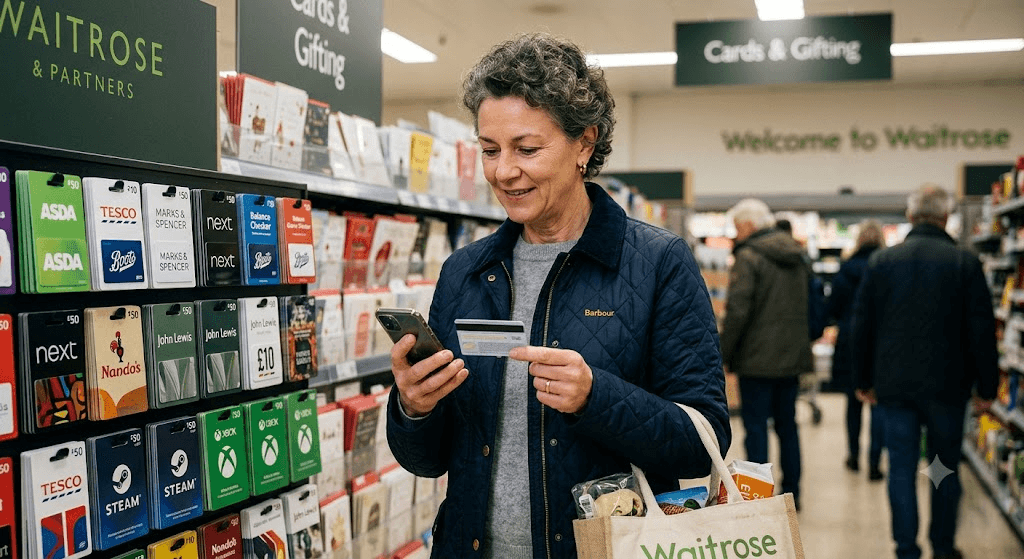
This is a sophisticated physical scam occurring in UK supermarkets right now. A scammer walks into a shop, takes a handful of unactivated gift cards off the peg, and sits in their car. Using a razor blade, they carefully peel back the security strip to reveal the card’s redemption PIN, record the 16-digit card number, and stick a replacement silver scratch-off sticker (bought for pennies online) back over the PIN.
They then walk back into the shop and hang the compromised cards back on the rack. An innocent shopper buys the card and loads £50 onto it at the till. Software run by the scammer constantly pings the balance check website; the second that £50 registers as active, the scammer uses the PIN they recorded days ago to spend the money online. When the legitimate recipient scratches the foil on their birthday, the balance is £0.00.
How to beat it: Never pick the front card off a retail hook. Reach to the very back of the peg. Inspect the cardboard packaging meticulously; if the edges look dog-eared, glued, or slightly torn, hand it to a member of staff and pick another.
The “HMRC / Police” Telephone Trap
If you ever receive a phone call, text, or automated voicemail claiming to be from HM Revenue & Customs, the Crown Prosecution Service, or your local police constabulary stating there is an “outstanding warrant for your arrest regarding unpaid tax,” hang up immediately.
The tell-tale signature of this classic scam is the settlement method: the caller will tell you that you can avoid immediate arrest by walking to a local shop, buying £500 worth of Google Play, Steam, or Apple gift cards, and reading the codes over the phone to the “officer.” No legitimate British institution, government body, or utility company will ever accept gift cards as a method of settling a legal or financial debt.
Stuck With a Dud? How to Turn Plastic Into Cash
What happens when your well-meaning auntie buys you a £75 voucher for a high-end steakhouse, entirely forgetting that you turned vegan three years ago? Historically, you were forced to force a grim smile and let the card gather dust.
Today, the UK has a thriving, legitimate secondary market for unwanted gift credit. Platforms such as Cardyard allow consumers to sell their unwanted digital and physical vouchers safely to other shoppers.
The math works out well for all parties:
- You list your unwanted £100 voucher on the platform.
- The platform offers it to a savvy bargain hunter for £92.
- The buyer gets an instant 8% discount on their weekend shopping.
- The platform takes a small commission, and releases roughly £85 directly into your UK bank account.
While you take a small haircut on the face value, £85 of versatile, spend-anywhere cash in your current account is objectively more valuable than £100 locked inside a shop you will never set foot in.
The Green Shift: The Death of PVC
Finally, the gift card is undergoing an urgent ecological transition. Historically, the billions of cards manufactured globally every year were punched out of heavy, non-recyclable PVC plastic—the exact same material used for bank credit cards.
Because these cards contain complex chemical dyes, magnetic strips, and metallic foils, they cannot be dropped into standard UK household recycling bins. For decades, expired gift vouchers have represented a silent, permanent mountain of toxic landfill.
Thankfully, the UK high street is aggressively phasing this out. Brands like Morrisons, Boots, and Primark have shifted their entire physical voucher stock over to FSC-certified, heavy-duty compressed paperboards. These cards offer the exact same satisfying “snap” and weight in the hand as plastic, but will biodegrade naturally if discarded.
Five Golden Rules for the Savvy Voucher Holder
To navigate the modern UK gift card ecosystem without losing a single penny, keep this simple checklist in mind the next time you are handed a voucher:
- Digital is King: Where possible, opt for an “e-Gift.” They cannot be lost down the back of the sofa, they generate zero plastic waste, and they sit inside your phone’s digital wallet where you will actually see them when standing at a physical checkout.
- Treat Vouchers Like Fresh Milk: Adopt the mental attitude that a gift card goes sour after 90 days. Do not wait for a “special occasion” to spend it; the special occasion was the day you received it.
- Photograph the Back: The moment you open a gift card, take a clear photograph of the long card number and the PIN on your smartphone. If your wallet is lost or stolen, many major UK customer service departments will reissue the balance to you if you can provide those two vital sequences.
- Consolidate Immediately: If you receive an Amazon, Apple, or Uber gift voucher, do not leave it in the email inbox. Click “Redeem” instantly. The balance will automatically attach to your master account profile, entirely removing the risk of you losing the original email or link.
- Check for the “Snap”: If buying a physical card in a shop, give the cardboard housing a gentle tug. If the perforated security seal is already broken, put it down and alert the checkout staff.