 savingsspot.co.uk
 With the cost of living keeping everyone on their toes, the weekly shop has transformed from a mundane household chore into an exercise in tactical warfare. Whether you are navigating the brightly lit aisles of your local Tesco Extra, popping into Aldi on a Tuesday evening, or hunting for digital discount codes on your smartphone, every pound kept inside your wallet is a silent victory.
However, saving money on shopping does not have to mean living on a miserable diet of unflavoured porridge and lukewarm tap water. True savvy shopping is about outsmarting the retail algorithms, sidestepping psychological traps, and utilising lesser-known consumer loopholes. Here is your definitive, step-by-step blueprint for cutting your British shopping bills down to size.
1. Understand Supermarket Seduction Psychology
Before you even pick up a shopping basket, you need to accept a fundamental truth: modern supermarkets are designed by behavioural psychologists. Every square inch of the shop floor exists to make you spend more money than you originally intended.
- Eye level is buy level: Supermarkets stock their highest-margin, most expensive branded goods right at your natural eye line. Look up to the very top shelf, or crouch down to the bottom shelf; this is where the cheaper, own-brand equivalents live.
- The sensory trap: Notice how the in-store bakery is almost always located at the furthest back corner of the store? The smell of fresh bread triggers your salivary glands, making you feel hungry and significantly increasing the likelihood of impulse purchases as you walk past forty other aisles to get to the loaves.
- The counter-clockwise drift: Retail studies show that shoppers who travel around a store in a counter-clockwise direction spend roughly two to three pounds more per trip than those moving clockwise. Retailers know this, which is why the vast majority of UK supermarket entrance gates force you to the left. Fight the current if your store layout allows it.
2. Master the Art of ‘Downshifting’
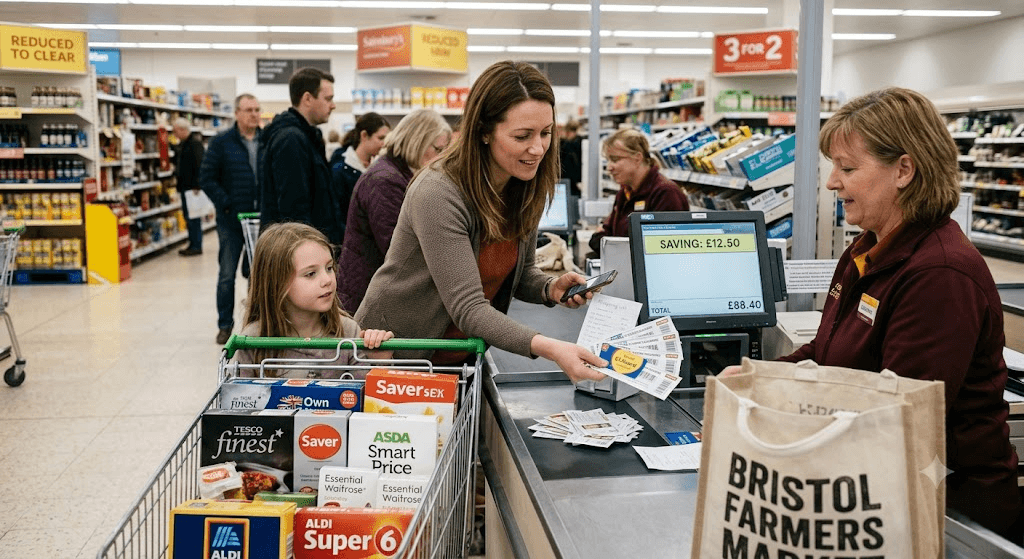
The “Brand Match Downshift” is arguably the single most effective weapon for slashing a grocery bill instantly. Almost every item in a UK supermarket falls into one of four distinct quality tiers:
- Premium (e.g., Tesco Finest, Sainsbury’s Taste the Difference)
- Branded (e.g., Heinz, Kellogg’s, McVitie’s)
- Supermarket Own Brand (The standard mid-tier private label)
- Value / Budget (e.g., Stockwell & Co, Just Essentials, Stamford Street)
The rule of downshifting is strictly methodical: drop every single item in your regular trolley down by one tier. If you usually buy branded baked beans, drop to the supermarket’s standard own-brand. If you already buy the standard own-brand, try the budget value range. Commit to this for four weeks.
In blind family taste tests, consumers typically cannot tell the difference in 70% of household goods—particularly with chopped tomatoes, dried pasta, plain flour, caster sugar, and household bleach. If your family genuinely despises a downgraded item, move it back up a tier the following week. On average, a total trolley downshift reduces a family’s weekly food bill by roughly 30%.
3. Unlock the ‘World Foods’ Aisle
This is one of the British high street’s most lucrative hidden secrets. When your shopping list calls for dried spices, coconut milk, soy sauce, rice, or tinned pulses, do not walk to the standard baking or condiments aisles. Walk straight to the World Foods aisle.
Because these products are sourced, imported, and packaged for demographic communities who use them as everyday bulk staples rather than “exotic recipe ingredients,” the retail markup is radically lower. You can frequently find a 100g bag of authentic Natco or KTC smoked paprika, ground turmeric, or chilli powder for half the price of a tiny 35g glass jar sitting in the mainstream herb aisle. The exact same logic applies to five-kilogram bags of Basmati rice and standard tins of chickpeas.
4. Crack the ‘Yellow Sticker’ Timetables
The “reduced to clear” section is the holy grail for the budget-conscious Brit, but successfully raiding it requires immaculate timing. Supermarkets operate on rigid, automated markdown schedules to clear out perishable goods reaching their legal ‘Use By’ dates:
- Morning (08:00 – 10:00): The first sweep of the day. Usually offers a modest 10% to 15% discount. Excellent for picking up slightly bruised fruit for morning smoothies.
- Early Afternoon (13:00 – 15:00): The post-lunch sweep. Discounts generally stretch to roughly 20% to 30% off.
- The Golden Hour (18:30 – 19:30): This is when floor managers need to clear the shelves before closing. Items are systematically slashed by 50% to 75% to prevent them from becoming financial write-offs in the store’s waste bins.
Treat your home freezer like an active savings account. Almost anything bearing a yellow sticker—from yellow-fin tuna steaks and double cream to blocks of cheddar and sourdough loaves—can be thrown straight into the freezer the moment you cross your threshold, immediately pausing its expiry clock.
5. Disregard the Price; Interrogate the Unit Price
Supermarket pricing teams are master illusionists. They will gladly place a vibrant, star-shaped “MEGA VALUE PACK” sticker on a 1kg tub of Greek yoghurt, tricking your tired brain into assuming it is the most economical choice available.
Train your eyes to ignore the large, bold numbers on the shelf tag and look directly at the microscopic print nestled in the corner: the Price per 100g (or price per litre / price per sheet for toilet roll). You will frequently discover that buying three smaller 300g tubs sitting on an unpromoted shelf works out significantly cheaper per gram than the giant “family economy” tub. Never trust the graphic design of the cardboard; trust the mathematics.
6. Decode the PL Codes on Medicine
If you catch a seasonal cold, picking up a packet of Nurofen or Panadol at the pharmacy counter will set you back anywhere from £2.50 to £4.50. Reaching for the unbranded supermarket “Ibuprofen” or “Paracetamol” sitting on the bottom shelf two feet away will cost you roughly 35 pence.
Under UK law, all manufactured medicines must be rigorously tested by the MHRA and granted a unique Product Licence (PL) number, which must be printed on the exterior packaging. If you pick up a 35p pack of basic supermarket paracetamol and compare it to a £3.50 branded box, check the PL numbers. If those two serial numbers match, the tablets inside were pressed in the exact same laboratory, using the exact same active chemical recipe. You are paying a £3.15 premium for a piece of glossy cardboard.
7. Practice Digital Cashback Stacking
Relying solely on your physical Tesco Clubcard, Asda Rewards app, or Sainsbury’s Nectar card is an outdated strategy; the modern shopper practices “cashback stacking.” This involves double or triple-dipping on a single digital transaction.
- Instant Gift Card Apps: Download verified mobile apps like JamDoughnut or Cheddar. When you are standing in the checkout queue at Morrisons with £100 worth of groceries, open the app and buy a £100 digital Morrisons gift card. The app instantly deposits 3% to 4% cashback into your digital wallet, and you simply scan the generated barcode at the till to settle your bill.
- Passive Card Linkers: Securely link your everyday Visa or Mastercard to Airtime Rewards. Whenever you spend money at participating high street giants (such as Boots, Greggs, Argos, or Halfords), the system tracks your transaction silently and deducts the earned cash directly off your monthly O2, EE, Vodafone, or Three mobile phone bill.
- Receipt Scanners: Apps like Shoppix, Storewards, and the Amazon Shopper Panel reward you simply for taking a clear photograph of your paper till receipts once you get home. It takes five seconds per shop and converts useless paper clutter into digital gift vouchers.
8. Execute the “Abandoned Basket” Online Hack
When shopping for non-perishable goods, high street clothing, or consumer electronics online, never complete the purchase on your first visit. Log into your account on the retailer’s website, add the desired items to your digital basket, proceed to the final checkout screen so the system logs your email address—and then explicitly close the web browser.
Leave the basket alone for 48 hours. E-commerce platforms possess sophisticated software designed to combat “cart abandonment.” In roughly 40% of instances, the retailer’s automated marketing suite will trigger an email to your inbox bearing a subject line such as: “Did you leave something behind? Take 15% off your basket to complete your order today.”
9. Outmanoeuvre Dynamic Online Pricing
Have you ever looked up the price of a train ticket to Edinburgh or a hotel room in the Lake District on a Monday, returned to book it on Wednesday, and noticed the price has surged by £35? You are being manipulated by dynamic pricing cookies.
Online retailers track your IP address and digital footprint. When their tracking software notices you repeatedly checking the exact same product or date range, it registers high buyer intent and artificially raises the displayed price to induce panic buying. When shopping for high-ticket items, flights, or UK getaways:
- Always clear your internet browser’s cache and cookies immediately before making the final booking.
- Check the prices on a completely separate network (for instance, browse on your home Wi-Fi, but check the final price using your smartphone’s 5G mobile data).
- When buying via Amazon, run the product URL through the free historical tracking website CamelCamelCamel. This reveals whether the “20% Off Limited Time Deal” is a genuine discount, or if the retailer simply jacked the baseline price up two weeks ago just to drop it back to normal today.
10. Reclaim the “Loose vs Packaged” Premium
For decades, British shoppers were conditioned to grab the pre-packaged plastic bag of six Gala apples or the plastic tray of three mixed courgettes under the assumption that bulk-bagged produce was cheaper. Today, the opposite is frequently true.
In a concerted bid to hit corporate plastic reduction targets, major supermarkets have inverted their pricing structures. If you take the time to place four loose baking potatoes, three loose red onions, or six loose carrots onto the scales, you will routinely find they cost 15% to 25% less than their plastic-wrapped siblings sitting directly above them. Furthermore, buying loose means you purchase the exact quantity your recipe requires, saving you from throwing rotten, forgotten vegetables into the food waste bin three weeks later.
11. Implement the “Eat the Fridge Bare” Audit
The ultimate shopping hack happens inside your own kitchen before you spend a single penny. Once every six weeks, declare a mandatory **”Zero-Spend Audit Week.”**
The average UK household throws away approximately £700 worth of completely edible food every year. During an Audit Week, you are strictly banned from crossing the threshold of a grocery store. You must force yourself to look into the dark recesses of your cupboards: the half-used jars of green pesto, the frozen bag of broad beans from last Christmas, the rogue tin of butter beans, and the strange varieties of grain sitting in Tupperware. Force yourself to get creative. Not only does this systematically clear out expiring stock, but it forces a completely zero-cost week into your monthly household cash flow.
Your Pre-Shop Golden Rules:
- Put your headphones in: Listening to fast-paced, upbeat music keeps you walking purposefully and stops you dawdling in the seasonal promotional aisles.
- Eat a high-protein snack: Research demonstrates that entering a supermarket on an empty stomach increases high-sugar and high-fat impulse purchases by up to 64%.
- Interrogate the sticker: Ask yourself: “Am I putting this in my trolley because my household genuinely needs it, or am I putting it in my trolley purely because the cardboard label happens to be bright yellow?”
By treating the modern retail landscape not as a passive marketplace, but as a complex environment designed to be carefully navigated, you reclaim control of your finances. Keep your eyes firmly fixed on the unit price, keep your smartphone primed to capture the cashback, and watch your monthly bank balance slowly begin to breathe again.