 savingsspot.co.uk
 The British relationship with coffee has undergone a quiet revolution over the last decade. We have migrated from the desperate morning stir of freeze-dried instant granules to becoming a nation of amateur kitchen baristas. However, as our palates have matured, so has the sheer cost of indulging them. With the average high-street flat white now hovering dangerously close to the £4.00 mark, investing in a home coffee machine is no longer just a luxury—for daily drinkers, it is a mathematically sound financial strategy.
The catch sits in the retail market itself. The domestic appliance sector is notorious for the “yo-yo” pricing model. A coffee machine will be listed at an eye-watering Recommended Retail Price (RRP) of £599 for three weeks, drop to £399 with a bright red “SAVE £200” banner for a Bank Holiday weekend, and then return to its inflated baseline. To the untrained eye, it looks like a bargain; to the savvy shopper, it is simply the true market value.
If you are looking to secure a genuine coffee machine deal in the UK, you need to look past the algorithmic marketing and understand the hardware, the seasonal rhythms of British retailers, and the hidden running costs. Here is your definitive guide to navigating the market.
1. The Four Machine Classes (And Their “True Deal” Thresholds)
Before hunting for discounts, you must identify your machine category. A £50 discount on the wrong machine is a worse investment than paying full price for the right one. Every class has its own pricing logic and its own baseline “good deal” price.
Bean-to-Cup Machines: The Long-Term Workhorses
These machines take whole roasted beans, grind them on demand, tamp them, extract the espresso, and dispense the spent grounds into a waste bin—all at the push of a single button. Brands dominating the UK space include De’Longhi, Melitta, Krups, and Siemens.
- The Retail Trap: Retailers frequently use legacy models to simulate massive discounts. A prime example is the De’Longhi Magnifica S (ECAM22.110.B). It is an indisputable masterpiece of budget home coffee, but it was launched over a decade ago. You will routinely see it listed with an “RRP of £399, down to £279”.
- The True Deal Price: The true standard market price for an entry-level De’Longhi bean-to-cup is roughly £270 to £285. A genuinely great deal on this class of machine is anything falling between £230 and £250. If you see a major-brand bean-to-cup cross below the £240 mark, pull the trigger.
Manual & Semi-Automatic Espresso Machines: The Hobbyist’s Choice
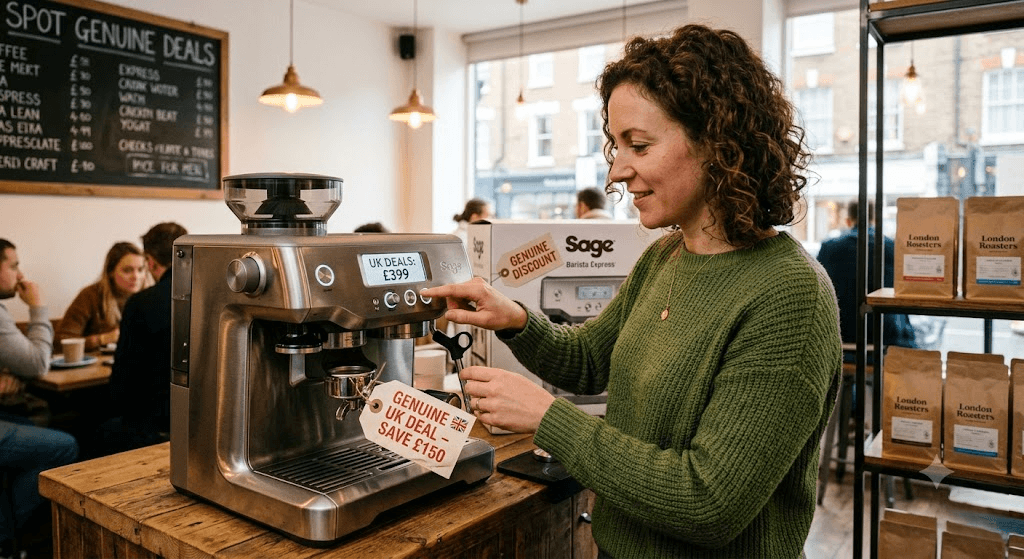
If you want the tactile satisfaction of dosing a portafilter, tamping the grounds, and manually steaming milk in a stainless steel jug, you are looking at the semi-automatic market. In the UK, this sector is ruled almost entirely by Sage (known as Breville outside Europe), alongside traditional Italian stalwarts like Gaggia and Rancilio.
- The Retail Trap: The “Sage Tax”. Because Sage machines hold immense cultural cachet, their baseline prices rarely drop by massive percentages. When third-party retailers offer “20% off”, they have usually inflated the base price the week prior.
- The True Deal Price: Take the benchmark unit: the Sage Barista Express. Its official retail ceiling is £629. A standard promotional price across Amazon, Currys, and Lakeland is £549. A true deal—one that happens perhaps three times a year—sees this machine drop to £419 to £449. For the entry-level Sage Bambino Plus, do not buy unless it is sitting at or below £299 (down from its £399 standard tag).
Pod & Capsule Machines: The “Razor and Blades” Illusion
Nespresso, Dolce Gusto, and Tassimo operate on the classic Gillette business model: sell the handle for pennies to lock the consumer into buying the proprietary blades for a lifetime.
- The Retail Trap: Treating a cheap pod machine as an outright saving. A £49 Nespresso Vertuo Pop feels like a steal until you realise that Vertuo capsules are patented, cannot be bought from third-party supermarket budget ranges, and cost between 45p and 85p per cup. Over two years of two-cups-a-day drinking, that “cheap” £49 machine will cost you over £700 in pods.
- The True Deal Price: Never buy a pod machine based solely on the hardware discount. A genuine deal in this sector is a Hardware + Credit Bundle. Look specifically for promotions directly from Nespresso or via John Lewis where the £60 machine comes paired with “100 free capsules” or a £30–£50 digital coffee credit applied to your brand account.
Filter & Batch Brewers: The Low-Fidelity Kings
For those working from home who require a constant, warm carafe of black coffee throughout the morning, drip filter machines remain unbeatable. Leading names range from budget-friendly Russell Hobbs and Morphy Richards to the gold-standard Dutch-engineered Moccamaster.
- The Retail Trap: Buying glass-carafe models on sale. Glass carafes sit on a heated hotplate to stay warm; after 25 minutes, the coffee begins to “cook”, turning bitter and sludgy.
- The True Deal Price: Only look for deals on thermal carafe models (where the jug is a double-walled vacuum flask that keeps the brew hot naturally). A fantastic deal in this space is securing a Melitta Look V Therm or a Bosch Styline for under £65.
2. Deconstructing the UK Retail Landscape
Where you buy your coffee machine in the UK dictates not just the price you pay today, but the headache you will face eighteen months from now when a pump fails or a thermal block scales up.
John Lewis & Partners: The Warranty Champion
When comparing identical price tags between Amazon and John Lewis, always buy from John Lewis. By default, John Lewis includes a 2-year electrical guarantee at no extra charge. Coffee machines mix high-pressure water, intense heat, and fine organic dust (coffee grounds)—they have a noticeably higher mechanical failure rate than a standard toaster. That second year of no-quibble retail protection is worth at least £40 in real terms.
Amazon UK: The Algorithm Tracker
Amazon offers the lowest historical troughs, but the highest volatility. Never buy a machine on Amazon without running the URL through an independent price tracker like CamelCamelCamel or the Keepa browser extension.
Furthermore, beware of the Grey Market Import trap. Because Amazon pools European inventory, third-party sellers frequently offload continental stock onto the UK platform. Check the seller details: if the machine arrives with a standard European 2-pin Schuko plug and a cheap, clunky plastic UK 3-pin adapter shoved into the cardboard box, it is a grey import. This can legally void your UK manufacturer warranty.
Currys: The “Trade-In” Hack
Currys suffers from standard high-street markups, but they hold one massive ace up their sleeve: the Green Recycling Trade-In. Several times a year, Currys runs promotions offering an instant £30 to £50 discount on small kitchen appliances when you bring in any old electrical item to be recycled. You can literally carry a broken £5 kettle from the back of your cupboard into a Currys branch and hand it over to knock £40 off a De’Longhi espresso machine.
The Manufacturer’s Direct Outlet
Do not assume the brands themselves are the most expensive place to shop. The official De’Longhi UK website and the Sage Appliances UK store routinely offer a “10% off your first order” code in exchange for subscribing to their email newsletter. If Sage happens to be running a site-wide 15% promotional sale, stacking that extra 10% welcome code on top will generate a final price that undercuts Amazon, Argos, and Currys simultaneously.
3. The Golden Calendar of UK Coffee Sales
Coffee machine pricing in the UK operates on a strict, predictable meteorological and cultural calendar. If you can time your purchase to sit within one of these four windows, your chances of securing an artificial discount drop to near zero.
- Late November (Black Friday / Cyber Monday): This is the Superbowl of coffee machine discounts. However, the best deals do not happen on Friday itself; they happen in the “Early Access” window roughly 8 to 10 days before Black Friday. This is when retailers test the waters with their lowest baseline prices before the general public floods the servers.
- December 26th – January 15th (The “New Year Routine” Push): Once Christmas concludes, retail marketing pivots instantly from “Gifting” to “Self-Improvement”. Retailers know consumers are heading back to work, staring at their bank statements, and resolving to stop spending £20 a week at Costa. This window offers the absolute steepest discounts on mid-range Bean-to-Cup machines.
- July & October (Amazon Prime Days): While Prime Day is littered with cheap white-label electronics, major coffee brands use it to clear excess warehouse stock. It is historically the absolute best day of the calendar year to buy the Sage Barista Pro or entry-level Nespresso Vertuo bundles.
- Late March / April (The Spring Range Transition): Home appliance manufacturers generally showcase their new iterations at European trade fairs in early Spring. Consequently, UK retailers use April to aggressively liquidate the “outgoing” models to make warehouse space for the slightly updated chassis arriving in May.
4. The Hidden Goldmine: Manufacturer Refurbished
There is a profound psychological barrier for British consumers when it comes to buying “used” kitchen equipment. Nobody wants to inherit someone else’s old, scaled-up milk steamer. However, the Official Manufacturer Refurbished market is the single most under-utilised money-saving hack in the UK coffee sphere.
When a UK customer buys a £600 coffee machine from John Lewis, tries it for four days, decides “it’s too much faff to clean”, and returns it under their 30-day statutory cooling-off rights, the retailer cannot sell it as new. It gets shipped back to the brand’s UK service hub.
There, a qualified technician descales the internal boilers, sanitises the group head, replaces the steam wand tip, repackages it in a fresh brown box, and issues it with a brand-new 12-month direct manufacturer guarantee. These are listed on the De’Longhi Official eBay Outlet or the eBay Certified Refurbished Hub at 30% to 45% off the high-street price.
When eBay runs its seasonal “20% off all Refurbished Stock” coupon codes (usually coded as something like REFURB20 or PROMO20), you can regularly acquire an immaculate, fully guaranteed Sage Barista Express for roughly £330—a full £300 under its standard high-street sticker.
5. The Hard Water Factor (The Hidden UK Tax)
If you live in Scotland, Wales, or the South West of England, you can largely ignore this section. If you live in London, the Home Counties, East Anglia, or the East Midlands, **hard water will decide whether your coffee machine deal was actually a deal.**
The chalky, mineral-dense tap water of the South East is the absolute nemesis of the narrow, hyper-heated aluminium and steel thermoblocks inside modern coffee machines. Limescale builds up exponentially at 93°C.
When calculating the cost of a “deal”, look at the machine’s water filtration requirements:
- Proprietary Filters: Sage machines require the ClaroSwiss water filter. These cost roughly £15 each and must be replaced every 90 days. That is an ongoing £60-a-year “tax” just to keep the machine’s warranty valid.
- The Workaround: Look for machine deals that offer standard, non-proprietary internal descaling cycles, or budget a separate £25 Brita Marella water filter jug into your kitchen setup. Feeding a coffee machine exclusively with pre-filtered water allows you to bypass expensive proprietary machine filters and extends the lifespan of a discounted machine from three years to ten.
6. Quick Reference: The UK Target Price Matrix
To cut through the noise, use this simple cheat-sheet. Keep this matrix on your phone when browsing the high street or checking online basket totals. If the price sits inside the “Target Deal” column, you are winning.
| Machine Model | Standard High-Street Price | Genuine “Target Deal” Price | Best Time / Place to Buy |
|---|---|---|---|
| De’Longhi Magnifica S | £299 – £349 | £239 – £255 | Amazon / Black Friday Week |
| Sage Barista Express | £549 – £599 | £419 – £449 | John Lewis / January Sales |
| Sage Bambino Plus | £399 | £279 – £299 | Lakeland / Spring Clear-out |
| Nespresso Vertuo Pop | £99 | £49 (Must include Pods) | Nespresso Direct / Prime Day |
| Melitta Caffeo Solo | £320 | £210 – £225 | Currys / Post-Christmas |
| Moccamaster KBG Select | £239 | £185 – £199 | Independent Coffee Roasters |
7. The 30-Second Deal-Checking Protocol
The next time you are targeted by an Instagram ad or walk past a glossy cardboard display in a department store offering a “unmissable flash discount” on a coffee maker, run through this mental checklist before reaching for your debit card:
- Open a browser and check Keepa/CamelCamelCamel: Did this machine sit at this exact “sale” price for four months last year? If yes, it is not a deal; it is the machine’s normal price.
- Check the plug and the warranty: Is the retailer an authorised UK dealer? If the machine goes pop in month eleven, do you have to post it at your own expense to a warehouse in Frankfurt, or will a UK courier collect it?
- Do the Pod Math: If it takes capsules, multiply your household’s daily consumption by 365, then multiply that number by £0.55. Add that figure to the cost of the machine. Do you still want it?
- Check for the “Sign-Up” loophole: Go to the manufacturer’s official UK landing page in an Incognito window. Wait for the “Take 10% off your first order” pop-up. Test if that code applies to their existing on-site sale items.
Armed with these principles, you cease being the target of domestic appliance marketing, and become an informed participant in the market. Secure the hardware at its true baseline, protect it from the local tap water, and put the hundreds of pounds saved toward buying freshly roasted, high-grade single-origin beans from your local independent UK roastery. That is the only way to genuinely upgrade your morning routine.