 savingsspot.co.uk
 Whether your personal target is to hit that elusive 10,000-step daily milestone, train for a wet Sunday morning Parkrun, or finally uncover why your sleep patterns feel so entirely unrefreshing, a dedicated fitness tracker is a transformative piece of kit. However, walking into a high-street shop on a whim or clicking ‘Buy Now’ on the very first sponsored search engine link you encounter is the fastest route to paying over the odds.
The wearable technology sector operates on highly predictable retail cycles, algorithmic price drops, and quiet manufacturer incentives. If you are currently browsing the digital aisles for genuine fitness tracker deals in the UK, understanding the underlying mechanics of how these devices are priced, packaged, and discounted can easily save you anywhere from £30 to well over £150. This breakdown will equip you with the insider savviness required to separate a genuine bargain from a clever marketing illusion.
1. The UK Retail Rhythm: When to Actually Open Your Wallet
To secure the lowest possible price on a Garmin, Fitbit, or Apple Watch, you have to sync your purchasing impulse with the UK’s retail calendar. Buying a wearable in mid-October or early February is, historically speaking, a tactical error. Retailers rely on the standard consumer acting on sudden motivation; your goal is to act on scheduled depreciation.
The January “New Year, New Me” Bloodbath
Counter-intuitively, the first three weeks of January represent one of the fiercest buyer’s markets for fitness tech. While you might assume retailers would raise prices to exploit the wave of New Year’s resolutions, the exact opposite happens. Brands like Fitbit and Huawei engage in massive market-share grabs. Because every major fitness retailer is fighting for the exact same newly motivated customer, discounting becomes aggressive. Look for ‘Bundle Deals’ during this window, where retailers throw in extra silicone straps or smart scales to tip the balance.
Amazon Prime Days (July and October)
While Amazon’s standard daily pricing can be a chaotic sea of fluctuating algorithms, their two annual Prime events are the undisputed dumping grounds for “Generation minus one” stock. When a brand like Garmin prepares to launch a new Forerunner model in the autumn, they use the July Prime Day to liquidate the preceding generation at 30% to 40% off RRP. If you do not require the absolute bleeding-edge sensor technology, these two 48-hour windows offer the highest pound-for-pound value of the year.
The “Successor Drop” Window
You do not need to wait for a public holiday to find a deal; you just need to set Google Alerts for tech press releases. The moment a brand announces the “Mark IV” version of a flagship tracker, the “Mark III” instantly becomes legacy stock. High-street stockists like Currys and Argos operate on strict warehousing metrics—they cannot afford to hold onto boxes of the older unit when the new one is arriving on pallets. The two weeks immediately following a new product announcement consistently yield the most honest, non-inflated price reductions.
2. Analysing the Big UK Stockists
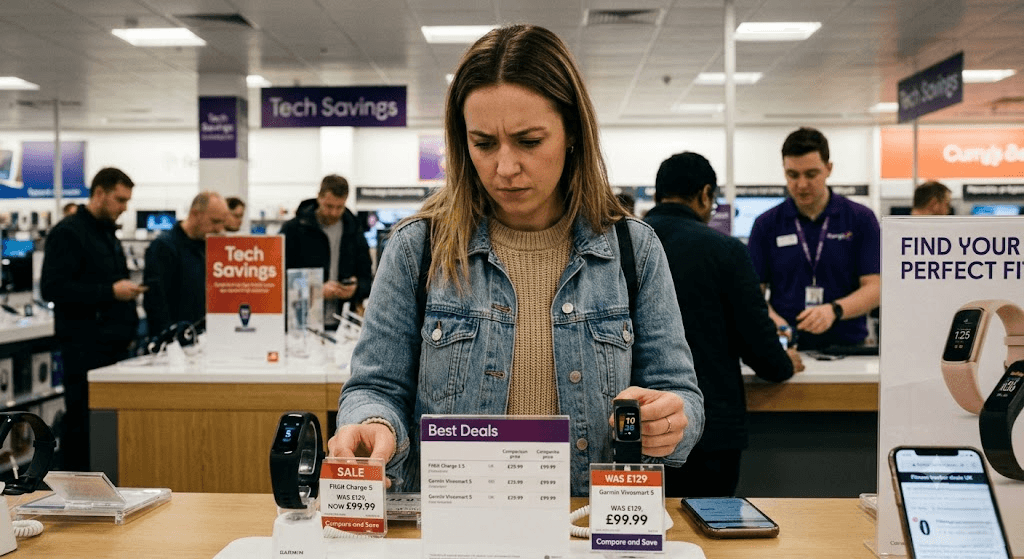
A yellow “Sale” sticker does not intrinsically guarantee a fair price. Different UK retailers possess completely different strengths, customer loyalty schemes, and pricing quirks. Knowing who offers what will dictate where you should finalise your checkout.
- Currys (The Trade-In Kings): Currys frequently runs ‘Price Match Promises’, but their hidden weapon is their recycling bonus. During major promotional drives, they will offer an arbitrary £20 to £40 guaranteed discount on a new smartwatch simply for handing over *any* old piece of electronic tech—even a completely broken 2012 MP3 player.
- Amazon UK (The Volatile Index): Never take Amazon’s “RRP” claim at face value. They frequently base the “Was £149.99” figure on the price the item launched at three years ago, making a £99 current price look like a monumental 33% discount when, in reality, it has sat at £99 for six months. Always run the product URL through a historical price tracker like *CamelCamelCamel* before purchasing.
- Argos (The Nectar Multiplier): Argos is rarely the absolute cheapest on raw cash price, but they are an exceptionally powerful option if you use a Sainsbury’s Nectar card. During ‘Nectar Double Up’ or points-boost weekends, spending accumulated grocery points on a high-value item like a Fitbit Versa can effectively net you the hardware for pennies.
- John Lewis & Partners (The Value of Peace of Mind): While they retired their famous “Never Knowingly Undersold” catchphrase in its historic format, John Lewis remains the premier destination for high-end trackers (such as the Apple Watch Ultra or Garmin Fēnix series) for one simple reason: their included two-year electrical guarantee. Squeezing an extra 12 months of warranty out of a device that sits on a sweaty wrist all day is intrinsically worth a £15 premium over a slightly cheaper, grey-market online seller.
3. Identifying a True Deal Across the Price Tiers
To avoid spending £150 on a glorified digital pedometer, or £400 on an elite triathlon computer when you only do gentle Pilates, you must understand the realistic “deal floor” for each tier of the market.
The Sub-£50 Bracket: The Budget Pioneers
The Target: Xiaomi Smart Band series, Huawei Band series, or the entry-level Fitbit Inspire.
What a genuine deal looks like: Paying between £25 and £32.
The Trap to avoid: The Amazon “Alphabet Soup” brands. If you see a tracker priced at £19.99 made by a brand named something like *XINZOU* or *BOPLUS*, walk away. These devices use uncalibrated white-label accelerometers, offer abysmal companion apps that siphon your data, and routinely fake their heart-rate readouts. Stick exclusively to the entry-level offerings of established telecommunication giants.
The £50 to £120 Bracket: The Everyday Workhorses
The Target: Fitbit Charge 6, Garmin vívosmart 5, Amazfit GTS/GTR series.
What a genuine deal looks like: A 25% to 35% drop from the manufacturer’s launch price.
The Reality Check: This is the most heavily contested price point in the UK. A great deal here isn’t just the price tag; it is the presence of an onboard GPS chip. Many trackers in this bracket rely on “Connected GPS” (meaning they have to piggyback off your smartphone’s location data via Bluetooth, forcing you to carry your heavy phone on runs). If you find a tracker in this price drop that features *Built-In* GPS, you have found a top-tier deal.
The £120 to £250 Bracket: The Serious Amateur
The Target: Garmin Forerunner 55 or 165, Polar Pacer Pro, Apple Watch SE (2nd Gen).
What a genuine deal looks like: Saving £40 to £60 off the standard retail ticket, or finding a bundle that includes a dedicated chest-strap heart rate monitor.
The Reality Check: At this point, you are paying for software refinement and data accuracy rather than just a colour screen. If an Apple Watch SE drops below £190, or a Garmin Forerunner 165 breaches the £200 barrier, stock levels will deplete within hours.
4. The “Hidden Paywall” Trap: Don’t Get Caught Out
This is the single most vital piece of consumer advice in the modern wearable market: a cheap piece of hardware is not a deal if the software holds your data to ransom.
When assessing a discounted price tag, you must calculate the “Total Cost of Ownership” (TCO) over a standard 24-month lifespan.
For example, imagine you spot a phenomenal deal on a **Fitbit Charge** discounted by £45. You feel like a master of commerce. However, Fitbit places its most genuinely useful, granular metrics—such as your Daily Readiness Score, your detailed Sleep Profiles, and your historical wellness trends—behind the *Fitbit Premium* paywall. This subscription currently costs the UK consumer £7.99 per month. Over two years of ownership, that “discounted” tracker will drain an additional £191.76 from your bank account just to show you the data its sensors are already collecting.
Conversely, look at a brand like **Garmin** or **Coros**. Their hardware is occasionally less heavily discounted on the surface, but they operate a strict zero-subscription ecosystem. The day you buy the watch is the last day you give them a penny; the Garmin Connect app is free forever. When calculating deals, always add £190 to the price of a Fitbit or an Oura Ring to see its *actual* comparative cost against a subscription-free rival.
5. Three Uniquely British Discount Loopholes
If the standard seasonal sales are letting you down, you can force your own discount using three specifically British consumer pathways:
1. The Vitality Health Loophole
If your workplace offers private healthcare through Vitality (or if you hold a personal policy with them), you have access to the best wearable discount scheme in the country. Vitality offers an “Active Rewards” system where you can buy an Apple Watch or a high-end Garmin for an upfront payment of around £10 to £30. The remaining balance of the watch is paid off via your weekly physical activity. If you hit your weekly step or heart-rate points targets, your monthly direct debit for the watch is literally £0.00. You are essentially getting a £300 watch for a tenner, provided you commit to walking the dog or hitting the gym.
2. The “Grade-A Refurbished” Backdoor
The British public has a habit of buying high-end tech, wearing it for four days, deciding “it looks a bit big on my wrist,” and returning it to the shop. Because of UK hygiene and distance-selling regulations, these cannot be sold as new.
Head to **eBay UK’s ‘Certified Refurbished’** portal or **Back Market**. Look strictly for items marked “Pristine” or “Grade A” sold directly by the manufacturer’s official outlet store (e.g., *Garmin Outlet* or *MusicMagpie*). These units have been professionally sterilised, fitted with a brand new battery, repackaged, and come with a legal 12-month warranty, but sit at a permanent 30% to 45% discount.
3. Airtime Rewards Stacking
Download the free UK app *Airtime Rewards* and link your Visa or Mastercard to it. The app gives you passive percentage cashback at major high-street retailers (frequently including Argos, Boots, and Currys) which is automatically used to pay down your O2, EE, Vodafone, or Three mobile phone bill. If you buy a £200 Garmin from Argos during a 5% Airtime window, you have just knocked £10 off your next phone bill instantly, purely for paying with your normal debit card.
6. The Quick-Scan Deal Buyer’s Checklist
Before you let a red “Limited Time Offer” banner rush you into typing your CVV number into a checkout page, take 60 seconds to answer these five questions:
- Is the strap proprietary? If the band breaks in 18 months, can you buy a £6 replacement on Amazon, or do you have to buy a custom £35 branded connector? Look for devices that state “Standard 20mm / 22mm Quick Release”.
- What is the battery chemistry? OLED screens look gorgeous, but they require charging every 24 to 36 hours. If you are buying the watch specifically to track your sleep, a watch that needs to sit on a charging cradle every morning while you get ready for work is fundamentally useless to you.
- Is the seller UK-based? If buying through a platform like OnBuy, Fruugo, or an Amazon third-party merchant, check the business dispatch address. If it ships from mainland China or Hong Kong, you risk being slapped with an un-budgeted 20% VAT import bill by Royal Mail before they hand the parcel over the threshold.
- Does it have NFC for UK banks? If you want to pay for your morning flat white using your wrist, check the small print. While *Apple Pay* and *Google Wallet* support 99% of UK high-street banks, proprietary systems like *Garmin Pay* or *Fitbit Pay* have notoriously patchy support for UK establishments (for instance, Garmin Pay still refuses to play nicely with several major UK high-street banking names, requiring users to set up third-party workarounds like Curve).
- Is the discount applied to the *current* model? Always Google the name of the watch followed by the word “release date”. If the top result says “October 2021”, that 40% discount isn’t a generous offer—it’s an end-of-life clearance sale.