 savingsspot.co.uk
 Great Britain is globally renowned for its rich architectural heritage. From charming Victorian terraces and sprawling Edwardian estates to mid-century semi-detached homes, our housing stock is bursting with character. However, this historical charm often conceals a hidden, highly dangerous flaw: outdated and severely strained electrical systems. Behind the elegant plasterwork and period features, many properties are relying on wiring designed for a bygone era, struggling to cope with the relentless energy demands of modern life.
An electrical upgrade is not merely a box-ticking exercise or a cosmetic enhancement; it is a fundamental necessity for safety, efficiency, and the future-proofing of your home. Today, we consume electricity at an unprecedented rate. We run high-voltage electric showers, fan-assisted ovens, multiple televisions, sophisticated computing equipment, and increasingly, we are charging electric vehicles (EVs) on our driveways. If your property’s electrical infrastructure has not been comprehensively reviewed in the last two decades, you are likely operating on borrowed time.
The Hidden Dangers of Ageing Wiring
To truly understand the importance of modernising your electrical system, it helps to look at the history of British home wiring. If your property was built before the 1960s and hasn’t been rewired, it might still contain vulcanised Indian rubber (VIR) or lead-sheathed cables. These materials degrade significantly over time. The rubber becomes brittle, crumbles away, and leaves live copper conductors completely exposed, posing a massive fire and electrocution risk.
Furthermore, homes wired before 1966 frequently lack an earth connection on the lighting circuits. In these older systems, if a metal light switch or a brass chandelier develops a fault, the casing itself becomes live. Without an earth wire to safely carry the fault current away and trip the fuse, the next person to touch that switch becomes the path to the ground, with potentially fatal consequences. Modern regulations absolutely mandate an earth connection for all lighting circuits, highlighting just one of the critical reasons why older systems must be upgraded.
Telltale Signs Your Property Requires an Upgrade
Electrical faults rarely happen completely out of the blue. The system usually provides several warning signs before a critical failure occurs. Recognising these symptoms early can save you from catastrophic damage and immense expense. Here are the primary indicators that your home is crying out for an electrical upgrade:
- The presence of an old-fashioned fuse box: If your meter cupboard houses a wooden-backed board with ceramic, rewireable cast-iron fuses, your system is practically a museum piece. These consumer units offer zero protection against fatal electric shocks and are fundamentally unsafe by modern standards.
- Frequent tripping and blown fuses: A circuit breaker tripping occasionally is doing its job. However, if you find yourself constantly resetting breakers or replacing fuses when you boil the kettle and run the toaster simultaneously, your circuits are dangerously overloaded.
- Flickering or dimming lights: While a single flickering bulb might just need replacing, lights that dim when a large appliance (like a washing machine or air source heat pump) switches on indicate a substantial voltage drop, suggesting the wiring cannot handle the current demand.
- Burning odours or scorch marks: This is a severe red flag. Brown or black discolouration around socket outlets, or a faint, fishy, burning plastic smell in a room, means that arcing or overheating is actively occurring behind the faceplate. This requires immediate emergency attention.
- A heavy reliance on extension leads: Older homes were typically built with only one or two single sockets per room. If your home is a sea of daisy-chained extension cables and multi-plug adaptors, you are placing severe thermal stress on a single wall socket, dramatically increasing the risk of an electrical fire.
The Heart of the System: Upgrading the Consumer Unit
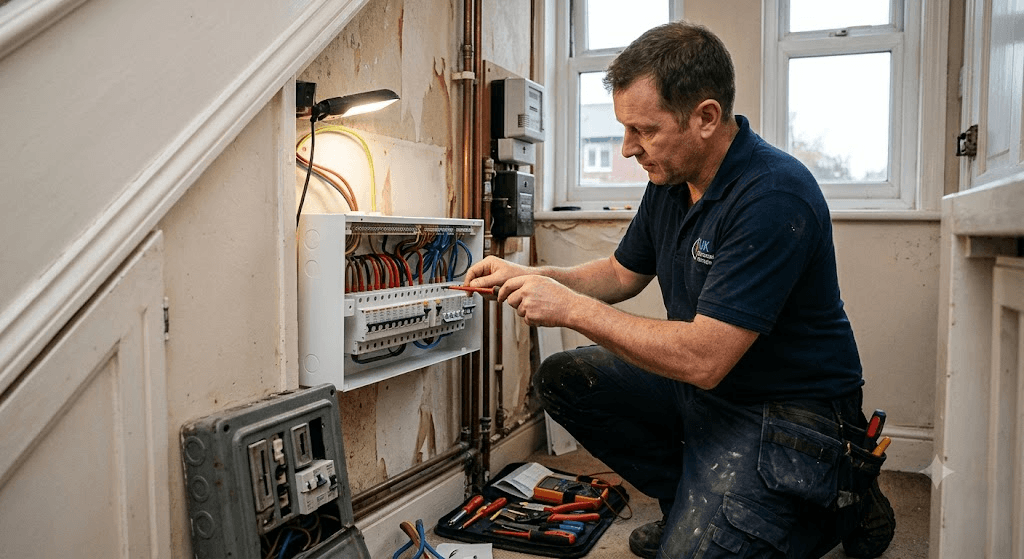
If there is one single electrical upgrade that provides the highest return on investment in terms of safety, it is the replacement of an old fuse box with a modern, 18th Edition compliant Consumer Unit. The consumer unit is the brain of your home’s electrical network, dividing the incoming power into distinct circuits and housing the vital safety devices that protect your property and your family.
A modern upgrade involves installing several highly sophisticated pieces of technology that older boards simply do not possess:
Residual Current Devices (RCDs) and RCBOs
An RCD is a life-saving device engineered to prevent you from receiving a fatal electric shock if you touch something live, such as a bare wire. It constantly monitors the electrical current flowing through the live and neutral wires. If it detects even a tiny imbalance—indicating that electricity is leaking to earth (perhaps through a person)—it shuts off the power in milliseconds. Modern installations often use RCBOs (Residual Current Breaker with Over-Current), which combine an RCD and a standard circuit breaker into one unit for each individual circuit. This means if a fault occurs on your kitchen socket circuit, only the kitchen loses power, rather than plunging the entire house into darkness.
Surge Protection Devices (SPDs)
Following Amendment 2 of the BS 7671 wiring regulations, Surge Protection Devices are now largely mandatory in new consumer unit installations in the UK. SPDs protect your property against transient overvoltages—sudden, massive spikes in electrical power. These surges can be caused by external factors like lightning strikes on the power grid, or internal factors like large motors switching on and off. Without an SPD, a single surge can instantly destroy thousands of pounds worth of sensitive electronics, including televisions, computers, smart home hubs, and even the circuit boards inside modern boilers and washing machines.
Arc Fault Detection Devices (AFDDs)
AFDDs are the latest advancement in electrical safety. They are designed specifically to detect dangerous electrical arcs—tiny, intense sparks that occur when a wire is loose, crushed, or degraded. Traditional circuit breakers and RCDs cannot detect these arcs, which are one of the leading causes of electrical house fires. While currently only mandatory in high-risk environments (like Houses in Multiple Occupation or purpose-built student accommodation), they are highly recommended for all domestic electrical upgrades to provide the ultimate level of fire prevention.
Full vs. Partial Rewiring: Making the Right Choice
When upgrading, homeowners often face the dilemma of whether to commission a full rewire or a partial one. The decision relies heavily on the age of the existing wiring and your future renovation plans.
A Full Rewire involves stripping out all the old wiring, back boxes, and sockets, and replacing everything with brand new, PVC-insulated cabling. It is a major, highly disruptive project. It requires floorboards to be lifted, and walls to be “chased” (channels cut into the brickwork or plaster to bury the new cables). Because of the mess and disruption, a full rewire is best undertaken when a property is vacant, or immediately after purchasing a “doer-upper” before any plastering or decorating takes place. A professionally executed full rewire will easily last 30 to 40 years, providing absolute peace of mind.
A Partial Rewire is a more targeted approach. It might involve upgrading the wiring in a single area, such as a newly fitted kitchen or a loft conversion, while leaving the rest of the house untouched (provided the existing wiring is tested and deemed safe). Partial rewires are also common when upgrading specific circuits, such as installing a dedicated, heavy-duty circuit for an electric induction hob or an electric vehicle charger. However, integrating new wiring with an old system can sometimes be problematic, and a thorough inspection is required beforehand.
Future-Proofing: Preparing for the Green Energy Transition
A modern electrical upgrade is not just about mitigating hazards; it is about facilitating the lifestyle of tomorrow. The UK is rapidly transitioning towards low-carbon technologies, and your home’s electrical infrastructure needs to be ready to accommodate these shifts.
Electric Vehicle (EV) Charging Infrastructure
With the impending ban on the sale of new petrol and diesel cars, home EV charging is becoming a standard requirement. A dedicated 7kW home charger draws a substantial continuous current (around 32 amps) for several hours at a time. Plugging this into an ageing, unassessed electrical system is highly dangerous. An electrical upgrade will ensure your incoming supply and consumer unit can safely handle the sustained load of an EV charger, often incorporating load-balancing technology so your main fuse doesn’t blow when you charge your car and cook dinner simultaneously.
Solar Photovoltaic (PV) and Battery Storage
As energy prices fluctuate, more British homeowners are turning to solar panels and battery storage systems. Integrating these technologies requires specialised wiring, smart meters, and an updated consumer unit capable of safely managing bidirectional power flow (electricity coming from the grid, and electricity being sent back to it). Upgrading your electrics now paves the way for a seamless, cost-effective solar installation in the future.
Smart Home Integration and Data Cabling
While upgrading the mains wiring, forward-thinking homeowners are also installing structured data cabling (such as Cat 6 or Cat 6a) alongside the electrical wires. Relying solely on Wi-Fi in thick-walled British homes often leads to dead zones. Hardwiring internet access points, smart TVs, and home office computers ensures flawless connectivity. Additionally, modernising allows for the installation of smart lighting systems, intelligent heating controls, and automated security arrays that require stable, modern electrical feeds.
Navigating UK Regulations: Compliance and Safety
Electrical work in Great Britain is strictly governed by law, primarily to prevent injuries and fatalities caused by incompetent workmanship. It is absolutely crucial to understand that major electrical upgrades are not a weekend DIY project.
Under Part P of the Building Regulations, any significant electrical work undertaken in a domestic dwelling—such as replacing a consumer unit, installing a new circuit, or rewiring a house—must be certified to prove it complies with the BS 7671 wiring standards. If you attempt this work yourself or hire an unqualified individual, you are breaking the law.
To ensure total compliance, you must employ a competent and qualified electrician who is registered with a government-approved Competent Person Scheme, such as the NICEIC, NAPIT, or ELECSA. These registered professionals have the authority to self-certify their work. Upon completion of the upgrade, they will issue you an Electrical Installation Certificate (EIC) and automatically notify your local authority’s Building Control department on your behalf.
Furthermore, if you are unsure about the current state of your electrics, you should commission an Electrical Installation Condition Report (EICR). Often referred to as a “landlord’s certificate” or “periodic inspection,” an EICR is an exhaustive test of your entire system. The electrician will push currents through the wires to test resistance, check earth loops, and visually inspect the consumer unit. The resulting report will code any faults found (C1 for immediate danger, C2 for potentially dangerous, C3 for improvement recommended), giving you a clear, unbiased roadmap of exactly what upgrades are required.
The Impact on Property Value and Insurance
Beyond the immediate benefits of safety and functionality, a comprehensive electrical upgrade offers significant financial advantages. When selling a property in the UK, prospective buyers are increasingly savvy about hidden costs. A surveyor will always check the age of the consumer unit and wiring. If they flag that a house needs a full rewire, buyers will routinely use this to negotiate thousands of pounds off the asking price, or they may pull out of the sale entirely due to the anticipated disruption.
Conversely, presenting a buyer with a freshly certified, modern electrical system, complete with EV charging capabilities and an updated consumer unit, is a major selling point that can genuinely boost the market value and saleability of your home.
Finally, there is the matter of home insurance. The vast majority of standard British home insurance policies stipulate that the property must be kept in a good state of repair. If an electrical fire breaks out and the subsequent investigation reveals it was caused by antiquated, degraded wiring or illegal DIY alterations, the insurance company is entirely within its rights to void your policy and refuse the payout. Maintaining modern, certified electrics is the only way to ensure your most valuable asset remains fully protected.
A Necessary Investment
Undertaking an electrical upgrade is undoubtedly a significant commitment, both financially and logistically. However, when weighed against the severe risks of fire, the threat of electrical shock, and the inability to utilise modern, energy-saving technologies, the decision becomes remarkably clear. By removing outdated infrastructure, installing highly responsive safety devices, and tailoring your circuits to the demands of the 21st century, you are not merely renovating a house; you are actively safeguarding your family and securing the future resilience of your home.