 savingsspot.co.uk
 The Great British autumn has undergone a profound cultural transformation over the last two decades. Where October once signalled little more than the putting back of the clocks, the arrival of heavier knitwear, and the gathering of garden waste for Bonfire Night, it now plays host to the second-largest retail event on the UK high street. Driven by a voracious generational appetite for immersive home decorating, American-style trick-or-treating, and high-production fancy dress, the UK Halloween economy is now estimated to be worth north of £700 million annually.
However, this booming market has created a wildly chaotic retail landscape. Between hyper-inflated “seasonal” markups, blink-and-you-will-miss-it stock drops, and high street clearance sales that begin while the pumpkins in the vegetable aisle are still green, navigating the UK Halloween sale season requires a tactical approach. Whether you are transforming a semi-detached house in Leeds into a Victorian mausoleum, hunting for a durable children’s costume that complies with rigorous British safety laws, or simply attempting to purchase three kilograms of fun-sized confectionery without remortgaging, this analysis explores how to time your purchases, decode retail pricing algorithms, and secure genuine bargains.
The Four Phases of British Halloween Retailing
To master the Halloween sales, a consumer must first understand the psychological calendar of the British retail sector. High street chains and digital giants do not apply discounts out of festive goodwill; they discount based on rigid warehousing logistics and the unyielding pressure of the Christmas roll-out. Because festive stock must occupy the primary shop floors the exact moment November begins, Halloween inventory operates on a strict, non-negotiable ticking clock.
Phase 1: The “Early Spook” Drop (Late August – Mid-September)
Paradoxically, the absolute best time to acquire premium, high-grade Halloween merchandise at a fair price is while the country is still experiencing late summer heatwaves. Brands like TK Maxx and Homesense have cultivated a massive, almost cult-like UK following by dropping their “Code 66” (the internal department code for seasonal goods) Halloween collections in late August. During this phase, you will not see red “sale” stickers, but you will experience the lowest baseline prices for high-end items—such as heavy ceramic cauldrons, imported Mexican Day of the Dead glassware, and woven autumn wreaths. Because these items sell out to collectors within days, waiting for an October markdown on premium decor is a fool’s errand; the stock simply will not exist.
Phase 2: The Mainstream Roll-out (October 1st – October 18th)
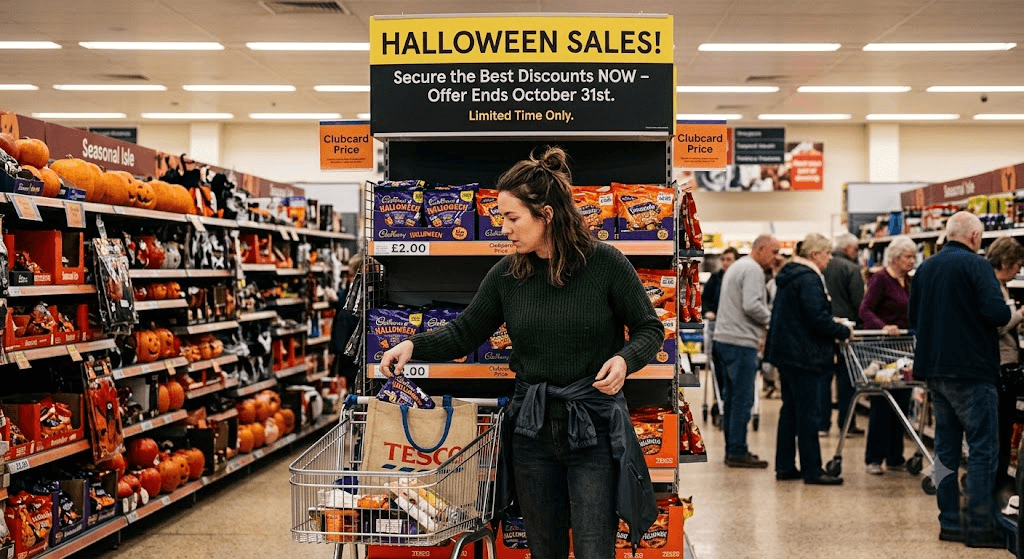
As October breaks, the major supermarkets (Tesco, Sainsbury’s, Asda, and Morrisons) enter the fray alongside variety discounters like B&M, Home Bargains, and Poundland. This is the era of the “Multi-Buy Promotional End”. Retailers use low-cost, high-visibility items to draw footfall. During this window, the smart money is spent on non-perishables and party essentials. Look for “3 for 2” offers on paper tableware, outdoor cobweb webbing, and standard LED string lights. Do not buy fresh pumpkins or high-end adult costumes during Phase 2; both are currently sitting at their absolute highest profit margins.
Phase 3: The Pre-Witch Panicked Markdown (October 24th – October 28th)
This is the golden window for the savvy British shopper. By October 24th, store automated stock-control systems calculate exactly how many unit days remain until the stock becomes dead weight. If an Asda superstore in Manchester still has four hundred plastic skeleton props sitting in the warehouse five days before Halloween, the regional pricing algorithm triggers an automatic 30% to 50% price slash. This is the optimal moment to purchase children’s fancy dress, high-end animatronics, and outdoor lawn decorations. The selection will be slightly picked over, but the cost-to-value ratio reaches its absolute peak.
Phase 4: The Post-Mortem Clearance (November 1st – November 5th)
On the morning of November 1st, Halloween stock becomes an active liability for store managers trying to clear space for artificial Christmas trees. Discounts instantly hit 70%, 80%, and occasionally 90%. While purchasing Halloween goods in November feels counter-intuitive, this is the masterclass tactic for forward-planners. High-density, non-perishable items like fog machines, heavy-duty silicone baking moulds, theatrical staging lighting, and unbranded Gothic home decor should be bought now and stored in the loft for 364 days.
The Retailer Power List: Where to Target Your Spend
Not all UK retailers treat the spooky season equally. Categorising them by their specific retail strengths prevents wasted journeys across retail parks.
- The Costume King (Asda George): Asda has consistently held the crown for the most extensive, reasonably priced fancy dress range in the UK. Their sizing runs up to plus-sizes for adults and covers premature infants up to early teens. Their mid-October “20% off all clothing” promotional weekends usually include fancy dress.
- The Atmospheric Stylist (Dunelm): Rather than selling cheap, single-use orange plastic, Dunelm has captured the “Soft Gothic” market. They specialise in heavy black velvet cushions, dark botanical bedding, and smoked glass candle holders. Because these sit on the boundary between regular autumn homeware and Halloween, their clearance sales in late October offer pieces you can genuinely leave on display all year round.
- The High-Volume Sweet Spot (Costco UK): If you live in an area with high trick-or-treater footfall, purchasing standard supermarket multipacks is a mathematical trap. Accessing a Costco warehouse (or using an online guest pass) allows you to purchase 1.5kg to 3kg bulk catering tubs of Swizzels, Cadbury Heroes, or Haribo. The cost-per-100g is frequently 40% lower than standard high street promotional pricing.
- The Middle Aisle Wildcards (Aldi & Lidl): The famous “Specialbuys” and “Middle of Lidl” aisles drop their Halloween ranges roughly three weeks before the day. Their strength lies in party hosting technology: £15 smoke machines, cheap strobe lights, automated doorbells that insult visitors, and low-cost gel window clings. When they are gone, they are gone.
The “Orange Tax” and How to Legally Evade It
Consumer rights champions frequently highlight the “Pink Tax”—the practice of charging more for standard products simply because they are packaged in pink for women. October brings the implementation of the “Orange Tax”. This is the retail practice of taking a completely standard, year-round household item, placing it inside a cardboard sleeve decorated with silhouettes of bats, and increasing the Recommended Retail Price (RRP) by 35%.
You can bypass the Orange Tax by applying simple lateral thinking in the aisles:
The Theatrical Blood Trap: A 50ml tube of branded “Vampire Fake Blood” in a party shop will routinely cost £4.99. However, if you walk into the baking aisle of any major supermarket, a 50g tube of standard Red Food Colouring Gel costs roughly £1.20. Mixed with a teaspoon of golden syrup and a tiny drop of blue food colouring (to give it rich, deoxygenated venous depth), you possess a vastly superior, completely edible product for a fraction of the outlay.
The Pillar Candle Illusion: Dedicated “Witch’s Altar Candles” sold in seasonal pop-up shops frequently command £8 to £12 each. Walk into the standard home-ware aisle of a Wilko stockist or an IKEA, and a pack of unscented, rustic dark grey or deep red pillar candles will cost roughly £3.50. The fire burns the same colour; your wallet retains the difference.
The Cobweb Conundrum: Packets of artificial synthetic cobwebs are an ecological nightmare and are notoriously overpriced for what is essentially unspun polyester. Go to a local builders’ merchant or a fabric haberdashery and ask for a metre of raw, unbonded polyester wadding or “batting”. For £2, you will receive enough material to wrap the entire exterior facade of a four-bedroom property.
The Secret Second-Hand Halloween Economy
The modern consumer is far more conscious of the environmental impact of “wear-once-and-chuck” synthetic costumes. Consequently, the UK’s second-hand market has developed a sophisticated sub-economy specifically engineered for October.
The Charity Shop “Hold-Back” Strategy
It is a little-known operational fact that major UK charity networks—such as Oxfam, the British Heart Foundation, Cancer Research UK, and Sue Ryder—do not put eccentric, dark, or vintage clothing out on the shop floor during the spring and summer. Shop managers are specifically trained to maintain a “Halloween Archive” in the stockroom.
When a donor hands in a crushed velvet 1980s prom dress, a heavily distressed leather trench coat, a genuine vintage tweed waistcoat, or a slightly chipped Victorian tea set in May, it gets tagged and boxed away. In the first week of October, these curated rails go live. For anyone seeking to assemble a genuinely unique, high-quality costume (such as a Peaky Blinder, a period vampire, or a classic Hitchcock protagonist), the local high street charity shop offers bespoke tailoring at fast-fashion clearance prices.
The Digital Resale Surge (Vinted & Depop)
The peer-to-peer app Vinted has thoroughly disrupted the UK fancy dress market. Because parents buy a £25 costume for a school “Spooky Disco” that is worn for precisely two hours, the app is flooded with pristine, second-hand children’s outfits. To get the best deals here, change your search filters from “Relevance” to “Newly Listed” and negotiate bundle deals with sellers who are trying to clear out multiple outfits from different growing years in one transaction.
Crucial Consumer Advice: The Safety Check
When chasing heavy discounts online, particularly via sponsored social media advertisements or overseas drop-shipping aggregators, British consumers must exercise extreme caution regarding product safety. Following several tragic, high-profile incidents involving children’s fancy dress costumes catching fire, the UK maintains some of the strictest flammability regulations in the world.
Legally, fancy dress costumes are classed as “toys” in the UK, rather than standard apparel. This means they must undergo a specific burn-rate test. When purchasing a heavily discounted costume, you must check the physical garment’s internal label for two non-negotiable legal markings:
- The UKCA or CE Mark: This proves the item has been subjected to standard European/UK safety verification.
- The EN71-2 Standard Code: This specific alphanumeric code dictates that the fabric has been treated with fire-retardant chemicals that ensure that, should the garment catch fire from a stray pumpkin candle, the flame will spread slow enough to allow the child to be stripped of the outfit safely.
If an online “70% Off Clearance Sale” offers unbranded, imported costumes shipped directly from overseas warehouses that lack these specific printed declarations, do not buy them. The financial discount is achieved entirely by skipping the chemical fire-proofing process.
Pumpkin Economics: Supermarket Loss-Leaders vs. “PYO” Farms
The orange winter squash sits at the absolute centre of the Halloween economy, and the pricing strategies surrounding it are fascinating.
In the final seven days of October, the major UK supermarkets utilize standard carving pumpkins as “Loss Leaders”. This means they deliberately sell the vegetable at a price lower than the cost of growing, shipping, and storing it. When you see Aldi or Lidl offering standard carving pumpkins for 49p or 75p, they are taking a financial hit on that specific item, fully aware that once you walk through the automatic doors to grab a cheap pumpkin, you are statistically 78% more likely to purchase your high-margin party food, beer, and sweets from their aisles at the same time.
Conversely, the massive explosion of “Pick Your Own” (PYO) pumpkin patches across the British countryside operates on an “Experience Economy” model. At a rural PYO farm in Kent or Cheshire, that exact same 49p supermarket pumpkin will cost you between £4.00 and £9.00. You are not paying for the squash; you are paying for the muddy outdoor aesthetic, the wooden wheelbarrows, and the autumn photo opportunity. If your goal is purely financial efficiency for an outdoor carving display, shun the picturesque farms and wait for the supermarket price war that inevitably erupts around October 25th.
Ten Golden Rules for the UK Halloween Shopper
To ensure you survive the spooky shopping season with your bank balance intact, keep this summary checklist in mind before tapping your contactless card:
- Calculate Sweets by the Kilo: Ignore the bright yellow “Special Offer” cardboard banners on supermarket tubs. Look strictly at the tiny, legally required “Price per 100g” text in the corner of the shelf label to find the true winner.
- Test the “Code 66” Theory: Visit your local TK Maxx in the first week of September. What you see on the shelves then is the highest quality decor you will see all season.
- Never Buy a “Carving Kit”: Flimsy plastic orange scoops and serrated tin blades snap within three minutes. A standard metal ice cream scoop to gut the seeds, and a thin, flexible boning knife from your kitchen drawer will outperform a £5 kit every single time.
- Raid the After-Christmas Bins: White outdoor string lights bought in the January Christmas clearance work perfectly as eerie back-lighting for Halloween silhouettes in October. Light has no seasonal allegiance.
- Watch for Sainsbury’s “TU” Weekends: Sainsbury’s routinely runs a “25% off all clothing” promotion in the middle of October. This discount applies to their entire fancy dress range, making them cheaper than primary discounters for a 48-hour window.
- Look for “Warm White” over “Bright White”: When buying cheap electronic candles or LED lights in the sales, verify the colour temperature. “Bright white” casts a sterile, blueish hospital glare. “Warm white” mimics the authentic, flickering amber glow of a 17th-century tavern.
- Utilise the Loft Cycle: If you buy a massive, £80 giant posable spider in the November 1st clearance for £24, you have not spent £24; you have saved £56 on next year’s guaranteed display.
- Scrutinise the “One Size Fits Most” Claim: In the budget costume market, “One Size Fits Most” is an industry euphemism for “Made of highly unforgiving, unbreathable static-generating nylon”. If a sale costume does not offer distinct, measured chest/waist sizing, leave it on the peg.
- Preserve Your Pumpkins: If you buy your pumpkins during the early price drops around October 20th, do not carve them immediately; they will rot and collapse into a mouldy puddle before Halloween night. Keep them intact in a cool, dark garage, and carve them no earlier than October 29th.
- Abandon Your Online Cart: If you are shopping on dedicated party supply websites during Phase 2 (early October), put your desired items in the basket, log into your account, and close the browser. Within 24 to 48 hours, their automated retargeting software will almost certainly email you a unique “10% to 15% off to complete your order” discount code to close the sale.