 savingsspot.co.uk
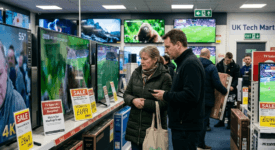
 There is a distinct, uniquely modern anxiety that strikes the moment you walk into a British electronics retailer during a major promotional event. A wall of sixty different glowing rectangles stares back at you, each broadcasting the exact same slow-motion footage of a brightly coloured tropical parrot or a sweeping Icelandic fjord. Slogans fly at your retinas: ‘Save £300!’, ‘Crystal UHD!’, ‘Quantum Processor!’.
In the United Kingdom, buying a television on sale has shifted from a straightforward transaction into a high-stakes psychological game. Between fluctuating Recommended Retail Prices (RRPs), artificially inflated baseline costs, and manufacturer jargon engineered to overwhelm the average consumer, spotting a genuine bargain requires a sharp eye.
Whether you are looking to upgrade your primary living room set for the upcoming Premier League season, or seeking a modest 32-inch screen for the back bedroom, this analysis will strip away the marketing fluff. Here is how the UK television retail ecosystem actually works, how to sidestep the pricing traps, and how to walk away with a genuine deal.
The UK Retail Calendar: The Exact Best Times to Buy
Timing is everything. In the UK, television pricing follows a strictly choreographed annual cycle. If you buy at the wrong point in this cycle, a “sale” price might actually be higher than the standard retail price just three months later.
1. The Spring Transition (March to May) – The Insider’s Sweet Spot
Most consumers assume November is the best time to buy a TV. Industry insiders know it is actually late Spring. Every January, major manufacturers like LG, Sony, Samsung, and Panasonic present their brand-new lineups at the Consumer Electronics Show (CES). By March and April, these new models start arriving in UK shipping containers.
Retailers suddenly find their warehouses choked with the previous year’s stock, which they are logistically desperate to clear to make room for the new arrivals. During this Spring window, you can regularly find the outgoing year’s top-tier, five-star-rated flagship televisions slashed by 35% to 50%. Because year-on-year panel improvements are usually minor, buying an outgoing flagship set in April is arguably the smartest purchase in British consumer tech.
2. Black Friday and Cyber Week (Late November)
Black Friday has taken firm root in the UK retail psyche, but it requires extreme caution. While genuine loss-leaders exist, a well-documented practice among some high-street giants is the “yo-yo” pricing strategy. A television will sit at £899 for most of the autumn, get quietly bumped to £1,099 in October, and then dramatically drop back to £849 for Black Friday, boasting a massive “Save £250” sticker.
Before putting anything in your digital basket during late November, run the model number through price-tracking websites like PriceRunner or CamelCamelCamel to verify the true price history of the hardware over the preceding six months.
3. Boxing Day and the January Clearance
Traditional British January sales remain a goldmine for “open-box”, customer returns, and ex-display units. If you live near a large Currys branch or an independent specialist, visiting in the first week of January to enquire about floor models can result in staggering discounts. However, you must insist on inspecting the screen for physical blemishes and “burn-in” before handing over your card.
Cracking the Code: The “Retailer Derivative” Trap

Have you ever tried to invoke a retailer’s “Price Match Guarantee”, only for the sales assistant to look at the barcode on your phone and say, “Ah, I’m sorry, that’s a slightly different model number”? Welcome to the retailer derivative trap.
To protect their profit margins and prevent consumers from cross-shopping price matches, major manufacturers produce hyper-specific model variants for different UK chains. For example, if you look at a popular mid-tier 55-inch television across the high street:
- John Lewis & Partners might sell the UE55CU8000.
- Currys will stock the UE55CU8070.
- Argos will offer the UE55CU8005.
To the naked eye, these look like three distinct televisions. In reality, they roll off the exact same assembly line. The difference? One might come with a dark grey plastic stand, another features a brushed silver stand, or one has a slightly different layout on the remote control. When browsing TV sales, ignore the last two digits of the product code. Focus entirely on the core prefix. If the core hardware is £150 cheaper elsewhere, do not pay the premium for the sake of a slightly darker bezel.
Matching Panel Technology to British Weather
When searching for television reviews online, North American tech publications tend to dominate the results. However, American living rooms—often bathed in intense Californian sunlight or situated in massive, wide-open basements—demand different screen characteristics than a Victorian terrace in Leeds or a 1930s semi-detached house in Birmingham. You must buy for the British lighting environment.
OLED: The King of the Cosy Winter
OLED (Organic Light-Emitting Diode) screens feature no separate backlight; each individual pixel turns itself off completely to generate genuine, pitch-black contrast. If your primary viewing habit consists of drawing the heavy curtains at 4:30 PM in November to watch moody dramas on BBC iPlayer or cinematic films, OLED is untouchable. Brands like LG and Sony dominate this space.
However, OLED panels have a highly reflective glass front. If your television sits directly opposite a large, south-facing bay window catching the low July sun, an OLED can become difficult to view due to heavy glare.
Mini-LED and QLED: The Gloom Busters
If your television is placed in a bright open-plan kitchen extension, or you watch a lot of daytime sport on weekend afternoons, you need raw peak brightness (measured in nits). Mini-LED and upper-tier QLED panels use thousands of tiny LED backlights to push immense amounts of light through the display. They shrug off ambient living room light and cut right through window reflections. Samsung’s ‘Neo QLED’ and TCL’s upper ranges are the absolute champions of the brightly lit British lounge.
The Budget Trap: Fake HDR
When shopping at the lower end of a TV sale (under £400), you will frequently see logos screaming HDR10+ or Dolby Vision. High Dynamic Range requires a television to reach high levels of peak brightness to make specular highlights stand out. Budget televisions simply lack the hardware to get bright enough to render real HDR; they accept the signal, but display a dull, dim, muddy image. If your budget is tight, turn HDR off in the television’s internal settings—you will almost always get a crisper, more vibrant Standard Dynamic Range (SDR) picture.
UK Broadcast Quirks: Refresh Rates and Energy Labels
The 50Hz Myth vs. 120Hz Reality
You will frequently see sale televisions heavily marketed as boasting a “120Hz refresh rate”. In the UK, traditional broadcast television—from BBC One HD to standard Sky channels—is transmitted at 50Hz (a direct legacy of the UK’s 50Hz AC mains electricity frequency). Therefore, if you are buying a set strictly to watch the six o’clock news, standard documentaries, or daytime television, paying a premium for a 120Hz panel offers zero visual benefit.
The only demographics in the UK who genuinely require a 120Hz panel are:
- Owners of a PlayStation 5 or Xbox Series X who wish to play compatible games at 120 frames per second.
- Households connecting a high-end gaming PC directly to the living room display.
Don’t Panic Over the ‘G’ Energy Rating
In March 2021, the UK Government overhauled the energy efficiency labelling system to eliminate the confusing “A+++” tiers, fundamentally rescaling the entire index. Because of this administrative shift, almost every single high-performance 4K television on sale in the UK today carries an intimidating ‘F’ or ‘G’ energy rating.
Do not let a ‘G’ rating frighten you away from a good deal. It does not mean the unit will cause your smart meter to spin out of control; it simply means the testing criteria was made so fiercely strict that only low-lit, small desktop monitors can achieve an ‘A’ or ‘B’ today. A modern 55-inch ‘G-rated’ LED television will typically cost an average UK household between £16 and £30 a year in electricity under normal viewing conditions.
The Big UK Retailers: Where the Real Value Lies
When the unit prices across the major players match to the exact penny, the “best deal” comes down entirely to the hidden aftercare perks provided by the retailer.
1. Richer Sounds (The VIP Champion)
Widely regarded as the most pro-consumer retailer in the UK tech space. Signing up for their free ‘VIP Club’ grants you an automatic, free 6-year guarantee on almost all televisions. When a manufacturer’s standard warranty is just 12 months, securing an extra five years of covered peace of mind for free is worth substantially more than a £20 point-of-sale discount elsewhere. They also operate a strict price-beat policy.
2. John Lewis & Partners (The Safe Haven)
John Lewis includes a 5-year guarantee as standard on all televisions. Furthermore, their customer service infrastructure is notoriously fair when handling legitimate panel degradation or dead pixels in year three or four. If two competing retailers have the exact same television on sale at £649, purchasing it from John Lewis is the objectively safer long-term investment.
3. Currys (The Showroom Goliath)
Currys remains the best place in the country to physically test a television’s operating system. Walk in, pick up the remote control, check how fast the Freeview Play interface responds, and test the off-axis viewing angles.
However, you must be prepared to hold your ground at the point of sale: decline the overpriced gold-plated HDMI cables, refuse the £40 “picture calibration” service (you can find professional calibration settings for free online in two minutes), and pass on the paid extended warranty.
4. Amazon UK (The Wildcard)
Amazon is exceptional for aggressive flash sales on budget-to-mid brands like Hisense, TCL, and LG’s entry-level UHD ranges. However, their logistics network handling 65-inch fragile glass monoliths can be variable. If buying a large screen from Amazon, open the top of the cardboard box and inspect the glass for hairline transit cracks the moment the courier places it inside your doorway.
Your 10-Minute Post-Delivery Checklist
You tracked the price charts, you secured the deal, and the massive cardboard delivery has just arrived in your hallway. Do not simply mount it to the wall and forget about it. Perform these three rapid verification checks within your 14-day standard UK distance-selling return window:
- Run the ‘YouTube DSE Test’: Open the YouTube app on the television and search for “Dirty Screen Effect Test”. It will play a solid grey screen panning left and right. Look closely for dark vertical smudges or severe banding. A tiny amount of shadow is normal on LED displays; heavy, highly distracting dark bars mean you should pack it back into the polystyrene immediately and request a retail exchange.
- Disable ‘Soap Opera Smoothing’: Manufacturers ship televisions with motion interpolation turned to maximum so the picture looks artificially hyper-fluid under the bright lights of a shop floor. In your home, it makes cinematic films look like cheap 1990s daytime soap operas. Navigate to the picture settings and turn off Trumotion (LG), Motionflow (Sony), or Picture Clarity (Samsung).
- Verify the UK Catch-Up Roster: Because of historical licensing disagreements, certain television operating systems occasionally drop support for foundational British catch-up services. Boot up the user interface and explicitly test that BBC iPlayer, ITVX, Channel 4, and My5 open correctly.
Armed with this data, you are no longer a passive target for seasonal retail pushes. Step past the glittering showroom floor models, double-check your historical pricing charts, secure your five-year warranty, and buy with total confidence.