 savingsspot.co.uk
 There is a highly specific, universally understood psychological shift that occurs across the British workforce at approximately 4:30 PM on a Friday. The laptop lid is eased shut, the prospect of standing over a chopping board drops to absolute zero, and the thumb hovers dangerously over a delivery app that will inevitably charge £34 for lukewarm Pad Thai.
Enter the great British safety net: the Marks & Spencer Dine In.
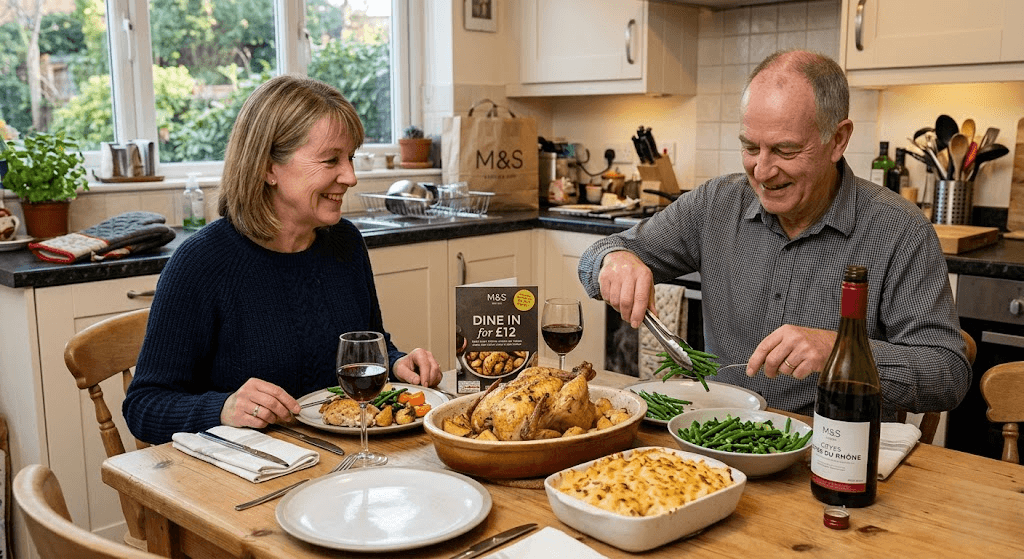
Originally launched in 2008 as the legendary “Dine In for £10” to offer the public a touch of economic ballast during the credit crunch, this promotional offer has transcended mere supermarket marketing. It has become a certified high-street institution. While the price point has gently migrated over the years to reflect the realities of modern inflation—now typically hovering at £12 for the standard menu, or £15 for the ultra-indulgent Gastropub upgrade—the core promise remains unchanged: a restaurant-grade Friday night in for the price of a couple of London pints.
However, treating the M&S meal deal as a simple grab-and-go exercise is an amateur’s game. To truly win the aisles of the M&S Foodhall requires strategy, foresight, and a basic grasp of retail mathematics. Here is the definitive breakdown of how to extract the absolute maximum value, flavour, and joy from the nation’s favourite meal deal.
The Anatomy of the Offer: How the Maths Works
To understand why the M&S Dine In commands such fierce loyalty, you have to look at the unbundled shelf prices. The standard £12 offer generally operates on a strict four-part matrix: One Main + One Side + One Starter or Dessert + One Bottle of Wine (or soft/non-alcoholic alternative).
If you were to walk through the shop and pluck those exact same items from their standard, non-promotional bays, your receipt would look drastically different:
- The Premium Main course: Typically retails at £7.00 to £8.50 standalone.
- The Luxury Side dish: Usually marked at £3.00 to £3.75.
- The Dessert / Starter: Consistently priced around £3.50 to £4.00.
- The Alcoholic Beverage: A bottle of standard tier wine sitting at £8.00 to £10.00.
When purchased separately, a top-tier combination routinely rings up at roughly £25.50. By handing over £12 at the till, you are effectively purchasing the bottle of wine and the side dish, while Marks & Spencer packs a high-end main course and a pudding into your tote bag entirely free of charge. In an era dominated by supermarket “skimpflation,” this remains one of the very few high-street promotions that respects the consumer’s intelligence.
The Masterclass Roster: Navigating the Mains
Marks & Spencer rotates its Dine In themes on a roughly fortnightly cycle. You will see the banners shift from Steak Night to Italian Festival, through to Tex-Mex and the beloved Gastropub Classics. Regardless of the theme, the mains can generally be divided into three distinct strategic categories.
1. The “High-Effort Fakes” (Maximum Value)
The golden rule of supermarket meal deals is to never buy something you could cook yourself in twelve minutes with a single pan. Therefore, bypass the standard chicken breasts and aim directly for the slow-cooked, pastry-bound, or complex dishes.
The undisputed king of this tier is the Gastropub Fish Pie. Packed with hefty chunks of Atlantic cod, succulent king prawns, and smoked haddock beneath a thick crust of cheddar-topped Maris Piper mash, making this at home requires three separate pans and twenty pounds worth of raw fishmonger ingredients. Similarly, the Slow-Cooked Beef Ragu or the Our Best Ever Steak Pie (which features an all-butter pastry base, rather than just a cheap puff-pastry lid) offer immense structural value.
2. The Friday Night Sizzle (The Steak Trap)
When “Steak Night” rolls around, the British public loses its collective mind. However, caution is required here. M&S offers genuinely fantastic, 21-day matured British rump and sirloin steaks in this deal, but they require proper home technique.
If you take an M&S sirloin straight from a 3°C fridge and drop it into a lukewarm non-stick pan, you will boil the meat, curse the meal deal, and ruin your evening. If you select the steak, commit to the process: unwrap it forty minutes before cooking, pat it aggressively dry with kitchen paper, salt it heavily, and use a smoking hot cast-iron skillet.
3. The Plant-Based Triumphs
Historically, supermarket vegetarian options in meal deals were an insulting afterthought—usually a damp mushroom risotto or a hollowed-out pepper stuffed with bland couscous. M&S has completely rewritten this script via their Plant Kitchen and standard vegetarian development. The Roasted Aubergine Melanzane alla Parmigiana is so deeply savoury and rich in garlic-infused tomato reduction that hard-line carnivores routinely pick it over the poultry.
Side Dish Strategy: Never Settle for Plain Veg
The side dish is where the casual shopper makes their most catastrophic financial error. You will routinely see tired commuters grabbing a plastic tray of tenderstem broccoli or basic garden peas.
Do not do this. You can buy a bag of frozen peas for £1.10 that will last you three months.
The side dish slot must be viewed purely as a vehicle for complex carbohydrates and dairy fats. Your primary targets should always be:
- The Potato Dauphinoise: Sliced potatoes suspended in a bubbling bath of double cream, Emmental, and garlic. It takes an hour to bake from scratch at home; it takes 25 minutes in its wooden tray.
- Triple-Cooked Chips: Prepared in beef dripping (or a high-smoke vegetable oil equivalent for the vegans). When done in an air-fryer, they achieve a glass-like exterior crunch that rivals high-end bistros.
- Truffle Mashed Potato: An unctuous, deeply rich puree that elevates a basic home-cooked sausage into a culinary event.
If your conscience demands something green, refuse the raw veg and opt only for the pre-prepared composite sides, such as the Layered Peas, Spinach, and Ricotta or the Green Vegetable Medley with Lemon and Garlic Butter.
The Sweet Finale: Decoding the Puddings
The pudding selection dictates the closing trajectory of your evening. While the fresh fruit pots are present to appease the strictly diet-conscious, the real magic happens in the foil trays.
The legendary Melt-in-the-Middle Chocolate Puddings remain the undisputed heavyweights of the M&S dessert aisle. The physics of these puddings is remarkably consistent; give them precisely 12 minutes at 180°C, and the centre yields a dark, warm molten Ganache that demands a splash of cold double cream.
For a lighter, more sophisticated exit, the Tarte au Citron slices offer a sharp, all-butter shortcrust palate cleanser, while the occasional appearance of the Mini British Cheese Board (usually featuring a sharp Cornish Cove cheddar and a mellow blue) allows you to pivot the end of the meal toward a late-night port pairing.
The Liquid Asset: Beating the Sommelier’s Loophole
The bottle of wine is the financial anchor of the entire Dine In proposition. Because M&S operates as its own bespoke wine merchant, they do not stock the mass-produced, branded bottom-shelf bottles found in other big-four supermarkets.
However, the internal price disparity on the Dine In wine rack is wild. On the very same shelf, you will find a light Italian Pinot Grigio that retails standalone for £6.50 sitting right next to a rich, oak-aged Argentinian Malbec or a Gascony Tannat retailing at £10.00.
To maximise your return:
- Look for the Gold Labels: M&S’s “Collection” or higher-tier regional wines occasionally slip into the promotion. Scan the back labels for specific appellations rather than generic regional blends.
- The Rosé Pivot: If you are buying the deal in the spring or summer, bypass the standard blush and look for the pale, dry Coteaux d’Aix-en-Provence styles, which carry the highest baseline cost in the store.
- The Sober Upgrade: If you do not drink alcohol, do not accept the basic one-litre carton of orange juice. Look for the premium 750ml glass bottles of Sparkling Botanical Pressés (such as the Rhubarb & Custard or Elderflower infusions), or check the shelf tags to see if the luxury Swiss Chocolate truffles have been enabled as the non-alcoholic substitute.
5 Insider Rules for the Savvy M&S Shopper
Even with the right menu items in mind, the physical environment of an M&S Foodhall at peak times can disrupt the best-laid plans. Commit these five operational laws to memory:
1. The Thursday Night Reconnaissance
New Dine In cycles strictly launch on Wednesdays or Thursdays. By 5:45 PM on a Friday, your local branch will resemble a battlefield; the Dauphinoise potatoes will be completely wiped out, leaving you staring at a lonely packet of crinkle-cut wedges. If possible, execute your shop on Thursday evening, or secure the bags during your Friday lunch hour and utilize the office fridge.
2. The “Yellow Sticker” Double-Dip
The meal deal discount barcode is programmed to override individual shelf prices. However, if an individual item within the deal (for instance, the sirloin steaks) is approaching its display use-by date and has been slapped with an orange “Reduced” sticker by store staff, the till software occasionally applies the overall promotion to the *already reduced* cumulative price. It is a rare algorithmic phenomenon, but a glorious one to catch.
3. The Freezer Hedging Strategy
Roughly 70% of the premium mains offered in the Gastropub deals are fully certified for home freezing. When an exceptionally strong menu lands, savvy shoppers buy two distinct deals. They cook one that evening, and drop the second main course and side straight into the chest freezer, locking in a bespoke, high-end ready meal for a rainy Tuesday next month at a fraction of the standalone cost.
4. Beware the “Halo” Ticket Trap
M&S visual merchandisers are masters of retail psychology. They will routinely place non-deal items (such as a £5 pot of premium gravy or an £8 box of salted caramel truffles) on the exact same display unit as the Dine In offer. Always look for the specific, uniform coloured cardboard crown attached to the shelf edge. If the barcode doesn’t sit directly beneath that purple or green cardboard tag, you will be paying full retail price at the self-checkout.
5. The “Fakeaway” Deception
If you are utilizing the Dine In for a third date or a low-stakes dinner party, the absolute first step upon crossing your threshold must be the total destruction of the packaging. Transfer the beef ragu into a pre-warmed terracotta serving dish, scatter a handful of torn fresh basil over the surface, put the wine in a decanter, and bury the black plastic trays at the very bottom of the recycling bin. As the famous 2004 voiceover noted: nobody needs to know.
The Supermarket Showdown: Is M&S Still the King?
Inevitably, the success of the M&S Dine In spawned a legion of imitators across the British grocery landscape. How does the pioneer hold up against the modern competition?
Tesco Finest (£12 with a Clubcard): A fiercely competent rival. Tesco’s meal deal offers phenomenal steak cuts and excellent potato accompaniments. However, their wine tiering feels distinctly more corporate, lacking the boutique, curated charm of the Marks & Spencer cellars.
Waitrose & Partners (£12 No.1 Deal): The most direct spiritual competitor. Waitrose routinely wins on the sheer quality of their fresh vegetable sides and delicate fish dishes, but their portion sizing on the main courses can occasionally feel somewhat more austere than M&S’s hearty, comfort-focused platters.
Sainsbury’s Taste the Difference (£12): A brilliant option for classic British comfort food, though their dessert engineering occasionally lacks the decadent, show-stopping flair developed by the M&S test kitchens.
Ultimately, Marks & Spencer retains the undisputed crown not just through culinary engineering, but through the intangible metric of “Event Factor.” Carrying a standard supermarket bag into the kitchen feels like the completion of a domestic chore; setting down that iconic green M&S paper bag onto the kitchen worktop feels like the official, indisputable commencement of the British weekend.