 savingsspot.co.uk
 The British evening meal has undergone a quiet revolution over the last decade. Gone are the days when dinner strictly meant a frantic dash around the local Tesco Metro or Sainsbury’s Local at 6:15 PM, staring blankly at a limp head of broccoli. Today, the insulated cardboard recipe box sitting on the doorstep has become a standard feature of modern UK domestic life.
Yet, as the cost-of-living conversation dominates the dining table, a fascinating consumer divide has emerged: those who pay the full advertised price for their recipe boxes, and those who treat the industry’s marketing budget as a heavily subsidised personal dining fund.
If you are currently paying upwards of £50 a week for your standard four-recipe box, you are effectively funding the jaw-dropping discounts being handed to the person living next door. The recipe box sector operates on an aggressive customer acquisition model; they are willing to take a significant financial hit on your first month of meals purely to get their branded ice packs inside your freezer. Understanding how to navigate, stack, and cycle meal kit discount codes is no longer just a frugal hobby—it is an essential household skill that can shave hundreds of pounds off your annual grocery outlay.
The Major UK Players: Decoding the Welcome Offers
To exploit the system, one must first understand the terrain. Britain boasts one of the most fiercely competitive meal kit markets in the world. Because the switching costs for the consumer are practically zero, brands are locked in a perpetual bidding war for your kitchen counter space. Here is how the big names structure their digital handshakes:
1. Gousto: The Variety Heavyweight
Gousto’s standard customer acquisition funnel relies on the “front-loaded blow”. Typically offering 60% off your first box, followed by 25% to 30% off all remaining boxes in your first month, their core aim is habit formation. Because Gousto offers over 75 recipes a week—the largest menu on the UK market—their discount code is best deployed when you have a chaotic month ahead and want to test highly diverse cuisines ranging from Wagamama collaborations to quick 10-minute stir-fries.
The hidden catch: The discount applies strictly to the food. The £3.99 delivery fee is sometimes tucked back onto the invoice after box one depending on the specific promotional affiliate link you clicked. Always check the final checkout breakdown before hitting ‘Confirm’.
2. HelloFresh: The Global Giant’s Tiered Ladder
HelloFresh prefers the psychological long game. Their classic voucher code structure looks like a descending staircase: 60% off box one, followed by 25% off your next two months (or a variation of “get your first box for £15”).
Because HelloFresh operates on massive global economies of scale, their introductory boxes offer arguably the highest volume of raw calories per discounted pound. If you are feeding a traditional family of four, an introductory HelloFresh voucher is mathematically the cheapest way to put fresh, high-protein meat and two veg on a British dining table.
3. Mindful Chef: The Premium Health Subsidy
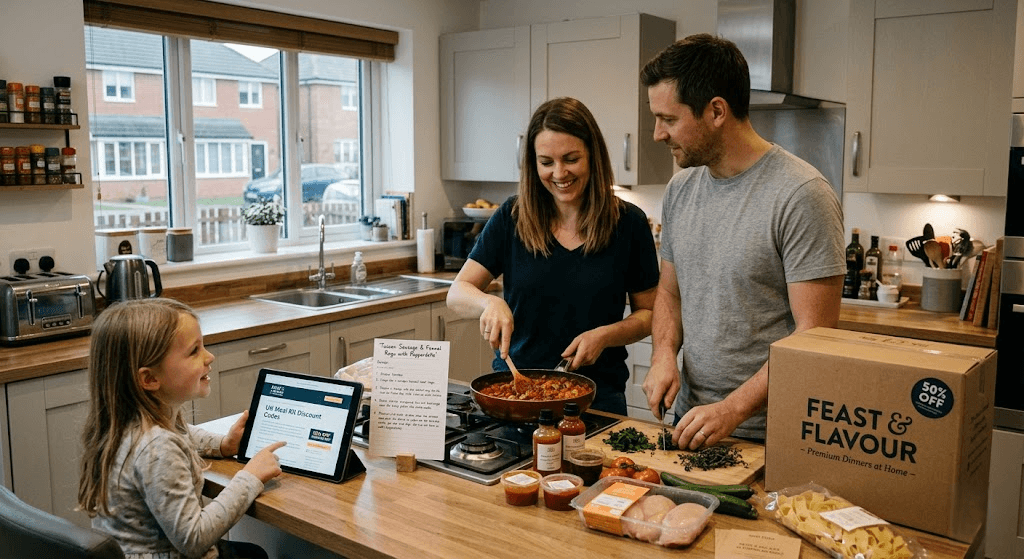
Mindful Chef does not do “cheap”, which makes their discount codes all the more vital. Completely gluten-free, dairy-free, and leaning heavily into grass-fed Yorkshire beef and sustainably caught British fish, a full-price box can easily make a serious dent in a monthly budget.
Their promo codes usually offer a flat monetary reduction—such as £20 off your first two boxes or 25% off your first four orders. Using a discount code here isn’t about eating for pennies; it is about accessing high-end, boutique farm-shop quality ingredients at standard supermarket prices.
4. SimplyCook: The Letterbox Trojan Horse
Strictly speaking, SimplyCook is an ambient ingredient-and-spice kit rather than a fresh meal box, but it belongs firmly in the budget-hacker’s repertoire. Their evergreen discount is legendary: your first four-recipe box for £1 (to cover postage). You supply your own fresh chicken or veg, but the complex flavour pots transform standard fridge leftovers into authentic Malaysian Laksa or Cuban Mojo Pork. It is the lowest-risk entry point into the subscription cooking sphere.
The Anatomy of a Promo Code: Reading the Small Print
When you spot an influencer waving a wooden spoon on Instagram promising “50% off”, the rational brain needs to instantly scan for three specific hidden tripwires standard to UK recipe platforms:
- The ‘Portion Inflation’ Trick: A headline claiming “Meals from £1.49 per person!” almost universally relies on a hyper-specific matrix: you must order the maximum possible configuration—usually 4 recipes for 4 people (16 portions total)—to achieve that headline unit cost. If you are a couple ordering 3 meals for 2 people (6 portions), your discounted per-portion cost will be noticeably higher. Always calculate the total out-of-pocket cash figure, rather than the advertised per-plate dream.
- The Logistical Lock-Out: Every recipe box operates a rigid logistical lockdown window, usually occurring 3 to 4 days before your scheduled delivery day at precisely 11:59 PM. If your discounted first box arrives on a Monday, the automated system has likely scheduled your second (potentially full-price) box to lock in on the preceding Thursday night. The number one reason consumers lose money on meal kits is forgetting to set a mobile phone alarm for the morning after their first box arrives to review, pause, or skip the next delivery.
- Surcharges Do Not Shrink: Discount percentages apply strictly to the base tariff of the box. If you fall to temptation and select the “Prime Rump Steak with Truffle Butter” or the “Pan-Fried Seabass”, the £3.50 per-person luxury surcharge remains at 100% of its cost. To truly squeeze the equity out of a voucher code, stick rigidly to the core menu.
The ‘Box Hopping’ Protocol: A 90-Day Itinerary
In the UK personal finance community, “box hopping” is the established practice of migrating systematically from one brand to another to ensure you are perpetually situated in the ‘honeymoon phase’ of customer acquisition discounts. Done correctly, a two-person household can eat gourmet dinners for three months without ever paying the baseline market rate.
Weeks 1 to 4: The Gousto Initiation
Start your cycle with Gousto’s 60%/30% offer. Set your delivery day for a Tuesday. On Wednesday morning of Week 1, log into the app. Skip Weeks 3 and 4 immediately, but keep Week 2 active to catch the tail-end of the 30% reduction. Once Box 2 arrives, go into your account settings and hit ‘Pause Subscription’. Do not delete your account; simply put it into hibernation.
Weeks 5 to 8: The HelloFresh Migration
Open a fresh browser session and trigger a HelloFresh introductory voucher. Because HelloFresh’s packaging and recipe cards are structured differently to Gousto’s, this month serves as a great culinary palate cleanser. Repeat the identical administrative safeguard: set a recurring weekly diary invite called “Check Meal Box” to ensure you never accidentally absorb a full-tariff charge.
Weeks 9 to 12: The Specialist Circuit
By month three, your household will be well-practised in the art of the 20-minute chop-and-stir. Now, deploy the high-value vouchers for the niche challenger brands. Spend two weeks using a Grubby introductory code to trial 100% plant-based cooking, followed by two weeks of Green Chef using their high-percentage keto or balanced-living onboarding codes.
The Reset (Week 13 onwards)
Here is the magic of the UK ecosystem: by the time you finish Week 12, Gousto and HelloFresh’s automated marketing algorithms will have flagged your account as “Lapsed”. Your inbox will begin receiving what the industry calls Win-Back Vouchers. These are bespoke, non-public discount codes offering things like: “We miss you! Come back for 50% off your next box, and 30% off the three after that.” You simply step back onto the escalator at the ground floor.
Advanced Stacking: Taking Savings Beyond the Promo Code
For the truly dedicated parsimonious foodie, entering a code at checkout is merely step one. To drop your net cost per meal into the realm of the genuinely absurd, you must stack the digital mechanisms available to British shoppers.
The Cashback Gateway
Never go directly to a recipe box URL to paste a discount code. Always route your browser through a UK cashback portal such as TopCashback or Quidco. Historically, both Gousto and HelloFresh have offered bounties ranging from £7.00 to £15.00 in raw cash back simply for opening a new subscription.
If you apply a 60% off promo code to a £35 box bringing it down to £14, and track a £10 cashback payout through Quidco, your net cost for four nights of dinners for two people sits at an astonishing £4.00. That is 50p per portion.
The ‘Cancel to Save’ Gambit
Software developers call it a “churn deflection flow”; savvy consumers call it a free lunch. When you go into a recipe app to officially cancel your membership, the system does not immediately show you the exit. Instead, it triggers an automated desperation sequence.
As you click “I am leaving because it is too expensive”, the screen will almost certainly flash up an instant counter-offer: “Wait! Take 40% off your next box to stay.” If you are happy with the service, accept the digital bribe, take the discounted delivery, and restart the cancellation dance the following month.
The Ultimate Currency: Referral Links
Once inside a brand’s ecosystem, standard voucher codes become obsolete compared to the power of the “Refer a Friend” hub. UK recipe boxes issue their active users with personalised links that grant the friend a 100% free first box (paying only a nominal £1 to £4 delivery fee), whilst rewarding the referrer with £20 to £30 in credit applied to their own next bill.
By setting up a simple rotation among a small circle of office colleagues, siblings, or flatmates, a group of four people can effectively pass free-box credits in a continuous loop for half a year before the system demands fresh blood.
The Key Worker Baseline
If you are a university student, work for the NHS, serve in the Armed Forces, or hold a Blue Light Card, standard commercial rules do not apply to you. Portals like GoCertify, Student Beans, and UNiDAYS maintain permanent baseline discounts for these demographics—often locking in a guaranteed 15% to 20% off every single box for life, long after the welcome offer has expired. Verify your status in the account settings before you ever let an invoice hit 100%.
The Reality Check: Do Discounted Kits Beat the Supermarket?
A common critique from traditional home cooks is that even with a 50% voucher, buying loose carrots and a pack of chicken thighs at Aldi or Lidl is cheaper. Strictly mathematically, on a weight-for-weight basis of raw agricultural produce, the supermarket wins. However, this argument ignores the **Cost of the Pantry**.
If you want to cook a rich Sri Lankan Black Pork Curry from scratch via a supermarket run, you have to buy a full jar of tamarind paste, a bottle of dark roasted curry powder, fresh curry leaves, a block of creamed coconut, and whole cardamoms. You will spend £18 on the dry goods alone, use a single teaspoon of each, and leave the jars to quietly gather dust in the back of a cupboard until 2029.
A discounted recipe kit delivers the exact 4 grams of tamarind required for that single Tuesday evening. Therefore, the true financial utility of a meal kit discount code lies in high-complexity dining. Use your supermarket runs for standard bangers and mash; use your promotional recipe codes to explore global gastronomy without acquiring a graveyard of half-used condiment bottles.
The Golden Rules of the Box
The British recipe box sector is a magnificent playground for the switched-on consumer. The brands have constructed the playing field; your only job is to refuse to play by the passive rules. Keep your mobile alarms set, treat your account status as fluid, exploit the cashback gateways, and never, under any circumstances, allow an un-discounted box to cross your threshold.