 savingsspot.co.uk
 We are a nation governed by the click of the kettle. When a national crisis strikes, we put the kettle on; when a long-lost friend appears at the doormat, we put the kettle on; when the dreaded three o’clock desktop fatigue sets in, a warm mug is our primary anchor to reality. Yet, for all our historic devotion to Camellia sinensis, the average British tea habit has spent the last forty years stuck in a surprisingly dusty rut.
For most of us, tea shopping consists of grabbing the same red, green, or orange cardboard box of mass-produced bags off the supermarket shelf, dropping them into a mug, and crushing them against the ceramic with a teaspoon until the water turns the colour of a wet piece of cardboard. But a quiet revolution is brewing across the UK. Driven by a desire for better flavours, ethical sourcing, and a touch of letterbox luxury, the British public is waking up to the transformative power of the tea subscription.
The Anatomy of a Letterbox Tea Delivery
To understand the appeal of a tea subscription, you first have to look at the logistics. There is a specific, modern form of mild trauma associated with the phrase: “Sorry we missed you.” Finding a red Royal Mail card sitting on your mat because you were in the shower when the postman tried to hand over a massive cardboard box is an instant mood-killer.
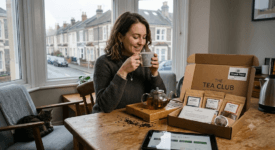
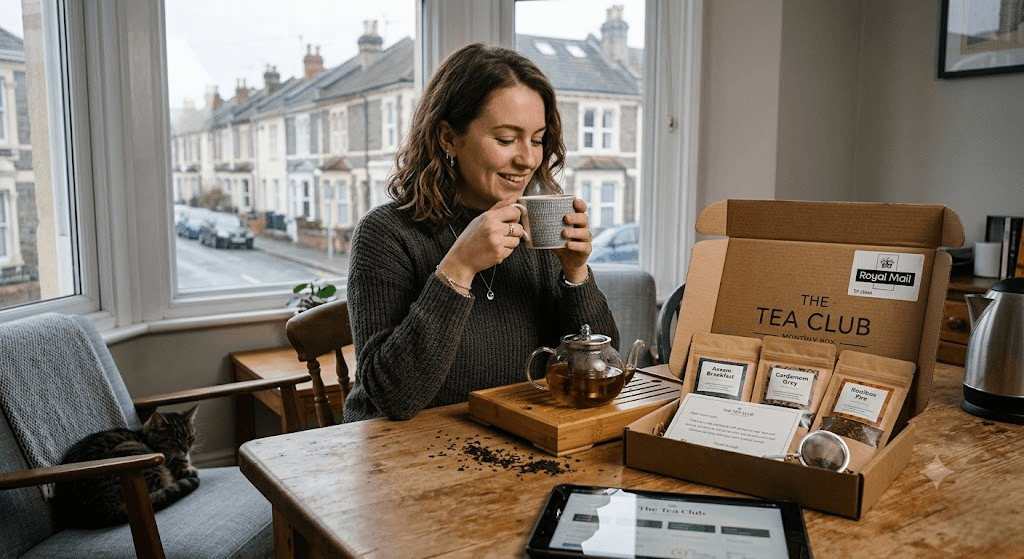
The modern UK tea subscription has been masterfully engineered to bypass this entirely. The packaging is almost universally designed to slide effortlessly through a standard 254mm x 38mm British letterbox. You do not need to be home. You do not need to rearrange delivery. You simply arrive home from work to find a sleek, beautifully branded flat box resting on your hallway carpet, radiating a faint, aromatic promise of bergamot, roasted rice, or high-mountain Assam.
Broadly speaking, these subscriptions divide the market into two distinct camps:
- The Explorer Model: Designed for the curious palate. Every month, you receive three or four mystery pouches curated by a master taster. One month might take you to the misty foothills of Darjeeling; the next might introduce you to an earthy volcanic green tea from Kagoshima.
- The Replenisher Model: Designed for the creature of habit who simply wants to upgrade their daily fuel. You find the bespoke breakfast blend or Earl Grey that makes your soul sing, and the algorithm ensures a fresh pouch drops through your door two days before your current stash runs dry.
The Great British Epiphany: Whole Leaf vs. “The Dust”
If you ask a tea sommelier what is actually inside a standard high-street tea bag, they will likely use the word “fannings,” or more bluntly, “dust.”
Most commercial tea is produced using the CTC method—which stands for Crush, Tear, Curl. The leaves are passed through a series of cylindrical rollers with hundreds of sharp teeth that crush the leaf into tiny, uniform pellets. This is done for one reason: speed. Tiny particles have a massive surface area, meaning when boiling water hits them, they throw out dark colour and heavy, bitter tannins in roughly thirty seconds. It gives you a fast, punchy brew that requires a heavy splash of milk to mask the bitterness.
A high-quality tea subscription introduces you to orthodox whole-leaf tea. Because the leaves are plucked and carefully rolled whole—rather than minced—they require a slower, more graceful extraction. When hot water hits whole loose leaves, they undergo what tea masters call the agony of the leaves, slowly unfurling like time-lapse photography of a blooming flower. The resulting liquor is complex, naturally sweet, highly nuanced, and entirely devoid of that dry, chalky feeling on the back of your tongue.
Four Telltale Signs You Need a Tea Subscription
Still on the fence about whether your kettle deserves an upgrade? If you identify with more than two of the following scenarios, it is officially time to hand over your curation to the professionals.
1. The Cupboard Graveyard
Open your kitchen cupboard right now. Look at the top shelf. Do you possess six half-crushed boxes of supermarket “superfruit” or “calming sleep” teas? You bought them in 2024 because the box promised the scent of sun-drenched Sicilian lemons or warm spiced apple. You brewed one cup, realised it tasted faintly of warm, pink citric acid, shoved the box to the back, and never spoke of it again. A subscription sends you smaller, high-grade batches that you actually consume.
2. The 3:00 PM Coffee Paradox
You drink a double espresso at three in the afternoon to survive a spreadsheet, but by midnight you are staring at the ceiling calculating how many hours of sleep you will get if you drift off right now. Tea contains caffeine, but it is uniquely bound to an amino acid called L-theanine. This compound promotes the release of alpha waves in the brain, resulting in a state of relaxed, hyper-focused alertness rather than the jittery, sweaty spike-and-crash of a late-day Americano.
3. The Hard Water Struggle
If you live in London, East Anglia, or the South East of England, your tap water is essentially liquid chalk. When you make a standard cup of high-street tea, a bizarre, iridescent scummy skin forms on the surface of the mug, leaving a brown ring of shame around the porcelain. Specialty tea curators understand regional UK water profiles and will often direct you toward robust, malty Assams or high-fired Oolongs that can cut through heavy calcium bicarbonate.
4. You Want to Practice “Micro-Hedonism”
We are living through an era of tightened belts, but human beings require joy. If you cannot justify a £150 tasting menu at a Michelin-starred restaurant, a £12-a-month subscription that delivers world-class, single-origin luxury to your kitchen counter offers an unbeatable return on investment for your mental well-being.
A Palate Passport: Rare Teas You Will Actually Discover
When you step outside the supermarket matrix, the vocabulary of tea changes entirely. Here is a taste of the profiles that routinely show up in British letterboxes:
- Milky Oolong (Jin Xuan): Grown in the high altitudes of Taiwan, this semi-oxidised tea is a sensory magic trick. Without a single drop of dairy being added to the leaf, it yields a thick, velvety liquor that tastes vividly of sweet double cream, buttered toast, and orchid blossoms.
- First Flush Darjeeling: Plucked during the very first spring growth in the Himalayan foothills. It yields a pale, golden-apricot liquor known as the “Champagne of Teas,” defined by a sharp, crisp note of muscatel grape. Putting milk in this is considered an international crime.
- Authentic Lapsang Souchong: Forget the cheap supermarket versions that taste like someone dissolved a barbecue briquette in your mug. Real, high-grade Zheng Shan Xiao Zhong from the Wuyi Mountains is dried gently over smoking pine needles, resulting in a sweet, warming flavour profile reminiscent of dried longan fruit, high-end pipe tobacco, and a distant Highland campfire.
- Silver Needle (Bai Hao Yinzhen): The absolute purest expression of the tea plant. Made strictly from the unopened, downy silver leaf-buds plucked over a two-week window in spring. It tastes like catching honeydew melon rain on your tongue.
The Cold, Hard Economics of the Kettle
It is entirely fair to ask the unit-cost question: “Why on earth should I pay £13 a month for a couple of bags of leaves when I can get 160 round standard bags for £3.40?”
The secret to the economics of whole-leaf tea lies in a concept the trade calls multiple steeping. A standard paper tea bag is a one-and-done transaction; all its flavour is sacrificed to the water in the first pour. High-grade loose leaf tea, however, is designed to be re-steeped.
If you take 3 grams of a premium Iron Goddess of Mercy Oolong, your first four-minute steep will be light and floral. You do not throw those leaves in the food waste bin. You leave them in the pot, go about your morning, and at 11:00 AM, you hit them with hot water again. The second steep is often richer than the first. You can repeat this process three, sometimes four times with the exact same measure of leaf.
When you recalculate your £12 monthly subscription based on actual liquid yield, your cost per world-class, artisanal cup drops to roughly 12p to 15p. When a high-street coffee chain is now asking £3.75 for an oat milk flat white, the home tea subscription is arguably one of the most sensible upscale lifestyle pivots a modern Brit can make.
How to Match a Subscription to Your Persona
Because the UK subscription market has matured rapidly, you no longer have to settle for a “one size fits all” service. You should look for a provider that matches your specific household rhythm:
The Eco-Purist
Look for brands that explicitly advertise NatureFlex inner pouches. These look and feel like clear plastic, but they are actually made from wood pulp and will turn into harmless soil in your back-garden compost bin within ten weeks. Check for plastic-free ink on the mailing boxes and a clear, transparent statement on farm-gate pricing (ensuring the tea pluckers in Kenya or Sri Lanka are paid living wages, rather than the commodity floor price).
The Caffeine Controller
If you are trying to cut down on your stimulants, look for an “Afternoon & Evening” or bespoke herbal track. The best services skip the cheap peppermint and hibiscus defaults, offering sophisticated, functional botanicals like Greek Mountain Tea, roasted dandelion root (which mimics the dark, bitter notes of coffee), and whole Greek verbena.
The Terroir Geek
If you are the sort of person who likes to know the exact soil composition of the vineyard your Pinot Noir came from, look for an unblended single-estate subscription. These boxes arrive with detailed tasting cards citing the exact altitude of the garden, the name of the estate manager, the cultivar of the bush, and the exact week of the harvest.
Three Golden Rules for Your First Delivery
When that first flat cardboard box hits your hallway mat, resist the urge to treat it like standard high-street tea. To get your twelve pounds’ worth, you must obey three non-negotiable laws of the leaf:
- Kill the rolling boil for Greens and Whites: Pouring 100°C water directly onto a delicate spring green tea instantly cooks the leaf, releasing bitter catechins and making it taste like boiled cabbage. If you do not have a temperature-controlled kettle, simply boil the water, open the lid, and let it sit in the silence of your kitchen for three full minutes to drop to 80°C before pouring.
- Respect the ratio: Buy a cheap digital pocket scale. Eye-balling loose leaf tea is a fool’s game; tightly rolled gunpowder green tea takes up a fraction of the volume of large, fluffy white tea leaves. The golden ratio is almost universally 2.5 to 3 grams of tea per 250ml of water.
- Never re-boil dead water: The secret ingredient in a great cup of tea is actually oxygen. Dissolved oxygen in the water acts as a carrier vehicle for the volatile aromatic oils in the tea leaf. Water that has been boiled, left sitting in the kettle for two hours, and boiled again is completely flat and de-oxygenated. Always empty the kettle and draw fresh, cold, highly aerated water from the tap.
The Postbox Sanctuary
In an age defined by the frantic ping of the smartphone notification, the automated Slack message, and the relentless speed of digital life, a tea subscription offers something quietly subversive: a mandatory pause.
You cannot rush an orthodox whole leaf. It forces you to stand by the kitchen counter watching the water turn from clear to deep amber. It forces you to wait. And in the chaotic landscape of modern Great Britain, having someone send a small cardboard box of guaranteed peace through your front door once a month isn’t just a purchase—it is a survival strategy.