 savingsspot.co.uk
 From the manicured, strawberry-scented lawns of SW19 to the ankle-deep mud of Pilton Farm, Great Britain possesses a wonderfully paradoxical relationship with live gatherings. We are a nation that treats the hyper-formal etiquette of Royal Ascot with the exact same level of solemn, unwavering dedication as a wet bank holiday cheese-rolling contest in Gloucestershire. In the UK, an event is rarely just an appointment on a calendar; it is a complex intersection of heritage, subculture, and micro-climatic survival.
Live events are a vital economic and cultural engine for the country. Generating over £70 billion annually for the British economy, the sector supports roughly 700,000 jobs across corporate conferences, boutique festivals, global trade expos, and private celebrations. Yet, as the digital age leaves us more atomised than ever, the psychology behind why we gather—and how we execute those gatherings—is undergoing a profound evolution. Whether you are an independent lifestyle brand launching a pop-up in Soho, an operations director planning a multi-day summit in the Scottish Highlands, or a volunteer trying to organise a community street party without falling foul of the local council, mastering the British event landscape requires an even split of high creativity and rigorous administrative pragmatism.
1. The Heritage Blueprint: From the ‘Social Season’ to the Tombola
To understand the modern UK event industry, one must look at its foundational masterplates. Historically, the British calendar was dictated by the “Social Season”—a spring-to-autumn stretch originally designed to coincide with the sitting of Parliament, where the landed gentry would migrate to London to introduce their debutante daughters to eligible bachelors. Today, the Season remains an enduring £2 billion titan of the hospitality sector, anchored by the classic quartet: Wimbledon, the Chelsea Flower Show, the Henley Royal Regatta, and Goodwood.
However, the true, beating heart of British gathering lives at the opposite end of the budget spectrum: the grassroots community event. The village fete, the local parish church bazaar, and the pub quiz are masterclasses in low-stakes, high-engagement event design. Take, for instance, that most curiously British of institutions: the tombola.
To the uninitiated foreign visitor, a tombola is a harmless table covered in folded raffle tickets, donated bottles of off-brand shampoo, and slightly dusty tins of shortbread. To the British legal system, however, a tombola run at a non-profit event is strictly classified as an “incidental lottery” under the Gambling Act 2005. This dictates that organisers are legally barred from selling tickets online or in advance; the transaction and the draw must occur purely during the physical duration of the event itself. It is this bizarre, highly specific intersection of quaint homemade charm and rigid statutory compliance that defines the domestic operational mindset.
2. The Era of ‘Competitive Socialising’ and Immersive Realities
If there is a single defining consumer trend that has reshaped British leisure events over the past decade, it is the absolute death of the passive spectator. The modern British attendee no longer wants to stand in a dark room holding a plastic pint of warm lager while watching someone else do something on a stage; they demand active participation.
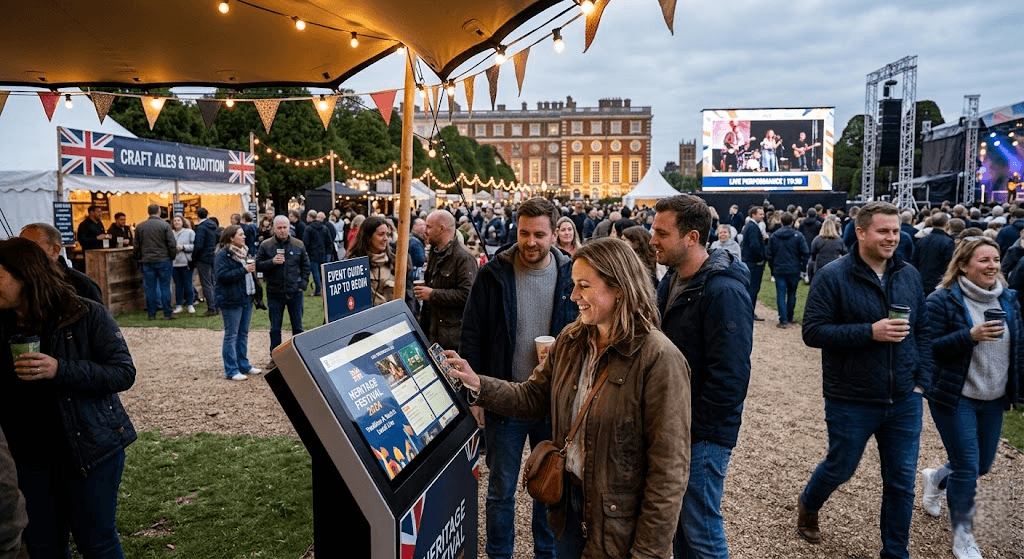
This psychological shift birthed the booming phenomenon of Competitive Socialising. What began as a modest London resurgence in boutique bowling alleys has exploded into a nationwide, multi-million-pound sub-sector. Venues like Flight Club (which reinvented the gritty pub game of darts using high-tech vision-tracking cameras), Puttshack (gamified mini-golf), and Fairgame (an adults-only homage to the classic British seaside fairground) have proven that the public will happily pay a premium to combine high-end cocktails with mild, friendly humiliation.
For private event planners and brand marketers, the takeaway is absolute: activity is the new icebreaker. When designing a product launch or a corporate retreat in the UK today, the traditional model of “speeches followed by canapés” results in instant attendee disengagement. The gold standard is now tactile immersion. Whether it is a bespoke scent-mapping workshop for a botanical gin launch in Covent Garden, or a fully costumed, secret-location dining experience hosted by the pioneers of immersive theatre in East London, the objective is to capture the attendee’s complete sensory bandwidth.
3. The ‘Festivalisation’ of the B2B Sector
Historically, the phrase “UK Business Conference” evoked a very specific, mildly depressing sensory profile: a windowless basement suite in a concrete hotel off the M4 corridor, a glass jug of tap water containing three exhausted slices of lemon, and an over-engineered PowerPoint presentation delivered to a room of blinking regional managers.
That era has been dismantled. Driven by a younger demographic entering the C-suite and a hybrid workforce that refuses to commute for mundane, passive lectures, British B2B (Business-to-Business) events have undergone a process universally referred to as “festivalisation.”
Organisers have realised that business delegates are, ultimately, just festival-goers wearing slightly more expensive knitwear. Consequently, major industry trade shows across venues like ExCeL London, the NEC Birmingham, and Manchester’s Central Convention Complex are borrowing heavily from the Glastonbury playbook. The modern trade floor features:
- The ‘In-the-Round’ Keynote: Scrapping the rigid, elevated stage-and-lectern setup in favour of low-level, circular 360-degree stages that foster an egalitarian, fireside-chat dynamic.
- Street Food Curation: Replacing the notoriously dry, silver-service chicken breast with curated rows of local independent food trucks, serving artisan bao buns, wood-fired sourdough pizza, and premium plant-based options.
- Acoustic Micro-Nesting: Breaking cavernous exhibition halls down into high-design “snugs” partitioned by living moss walls, outfitted with mid-century soft furnishings and dedicated barista bars to encourage organic networking.
4. The London 2012 Legacy: Setting the Global Green Standard
When London hosted the 2012 Olympic and Paralympic Games, the organising committee achieved something far more permanent than a temporary infrastructure overhaul: they birthed ISO 20121, the official international standard for sustainable event management. Because of this domestic legacy, the United Kingdom operates under the most progressive, unforgiving eco-scrutiny in the global events market.
In the contemporary UK landscape, sustainability is no longer an optional paragraph tucked away at the back of an event brochure; it is a primary procurement filter. Major British venues, production agencies, and festival sites have moved far beyond the low-hanging fruit of banning plastic straws. Standard operational practices now dictate:
- Zero-to-Landfill Mandates: Major venues like the SEC in Glasgow operate entirely on strict closed-loop waste management systems.
- The Demise of the Lanyard: The massive, date-stamped, glossy PVC delegate pass is universally viewed as a badge of corporate negligence. Planners have migrated to seeded paper badges that can be planted post-event to grow wildflowers, or entirely paperless NFC smartphone check-ins.
- The ‘100-Mile Catering Rule’: High-end event caterers are routinely asked to prove that every ingredient on their menu—from the heritage beetroot to the sparkling wine—was farmed, caught, or fermented within a two-hour radius of the venue’s postcode.
If an event in the UK fails to demonstrate a clear, verifiable carbon mitigation strategy, it risks not just lukewarm press, but an active, highly vocal boycott from Millennial and Gen Z attendees.
5. The Ultimate British Attendee: Managing the Weather Pivot
There is an old, battle-hardened adage in the British outdoor events sector: “You do not plan an outdoor event in the UK; you plan a dry event, and then you plan an ark.”
The British maritime climate is an active, highly volatile participant in every gathering hosted between Land’s End and John O’Groats. However, elite UK event producers do not view the weather as a threat; they view it as an ambient design parameter. The secret to surviving the British sky lies in the Triple-Tier Contingency Plan:
Tier One: The Romantic Ideal
The event operates exactly as rendered in the initial pitch deck. The sun shines, the stretch tents have their side-walls rolled up, the acoustic duo plays on the lawn, and the iced Pimm’s flows unhindered.
Tier Two: The Atmospheric Buffer
The sky turns the colour of wet slate and the wind picks up. This triggers the deployment of the modern event planner’s greatest asset: the non-reflective, Bedouin-style stretch canvas. Because these can be rigged directly off the sides of historic brickwork, tied to old oaks, and dropped flush to the grass on the windward side, they create an instant, architectural halfway house that feels deliberate rather than desperate.
Tier Three: The Stoic Pivot
The heavens open in a torrential downpour. At this point, the worst thing an organiser can do is act surprised or apologetic. Premium British events lean into the chaos. They pre-order branded, heavy-duty yellow fishing slickers; they station wellington-boot buffing stations at the door; they immediately switch the signature welcome drink from chilled champagne to warm mulled cider or hot spiced rum. If an organiser can successfully turn a sudden storm into a shared, cosy moment of Blitz-spirit camaraderie, the event becomes infinitely more memorable than it would have been under clear blue skies.
6. The Invisible Web: Navigating UK Event Red Tape
While the conceptualisation of a British event is an exercise in pure imagination, the execution is a test of administrative endurance. The UK regulatory framework is exceptionally dense, and tripping over a single compliance wire can result in an enforcement officer pulling the plug on your audio system thirty minutes before the doors open.
For any producer operating on British soil, four silent logistical hurdles must be factored into the critical path from day one:
The Temporary Event Notice (TEN)
If you are planning an activation in an unlicensed space—such as a dry-hire Victorian warehouse in Manchester, an empty retail unit on the high street, or a private barn in Dorset—and you intend to sell alcohol or supply regulated entertainment past 11:00 PM, you must submit a TEN to the local council licensing authority, the environmental health team, and the police. The hard operational catch? A standard TEN is legally capped at a maximum of 499 people inside the perimeter at any single moment, and that count strictly includes your bar staff, the security team, and the DJ. If your guest list hits 500, you have crossed the legal threshold into requiring a full Premises Licence, a convoluted process that takes months rather than days.
Dual Music Licensing (PRS and PPL)
You cannot simply plug a tablet into a PA system and hit shuffle on a commercial streaming service. In the UK, public music performance is governed by two separate entities: the PRS (which collects royalties on behalf of the songwriters and composers who wrote the track) and the PPL (which collects on behalf of the session musicians and record labels who recorded it). If your event is ticketed, or if it is a corporate gathering hosted in a semi-public venue, holding a valid, dual PRS/PPL licence is a strict legal requirement.
The Network Rail Matrix
In most international event hubs, dates are selected based on venue availability and seasonal pricing. In Great Britain, event dates must be selected by cross-referencing venue availability with the scheduled weekend engineering works of **Network Rail**. Booking a massive Saturday consumer expo in central Birmingham on the exact weekend that the West Coast Mainline decides to close the tracks between London Euston and Coventry for overhead wire maintenance is an easy way to lose 35% of your projected footfall to the purgatory of a rail replacement coach service.
The Allergen Imperative (Natasha’s Law)
Following a series of tragic, high-profile allergen fatalities, the UK implemented the Food Information (Amendment) (England) Regulations 2019, commonly known as Natasha’s Law. If your event offers any pre-packaged food items made on-site for direct sale or distribution, every single item must feature a fully printed label detailing the complete ingredient list, with all 14 major UK allergens clearly highlighted in bold text. For seated, plated gala dinners, the printed “Allergen Matrix” handed to the venue’s head waiter is treated with the exact same level of frantic, zero-tolerance scrutiny as the primary run-of-show document.
Conclusion: The Human Anchor
When the staging is unbolted, the LED video walls are packed into their flight cases, the stretch tents are dropped, and the final Temporary Event Notice expires, what actually remains of a Great British gathering?
Beneath the world-class production values, the slick digital ticketing infrastructure, and the labyrinthine safety paperwork, the fundamental mechanics of a British event remain wonderfully primitive. We inhabit an island characterised by long, grey winters and hyper-compressed, intensely euphoric summers. Consequently, our instinct to congregate—to stand in a muddy field listening to a guitar, to debate a complex industry niche over a flat white, to inspect an oversized vegetable at a county show, or to lose our individual identities inside the deafening roar of a football terrace—is an essential exercise in collective social thermoregulation.
The truly great event planners in Great Britain are not those who command the most expensive laser arrays or secure the most famous keynote speakers. They are the operators who understand that their primary job is to construct a safe, warm, and legally compliant framework, step back, and allow the eccentric, deeply communal spirit of the British public to take over.