 savingsspot.co.uk
 For anyone working within the British motor trade, managing the margins on service parts, consumables, and tools is the difference between a profitable week and merely breaking even. While traditional motor factors like Euro Car Parts and GSF dominate the morning delivery runs, there is a “trade secret” sitting in plain sight on almost every major UK retail park: the Halfords Trade Card.
Historically dismissed by some old-school mechanics as a retail shop for Sunday morning DIYers, Halfords has quietly built one of the most aggressively priced, highly accessible wholesale networks in the country. However, because Halfords does not operate on a flat-rate “10% off everything” model, understanding how the card actually works can feel like deciphering an ancient manuscript.
This guide breaks down the exact mechanics of the Halfords Trade Card discount, who qualifies (including the lesser-known loopholes), and how to leverage the till system to ensure you never pay forecourt retail prices again.
How the Trade Card Pricing Model Actually Works
The most common misconception regarding the Halfords Trade Card is that it acts as a traditional retail discount voucher. It does not. The card operates on a strictly tiered, “cost-plus” wholesale pricing structure.
When the cashier scans your card, the till system looks at the base trade price of that specific item, adds the agreed trade markup, and offers you that price. Because of this, your savings will swing wildly depending on the product category you have placed on the counter. In practice, the discounts fall into four distinct tiers:
Tier 1: The “Heavy Hitters” (30% to 50%+ off Retail)
This is where the card pays for itself on day one. Halfords holds massive buying power on fast-moving consumables, allowing them to slash the retail markup for the trade. You will see the largest price drops on:
- Automotive Bulbs: Standard 501, H7, or H4 halogen bulbs often drop by 45% to 55%. A £9 twin-pack of headlamp bulbs will routinely scan at roughly £3.80.
- Wiper Blades: Both standard Halfords own-brand and premium Bosch Aerotwin blades carry massive discounts, frequently sitting between 30% and 40% off.
- Car Batteries: This is arguably the card’s greatest asset. Premium Yuasa and Halfords Advanced AGM/EFB start-stop batteries usually clear at 30% to 35% below retail.
- Fuses and Small Fixings: Bulk packs of blade fuses and electrical connectors often receive the maximum possible percentage discount.
Tier 2: The Service Essentials (15% to 25% off Retail)
Routine service components offer reliable, steady margins for mobile mechanics and local workshops. In this bracket, you can expect solid deductions on:
- Engine Oils: Five-litre tubs of Castrol EDGE, Mobil 1, and Halfords Advanced synthetic oils usually drop by 20% to 25%.
- Filters: Oil, air, cabin, and fuel filters (predominantly supplied by MANN-FILTER or Fram via Halfords) sit at roughly 20% off.
- Spark Plugs and Glow Plugs: NGK and Bosch ignition parts carry a very dependable 15% to 20% trade markdown.
- Maintenance Fluids: De-icer, five-litre concentrated screenwash, brake fluid (DOT 4/5.1), and antifreeze/coolant.
Tier 3: The Workshop & Detailing Tier (10% to 20% off Retail)
While you won’t get half-price spanners, the professional user gets a very fair adjustment on the gear used to get the job done:
- Halfords Advanced Hand Tools: Socket sets, ratchets, torque wrenches, and modular tool trays drop by roughly 15%. Because these tools already come with an unconditional lifetime guarantee, buying them on a Trade Card makes them some of the most cost-effective professional hand tools in the UK.
- Lifting Equipment: Low-profile trolley jacks, axle stands, and engine cranes normally see a 10% to 12% reduction.
- Car Care: Meguiar’s, Autoglym, Bilt Hamber, and Dodo Juice detailing chemicals usually scan at 10% to 15% off the standard shelf sticker.
Tier 4: The “Nil Points” Exclusions (0% off)
It is equally important to know what the card will not help you with. Halfords applies zero trade discount to:
- In-Car Technology: Dashcams (Nextbase, Garmin), aftermarket Apple CarPlay stereo head units, and satellite navigation systems.
- Leisure & Travel: Thule roof boxes, roof bars, cycle carriers, and camping gear.
- Standard Bicycles & E-Bikes: Though it should be noted that professional bicycle mechanics can apply for a bespoke “Halfords Cycling Trade Card” which unlocks discounts on Shimano, SRAM, and general bike components.
A Real-World Trade Basket Comparison
To demonstrate the real-world impact of the “cost-plus” system, look at a standard winter service job for a 2018 Volkswagen Golf 2.0 TDI, priced out at a standard retail park checkout versus the Trade Card tap:
| Item Description | Standard Retail Price | Trade Card Price | Total Cash Saved |
|---|---|---|---|
| Bosch S4 Car Battery (096) | £125.00 | £82.50 | £42.50 |
| Castrol EDGE 5W-30 LL (5 Litres) | £51.99 | £38.99 | £13.00 |
| Bosch Aerotwin Front Wiper Set | £35.00 | £23.10 | £11.90 |
| Halfords -10°C Screenwash (5L) | £7.50 | £4.50 | £3.00 |
| Two H7 Halogen Headlight Bulbs | £11.00 | £5.20 | £5.80 |
| TOTALS | £230.49 | £154.29 | £76.20 (33% overall saving) |
Who Strictly Qualifies? (And the ‘Grey Areas’)
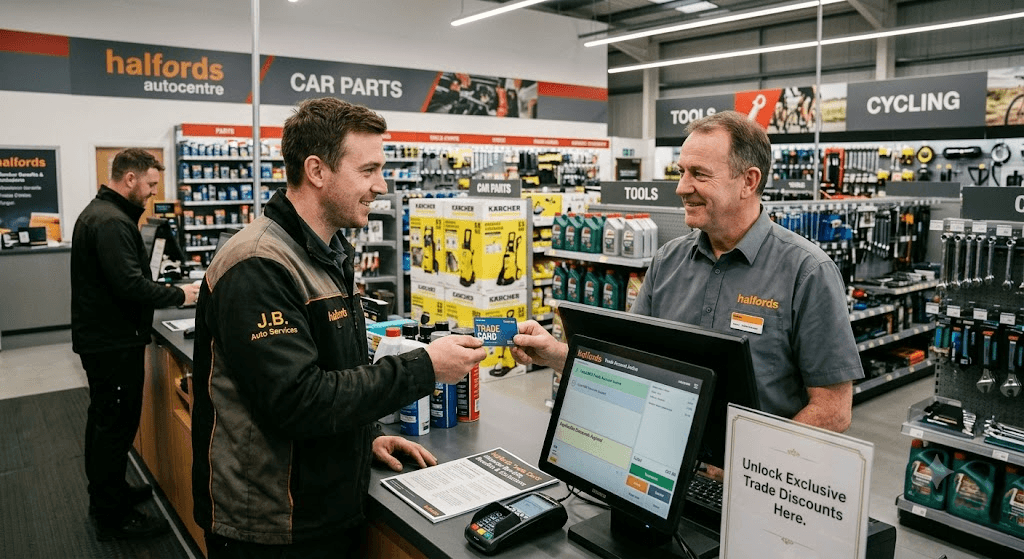
Halfords keeps the gates to this program relatively well-guarded to prevent the general public from eroding their retail margins. Officially, the application form demands proof of full-time employment or self-employment within the motor trade. The instantly accepted categories include:
- Qualified vehicle mechanics and mobile technicians
- Auto electricians and diagnostic specialists
- Bodyshop technicians, panel beaters, and sprayers
- Commercial transport mechanics (HGV/PSV)
- Professional vehicle valeters and detailers
- Roadside recovery operators (AA, RAC, Green Flag, independent flatbeds)
The “Backdoor” Qualification Routes
What happens if you aren’t a traditional greasy-handed mechanic? Several secondary groups legally qualify for the card, though they frequently fail to realise it:
1. Automotive College Students and Apprentices:
If you are currently studying for an IMI, City & Guilds, NVQ, or BTEC qualification in any automotive discipline, you are fully entitled to a Trade Card. You simply need to present your active college enrolment letter or student ID bearing the course name.
2. Owner-Driver Couriers and Fleet Operators:
If you operate a registered limited company that relies on a fleet of vehicles (for example, a local courier running three Mercedes Sprinters, or a landscaping business with two tipper trucks), you qualify under the ‘Fleet Operator’ clause. You will need to show a copy of your V5C logbooks tied to the business address alongside your company certificate of incorporation.
3. Armed Forces Transport Engineers:
Serving members of the REME (Royal Electrical and Mechanical Engineers) or RAF/Naval equivalent mechanical trades gain instant access upon presenting their military trade ID.
Note on Taxi and Private Hire Drivers: Historically, hackney carriage and private hire drivers were granted trade cards instantly. In recent years, Halfords has tightened this policy. A standard Uber or local mini-cab badge will no longer guarantee an over-the-counter pass unless you can prove you personally purchase the service parts to maintain the vehicle yourself via business receipts.
The Application Process: How to Avoid Getting Rejected
You can apply for the card via two avenues: online through the Halfords web portal, or physically at the parts desk inside any retail branch. Always choose the physical branch option.
The online verification portal uses an automated document-checking system that is notoriously temperamental; a slightly blurry photograph of a public liability insurance document will result in an automated rejection email three days later. Going into a branch allows a human duty manager to use their discretion.
Walk up to the parts desk with two forms of proof from the following list:
- A recent business invoice from a recognized motor factor (e.g., a receipt from TPS, GSF, or Andrew Page showing your trade account name).
- Your public liability insurance schedule showing ‘Motor Trade’ or ‘Vehicle Repair’ as the insured activity.
- A formal City & Guilds / IMI qualification certificate.
- A business bank account statement showing your trading name.
- A formal payslip from a registered garage or dealership showing your occupation as a technician.
Once the manager inspects the documents, they will assign a barcode to your account and hand you a physical card on the spot. More importantly, they will link it to your email address.
6 Insider Rules Every Trade Card Holder Needs to Know
Once that piece of plastic is sitting in your wallet, you need to understand the software quirks of the Halfords retail system to squeeze the absolute most out of it.
1. The “Lowest Price Wins” Till Logic
Halfords frequently runs aggressive consumer promotions (e.g., “20% off all socket sets” over a Bank Holiday weekend). A common point of confusion at the till is whether your trade discount stacks on top of the sale price.
It never stacks. However, the till software is programmed with a “best price guarantee for the trade.” When the item is scanned, the computer calculates the standard Trade Card price, compares it to the live public promotional price, and automatically charges you whichever figure is lower. You will never accidentally pay more than the public, but you cannot get “double discounts.”
2. The Crucial ‘Online Account Link’ Step
Many mechanics keep the physical card in their van, walk into a store, find out a part isn’t in stock, and leave frustrated. The very first thing you should do upon receiving your trade barcode is log into your standard Halfords.com consumer account, go to ‘My Account’, and enter your Trade Card number.
Once linked, the entire Halfords website transforms. Every time you view a product logged in, the standard retail price is crossed out in red, and your bespoke trade price is displayed alongside live local Click & Collect stock levels. You can order a trade-priced car battery at 10:30 PM from your sofa and have your apprentice collect it at 8:00 AM the next morning.
3. Exploit the “Trade Only” Bulk Part Numbers
There are products kept in the back stockroom that do not appear on the public shop floor. These are prefixed in the Halfords inventory system with trade codes. For example, rather than picking up four individual 1-litre bottles of brake fluid from the shelf, ask the desk for the “Trade 5L Workshop Brake Fluid Drum.” The unit cost per millilitre drops to a fraction of the retail equivalent.
4. The Advanced Tool Warranty Loophole
If you snap a Halfords Advanced T40 Torx bit while working on a stubborn subframe, you do not need to show your Trade Card to get it replaced. You simply walk in, hand the broken bit to the cashier, and they hand you a brand new one from the shelf under the lifetime guarantee. However, always scan your Trade Card anyway. Why? Because it logs the transaction history to your digital account, meaning if you ever lose the tool entirely or have your workshop broken into, Halfords can generate a complete itemised trade-replacement proof of ownership for your insurers.
5. Separate Your “Motoring Club” Account
Halfords heavily pushes its consumer “Halfords Motoring Club” (which offers free MOT check-ups and a £5 welcome voucher). Do not attempt to merge a Premium Motoring Club account with a Trade Card account on the same email address; the software frequently gets stuck in a loop trying to decide whether you are a retail retail customer or a trade customer, occasionally locking out your wholesale pricing tiers.
6. Keep an Eye on “Web Exclusive” Consumer Prices
In very rare instances—usually around Black Friday—Halfords will drop a consumer item (like a high-end pressure washer) to a “Web Only Super-deal” price that is actually lower than the automated Trade Card cost-plus calculation inside the store. If you are standing at the trade counter, open the web browser on your phone to double-check the public web price before tapping your card.
The Motor Factor Showdown: Halfords vs. Euro Car Parts
The ultimate question for any working garage is: *Should I actually use Halfords over my local Euro Car Parts, GSF, or LKQ branch?*
The honest answer is that they serve two entirely different logistical purposes.
Euro Car Parts will beat Halfords on the sheer breadth of obscure mechanical components. If you need a dual-mass flywheel for a 2011 Alfa Romeo Giulietta or a specific eccentric bolt for a BMW rear suspension setup, Halfords will not be able to help you. Their aftermarket car-parts catalogue (sourced via their partnership with *Cataclean* and *National*) takes 24 to 48 hours to arrive in-store.
Where the Halfords Trade Card completely obliterates the traditional motor factors is the emergency logistics window.
Traditional motor factors shut their trade counters at 12:30 PM on a Saturday and do not reopen until Monday morning. If it is 3:15 PM on a Sunday afternoon, you have a customer’s Nissan Qashqai stuck on your 2-post lift with a dead cell in the battery, and the owner needs the car to drive to Manchester at 6:00 AM on Monday, Halfords is the only game in town. Being able to walk into a bright retail store on a Sunday afternoon, bypass the queue, show a piece of plastic, and walk out with a Yuasa battery at wholesale cost is an indispensable safety net for any serious automotive business.