 savingsspot.co.uk
 In an era where the cost of living dominates the national conversation, the desire for personal aesthetic refinement hasn’t vanished—it has simply become more financially scrutinised. Across the United Kingdom, the search for “cosmetic surgery deals” has reached an all-time high. From discounted dermal fillers to packaged mummy-makeovers, the modern British patient is actively hunting for value.
However, aesthetic medicine occupies a unique space in the consumer market. If you hunt for a bargain on a television and it fails, you return it to the shop. If you hunt for a bargain on a general anaesthetic procedure and the standards have been compromised, the consequences can be permanently life-altering. Navigating the world of aesthetic promotions requires a complete shift in consumer mindset: you are no longer shopping for a commodity; you are commissioning a permanent alteration to your own biology.
This article explores the landscape of cosmetic surgery offers in the UK, examining how clinics construct their pricing, how to identify a genuine financial saving versus a dangerous corner-cut, and the legal protections you hold as a British patient.
The Anatomy of a Surgical Price Tag
To understand what constitutes a legitimate “deal,” you must first understand what you are actually paying for when you receive a quote of £6,000 for a standard procedure. A reputable UK clinic’s invoice is split across four rigid financial pillars:
- The Surgeon’s Fee: This reflects the practitioner’s years of training, their standing on the General Medical Council (GMC) Specialist Register, their insurance premiums, and their track record.
- The Anaesthetist’s Fee: Often overlooked by patients, a dedicated Consultant Anaesthetist is required to keep you alive and pain-free during the operation. Their time is billed by the hour.
- Theatre and Facility Costs: Operating theatres must meet stringent Care Quality Commission (CQC) standards for air filtration, sterility, and emergency resuscitation equipment. This represents a massive fixed overhead.
- Consumables and Implants: The physical materials used, from the high-grade medical silicone of a breast implant to the specific brand of botulinum toxin or surgical sutures.
When you see a promotion offering 40% off a surgical procedure, basic mathematics dictates that one or more of these four pillars has been heavily compressed. The golden rule of aesthetic shopping is simple: a clinic can discount their profit margin, but they cannot discount the cost of safe medical delivery.
Regulatory Red Flags: The “Two-Week” Rule
In the United Kingdom, the marketing of medical procedures is strictly monitored by the Committee of Advertising Practice (CAP) and the regulatory codes set out by the GMC. If you encounter a cosmetic surgery deal that utilises any of the following tactics, you should walk away immediately:
“Book by Friday to secure this price.”
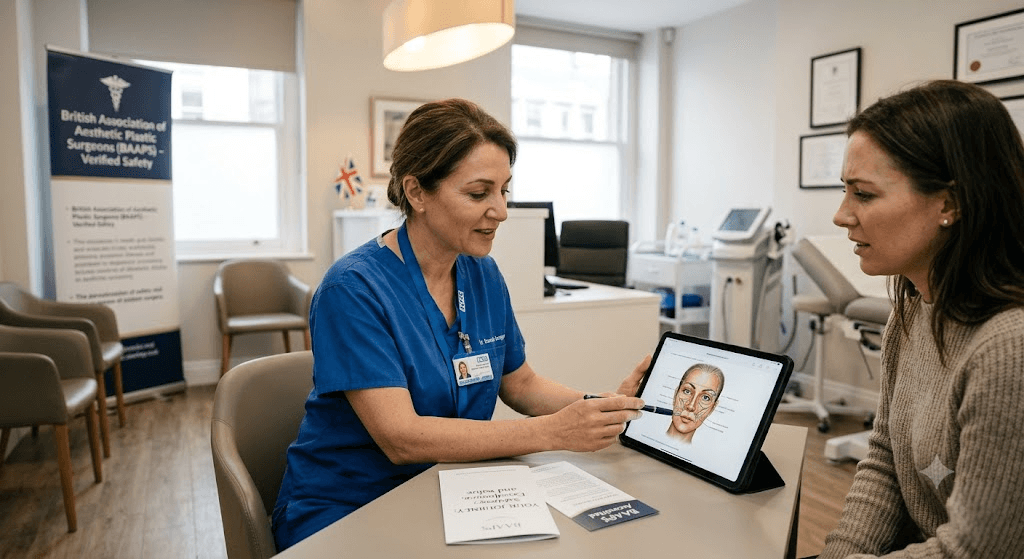
Time-limited discounts are considered a severe breach of professional medical ethics in the UK. The British Association of Aesthetic Plastic Surgeons (BAAPS) and the GMC explicitly state that patients must never be placed under financial pressure to undergo a procedure. By law and professional code, you are entitled to a mandatory “cooling-off” period—typically 14 days between your initial consultation and the date you hand over your deposit. A deal that expires to force your hand is a rogue offer.
“Win a free Rhinoplasty in our Instagram giveaway.”
Offering prescription-only medicines (such as Botox) or invasive surgical procedures as prizes in social media raffles is illegal under UK advertising rules. Clinics engaging in this behaviour are demonstrating a fundamental disregard for patient triage and medical suitability.
“Buy one area, get the second half price.”
While common in high-street retail, treating human tissue like a supermarket buy-one-get-one-free promotion encourages over-treatment. A medical professional should only ever administer what your specific anatomy requires, not what a sales bundle dictates.
Four Legitimate Ways to Reduce UK Surgery Costs
If seasonal flash sales are dangerous, how does a savvy consumer legitimately lower the cost of private cosmetic work in Great Britain? There are four safe, structurally sound avenues to secure better value.
1. Utilising 0% Medical Finance
The most sensible “deal” available in modern British healthcare is not a reduction in the headline price, but the elimination of the cost of borrowing. Rather than hunting for a cheap £3,000 operation, seek out a top-tier £5,000 surgeon who operates via a specialised medical finance provider (such as Chrysalis Finance). Securing a 12 to 24-month 0% APR payment plan allows you to access elite, highly regulated CQC-inspected facilities without paying a single penny in interest, effectively protecting your capital against inflation.
2. The Combined Procedure Economy
If you require more than one intervention—for example, a breast lift and an abdominoplasty (commonly termed a ‘Mummy Makeover’)—booking them as separate operations over two years is exceptionally bad financial management. Every time you enter a surgical theatre, you pay a fixed baseline fee for the room set-up, the admission, and the anaesthetist’s initial attendance. By combining compatible procedures into a single theatre session, the clinic saves on logistical overheads, and those savings are passed directly to you. You pay the “facility drop fee” once, rather than twice.
3. Academic and Masterclass Modelling
There is a vast difference between a back-room beautician offering “model slots” for £50 filler, and an accredited medical institution seeking patient models. High-end training academies, often run by leading BAAPS-registered consultants, run advanced masterclasses to teach fully qualified plastic surgeons new, highly specialised techniques (such as deep-plane face-lifting or preservation rhinoplasty). Because the operation is being observed or performed under the direct, unblinking supervision of a master surgeon, the cost of the surgery is heavily subsidised. You receive top-tier expertise at a fraction of the standard private list price, exchanged for your time and the use of your anonymised clinical photography.
4. Identifying “Off-Peak” Clinical Windows
While reputable surgeons do not do “January Sales,” private hospital groups operate as businesses with high fixed overheads. During the deep mid-winter (late January and February) and the peak summer holiday season (August), elective surgery bookings naturally dip as patients prioritise holidays or post-Christmas recovery. Clinics are frequently willing to bundle high-value aftercare packages—such as complimentary lymphatic drainage massage sessions, premium post-operative compression garments, or extended review periods—into standard surgical quotes during these quieter months to keep their theatre staff fully utilised.
Deconstructing the “Package Deal”: The Hidden Exclusions
When assessing a quote that looks remarkably cheap, you have to play the role of a forensic accountant. Sensationally low package prices almost always rely on “unbundling” standard medical care. When reviewing a cosmetic quote, look closely at the small print to see if the following essentials have been quietly shifted onto a secondary bill:
- Pre-Operative Diagnostics: Does the price include your mandatory MRSA swabs, blood panels, and pre-op electrocardiograms (ECGs), or will you receive an unexpected invoice from the laboratory a week before surgery?
- The Revision Policy: This is the single most vital clause in your contract. Even in the hands of the world’s best surgeon, the human body can react unpredictably; capsular contracture, asymmetrical healing, or thick scarring occurs in a small percentage of all cases. If you require a secondary revision surgery six months down the line, *who pays for the theatre time?* A cheap deal becomes a financial catastrophe if the clinic’s policy states that revision theatre fees are entirely at the patient’s expense.
- Post-Operative Pharmacotherapy: Are your take-home broad-spectrum antibiotics, high-strength analgesics, and anti-emetics covered, or will you be handed a private prescription to take to a high-street chemist at your own expense?
- Overnight Stays: If your procedure finishes late in the afternoon or runs into a minor complication, does your package cover an unexpected overnight stay in a private ward, or does it trigger an automatic “late discharge fee” billed at £500 per hour?
The Long-Haul Illusion: Sourcing Deals Abroad
It is impossible to discuss cosmetic deals without addressing the colossal market of medical tourism, most notably in Turkey, the Czech Republic, and Lithuania. The mathematics of an all-inclusive “flight, hotel, and surgery” package for £2,800 when the UK equivalent sits at £6,500 feels intellectually impossible to ignore.
However, the British consumer routinely miscalculates the *True Landed Cost* of surgical travel. When evaluating a foreign package deal, you must price in the unwritten variables:
First, factor in your lost economic productivity. A standard UK procedure allows you to rest at home; an operation abroad requires you to take an extra five to seven days of annual leave strictly to sit in a hotel room waiting for a “fit to fly” certificate. Second, consider the atmospheric physics of a commercial aircraft cabin. Flying within 48 to 72 hours of major surgery exposes traumatised tissue to fluctuating cabin pressure, drastically increasing the risk of deep vein thrombosis (DVT), severe swelling, and wound separation.
Most critically, calculate the “UK Remedial Tax.” The National Health Service (NHS) is under immense operational strain; its official mandate regarding botched cosmetic surgery performed abroad is strictly limited to *saving life and limb*. If you return to the UK with an infected seroma, a necrotic wound edge, or asymmetrical placement that isn’t actively threatening your life, the NHS will stabilise you and discharge you. You will be forced to seek out a British private consultant to correct the work. Because UK surgeons carry massive liability when operating on unknown scar tissue created by undocumented practitioners, the fee for “revision of foreign surgery” is routinely 150% to 200% of the standard primary price.
A £2,500 saving made in Istanbul can instantly evolve into an £11,000 private reconstruction bill in Manchester.
The Ultimate UK Patient Safety Checklist
If you have found a competitively priced cosmetic package within Great Britain and want to verify its legitimacy before committing your finances, subject the offer to this four-step audit:
- Verify the Specialist Register: Do not just look up the doctor on the GMC register to see if they are licensed. Look specifically at the *GMC Specialist Register for Plastic Surgery*. A general practitioner can legally call themselves a “Cosmetic Surgeon” in the UK without holding formal Royal College of Surgeons (FRCS Plast) accreditation.
- Audit the Premise via the CQC: Go to the Care Quality Commission website and type in the exact postcode of the building where the knife will cut skin. Read the latest inspection report. Look specifically at the sub-ratings for *Safety* and *Leadership*.
- Pay the Deposit via Credit Card: Under Section 75 of the UK Consumer Credit Act 1974, if you pay for a service costing between £100 and £30,000 using a credit card (even if you only put a £200 deposit on the card and pay the rest in cash), the credit card provider becomes jointly liable with the clinic. If the clinic goes into sudden financial administration before your surgery, or delivers a service that fundamentally breaches the contract, your credit card firm is legally bound to fight for your refund.
- Demand the “Implant Passport”: If your deal involves any form of prosthetic insertion, insist on written confirmation that you will be provided with the manufacturer’s lot number, serial sticker, and product passport upon discharge.
The Bottom Line on Aesthetic Value
True value in cosmetic surgery is defined entirely by the absence of regret. A cheap procedure that results in poor symmetry, a painful recovery, or an eroded sense of self-esteem is the most expensive purchase you will ever make.
When searching for cosmetic surgery deals across Great Britain, treat the market with the analytical coldness of an investor. Look for clinics that create financial savings through operational efficiency, combined bookings, and clever scheduling—and run a mile from any practitioner who tries to put a ticking clock on your self-image.