 savingsspot.co.uk
 When the cost of the weekly food shop feels less like a routine domestic chore and more like an exercise in high-stakes financial negotiation, supermarket loyalty schemes stop being a polite perk and become an absolute necessity. For millions of British households, the green-and-yellow branding of Morrisons represents the traditional, reliable middle ground of UK grocery shopping—sitting comfortably between the aggressive German discounters and the high-end, premium food halls. Yet, if you are simply swiping a plastic card or tapping your phone at the till without actively interrogating the digital side of MyMorrisons offers, you are quite literally leaving your own hard-earned change sitting on the conveyor belt.
The United Kingdom’s supermarket loyalty landscape has undergone a profound psychological shift over the last five years. We have collectively moved away from the passive “collect a solitary point per pound and check the balance once a year” model toward an aggressive, hyper-personalised, gamified arena of instant digital discounts. Morrisons has been right at the epicentre of this evolution, transitioning its scheme through various complex iterations before settling into the robust, data-driven ecosystem we use today.
Whether you still refer to it as the MyMorrisons app, the Morrisons More card, or simply “that barcode on my phone,” mastering its internal logic is the difference between a standard receipt and one that makes you smirk all the way back to the car boot.
The Great Identity Shift: From MyMorrisons to Morrisons More
To truly understand how to extract the maximum value from the app today, one has to look at the recent history of the scheme. In 2021, Morrisons made the controversial decision to axe its points-based system entirely, rebranding to “MyMorrisons” and offering shoppers instant, personalised money-off coupons instead. The British public, fiercely protective of their right to watch an imaginary digital balance tick upward, did not take kindly to the loss of their tangible points.
Listening to a tidal wave of consumer feedback, the supermarket executed a masterclass in brand correction. They brought back the beloved “More Points” system while permanently retaining the intelligent, tailored digital coupons developed during the MyMorrisons era. Today, the platform operates as a dual-threat hybrid scheme:
- The Points Engine: You earn 5 points for every £1 spent on selected products across the store, and 5 points for every litre of fuel purchased at a Morrisons petrol station.
- The Offer Hub: A rotating digital carousel of bespoke price cuts, multi-buys, and freebies tailored entirely to your historical till receipts.
Because the internet has a long memory, millions of UK shoppers still type “MyMorrisons offers” into search engines when hunting for their weekly discounts. The great news is that whether you log in via the classic desktop portal or the updated mobile app, the offers live in the exact same place—they just carry far more financial firepower than they used to.
How the Offers Algorithm Actually Sees Your Trolley
Have you ever wondered why your partner’s app offers them 20% off fresh salmon, while your app offers you 70p off a massive tub of peanut butter? You are witnessing the Morrisons predictive customer engine at work. The app does not issue a blanket set of vouchers to the Great Britain public; it runs a complex behavioural matrix based on your scanned barcode history.
The algorithm groups shoppers into distinct archetypes. If the software notices that you buy semi-skimmed milk, Cathedral City cheddar, and Warburtons crumpets every single Tuesday without fail, it will rarely give you a voucher for crumpets. Why would it subsidise an item you have proven you will buy at full price? Instead, the algorithm will deploy “brand stretch” offers. It will offer you 15% off Morrisons’ *The Best* sourdough to tempt you away from the crumpets, or offer you 500 bonus points to try a new plant-based butter.
Understanding this gives the savvy consumer an immediate advantage: to get better offers, you have to occasionally disrupt your own shopping habits.
The Five Pillars of MyMorrisons Offers
When you open the application on a Friday morning to plan your weekend top-up shop, the interface separates your potential savings into five distinct categories. Treating them as separate financial tools is the key to dropping your basket total.
1. The “More Card Exclusives” (The Yellow Shelf Barkers)
This is Morrisons’ direct answer to Tesco’s Clubcard Prices. These are non-personalised, store-wide instant discounts applied at the point of payment simply for scanning your card. They are heavily concentrated in the meat, alcohol, and ambient household aisles. A £12 bottle of Malbec marked down to £8 for cardholders is an instant £4 saving that requires zero prep-work inside the app.
2. The Tailored Digital Coupons
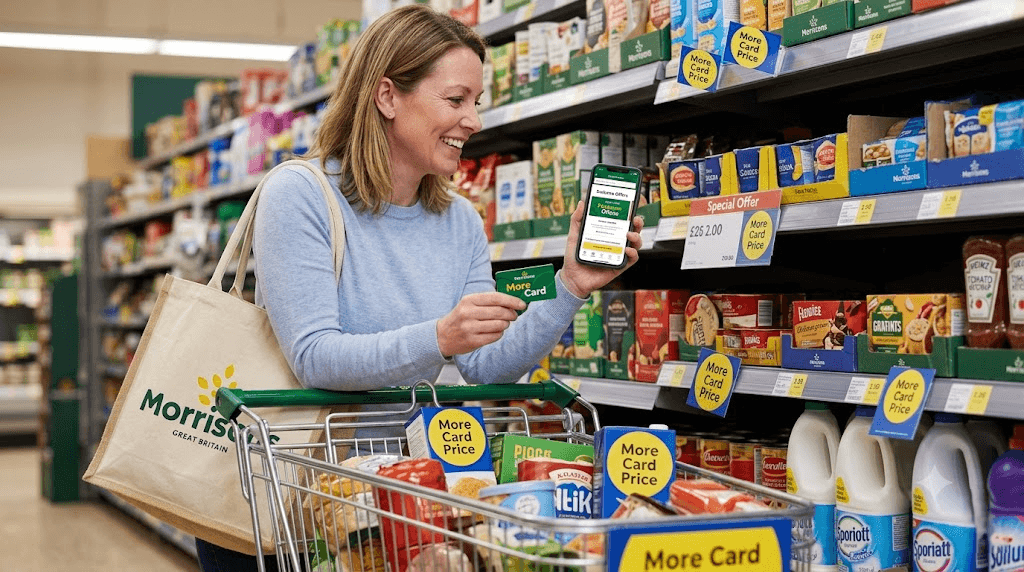
These are the core “MyMorrisons” legacy offers. Usually lasting for 7 to 14 days, these sit in your app waiting to be noticed. They typically manifest as percentage discounts on specific departments (e.g., “15% off all Frozen Food”) or fixed cash deductions on brand names (e.g., “£1.00 off any large box of Yorkshire Tea”).
3. The Gamified “Basket Bonus”
One of the most psychologically clever additions to the app. When you scan your digital card at the till, the system occasionally triggers a hidden digital scratch-card inside your app. Upon opening it, you might be told you have won a free bag of jam doughnuts from the bakery, a £5 off your next £40 shop voucher, or a cluster of bonus points. It turns the mundane act of paying into a low-stakes raffle.
4. The Legendary “Morrisons Fivers”
The ultimate goal of the points collector. Once your balance hits 5,000 points, the app automatically generates a £5.00 voucher. What makes the Morrisons Fiver superior to several competing schemes is its liquidity: you can generate it instantly on your smartphone while standing in the queue, push it to your active card, and have five quid wiped off the total three minutes later.
5. The Fuel Saver Mechanics
During periods of high inflation, Morrisons regularly runs the “Shop £40, Save 5p per Litre” promotion. Your app acts as the digital vault for these fuel tokens. When you pay at the kiosk or the pay-at-pump terminal, scanning the app automatically knocks the promotional pence off your final forecourt tally.
The Cardinal Sin of Morrisons Shopping: Forgetting to Activate
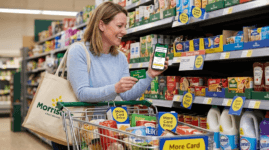
If there is one trap that catches out traditional British shoppers more than any other, it is the manual “Activate” button. Unlike the physical coupons of the 1990s that you handed to a cashier, or standard store-wide discounts, tailored MyMorrisons offers remain completely dormant until you physically tap the little box next to them on your touchscreen.
Picture the tragic British retail scene: a shopper spends forty minutes carefully selecting items that match the vouchers they saw on their iPad over breakfast. They get to the self-checkout, scan their items, scan their phone, pay, and check the receipt—only to realise the total is £14 higher than expected. They forgot to press activate.
The app requires a digital handshake. To avoid holding up the queue while desperately trying to get a 4G signal inside a steel-roofed supermarket building, make it a religious habit to sit down on a Thursday evening on your home Wi-Fi, open the offer tab, and simply hit “Activate All”. There is no penalty for activating an offer you don’t end up using.
Advanced Tactics: The Fine Art of “Offer Stacking”
For the elite bargain hunter, a single discount is a failure of imagination. True supermarket mastery comes from “stacking”—aligning an in-store promotion, a digital app coupon, and an external payment vehicle on the exact same product.
Consider a theoretical example using a large tub of branded laundry capsules:
- The Store Level: The capsules are placed on a standard promotional drop from £10.00 down to £7.00.
- The Exclusive Level: A shelf tag notes that More Card holders get an extra £1.00 off, bringing the till price to £6.00.
- The App Level: You have checked your MyMorrisons offers and activated a bespoke voucher for “20% off all Laundry & Household Cleaning”. This takes another £1.20 off the price, bringing it to £4.80.
- The Payment Level: You pay for your shop using a Morrisons digital gift card purchased through an employee benefits portal (such as Blue Light Card, Edenred, or a corporate perk scheme) offering a 4% upfront discount on the voucher purchase.
Through systematic stacking, a £10.00 box of washing powder is acquired for roughly £4.61. When applied across an entire 80-item family shop, stacking is the mechanism that routinely slashes £25 to £35 off the checkout display.
Unlocking Hidden Tiers: The Morrisons Clubs
Tucked away inside the account settings of the digital platform are the “Clubs”. Many users ignore these, assuming they are digital mailing lists for junk mail. In reality, opting into these clubs tells the algorithm to drop specialized, high-yield offers into your feed.
The More Card Baby Club
If you have a child under the age of four (or are expecting), joining this tier is non-negotiable. Members receive exclusive, highly aggressive discounts on Mamia and Pampers nappies, infant formula, baby wipes, and organic toddler pouches. Furthermore, the app regularly drops “Free Gift” vouchers into Baby Club wallets, allowing parents to pick up a free pack of sensitive wipes or a baby wash at the till.
The NHS & Blue Light Integration
While the famous universal 10% NHS discount that Morrisons ran during the pandemic eventually came to an end, the app retained a soft spot for healthcare and emergency workers. By linking a valid Blue Light Card or NHS email address to your MyMorrisons account profile, the algorithm flags you for elevated “Key Worker” promotional drops, particularly around Christmas, Easter, and national bank holidays.
The “Dormancy Hack”: Testing the Re-engagement Engine
Supermarket data scientists are terrified of “churn”—the moment a loyal customer starts wandering over to Sainsbury’s, Asda, or Aldi. Because the MyMorrisons app tracks the exact timestamp of your last transaction, you can weaponise their data against them using the principle of strategic absence.
If you use your card three times a week, the app knows it has you hooked; it doesn’t need to try very hard to get you through the automatic doors. However, if you abruptly stop scanning your app at Morrisons for 21 to 28 days, a digital panic alarm goes off in the system. The predictive model flags you as a “lapsed customer”.
To win you back, the system will automatically deploy what the industry calls “re-engagement bait”. Suddenly, your sleepy app will light up with a push notification: “We’ve missed you! Here is £5 off your next £30 shop,” or “Enjoy 1,000 bonus points on us the next time you buy any fresh bread.” By rotating your big monthly shops between two or three different supermarket chains, you can keep their respective algorithms in a perpetual state of desperate re-engagement.
Why the Plastic Key Fob is Costing Older Shoppers Money
Walk through any Morrisons in Great Britain on a Tuesday morning, and you will see dozens of pensioners diligently holding up a small, battered green plastic fob attached to their house keys. While this physical fob successfully captures base points, it is a fundamentally crippled version of the loyalty scheme.
Because the physical card has no screen, it cannot display the tailored “MyMorrisons offers” generated by the backend server. Unless an elderly relative has logged onto the Morrisons website via a desktop computer at home to manually click “Activate” on their digital dashboard, those personalised 20% off vouchers will sit in the cloud forever, unused, while the shopper pays full retail price at the till.
If you have parents, grandparents, or non-tech-savvy neighbours who shop at Morrisons, the single kindest financial favour you can do for them is to download the app onto their smartphone, log them in, and teach them how to hit the green “Activate” buttons once a week over a cup of tea.
Navigating Till Disasters: When Offers Fail to Apply
Nothing spikes the British blood pressure quite like watching the final subtotal appear on a self-service screen and realising the digital offers haven’t worked. When this happens, do not panic and do not immediately blame the machine; check the four golden troubleshooting rules of the Morrisons checkout:
- The Order of Operations: At Morrisons self-service tills, always scan your mobile phone barcode *before* you start scanning your groceries. This forces the internal computer to live-calculate the “More Card Exclusives” as the items go down the belt, giving you real-time visual confirmation that your discounts are working.
- The Exclusions List: By UK law and strict corporate policy, certain items are strictly forbidden from generating points or acting as the qualifying spend for a digital voucher. These include infant milk formula (Stage 1), postage stamps, National Lottery tickets, tobacco, prescription medicines, and third-party gift cards. If your voucher says “Spend £40 get £5 off”, and £8 of your basket consists of stamps and a lottery ticket, your *qualifying* spend is only £32. The voucher will fail to trigger.
- The “Minimum Spend” Catch: When using a tailored app coupon (e.g., “Save £2 on a £15 fresh meat spend”), the £15 threshold must be met *after* all other multi-buys have been applied. If a 3-for-£10 meat deal knocks your meat subtotal down to £9.99, your app coupon will instantly deactivate.
- The Screen Brightness Issue: If the red laser at the checkout refuses to acknowledge your phone, turn your device’s auto-brightness off and crank the screen to 100%. Modern smartphone privacy protectors and anti-glare screens scatter the checkout’s optical scanner unless the backlight is set to maximum.
The Verdict: Is the MyMorrisons Ecosystem Worth the Digital Faff?
In a saturated market of digital schemes, the Morrisons More offering succeeds precisely because it refuses to be just one thing. For the passive shopper, the yellow shelf-edge labels offer zero-friction, immediate gratification. For the digital native willing to spend four minutes a week ticking boxes on a phone screen, the custom “MyMorrisons offers” act as a bespoke shield against grocery inflation.
By treating the app not as a digital nuisance, but as a live control panel for your household food budget, you transform the weekly supermarket run from a passive financial drain into a highly rewarding tactical exercise.