 savingsspot.co.uk
 Walk into any high street supermarket in the United Kingdom at half-past twelve on a weekday, and you will witness a deeply ingrained cultural ritual. Professionals, students, and tradespeople alike congregate around the chilled aisles, performing a familiar, calculated dance. They are partaking in the modern British lunchtime tradition: securing the Tesco meal deal. It is far more than just a quick lunch; it is an institution, a mathematical challenge, and a social identifier all rolled into one.
For the uninitiated, the concept is beautifully simple. You select a main course, an accompanying snack, and a drink for a set, discounted price. Yet, beneath this straightforward premise lies a complex ecosystem of pricing tiers, Clubcard strategies, and fierce internet debates. This article delves deep into the fabric of the Tesco meal deal, exploring how it revolutionised the grab-and-go food market, how you can maximise your value, and why it holds such a special place in the nation’s heart.
The Anatomy of the Deal: How It Works
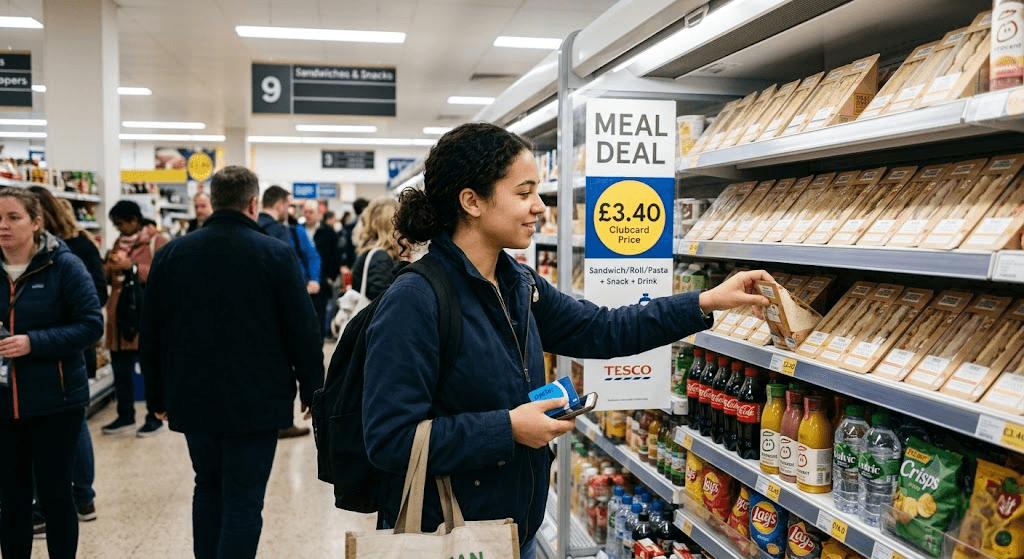
At its core, the Tesco meal deal relies on the holy trinity of convenience food. To qualify for the heavily discounted set price, a shopper must select three specific items marked with the iconic meal deal logo:
- The Main: The foundational element. This category spans traditional sandwiches, wraps, pasta salads, sub rolls, and increasingly, dietary-specific options like gluten-free or vegan dishes.
- The Snack: The supporting act. Traditionally a packet of crisps, but the definition has expanded to include chocolate bars, fruit pots, boiled eggs, meat snacks like Fridge Raiders, and even miniature cakes.
- The Drink: The hydration component. Ranging from a humble bottle of still water to premium cold-pressed smoothies, iced coffees, and heavily caffeinated energy drinks.
The magic happens at the till. Individually, these items could easily tally up to £6 or £7. However, when combined, the till applies a magical algorithm that drops the price to a flat, highly appealing rate. But in recent years, the mechanics of this discount have undergone a radical transformation.
The Clubcard Revolution: Two-Tier Pricing
Historically, the Tesco meal deal was a flat £3 for everyone. It was the great equaliser. However, as inflation began to bite and retail strategies evolved, Tesco introduced a seismic shift in how Britain pays for its lunch: the Clubcard price.
Today, the meal deal is structured around customer loyalty. If you swipe your Tesco Clubcard at the checkout, you unlock the optimal price (currently sitting around £3.40 for the standard deal). If you forget your Clubcard, or choose not to participate in the loyalty scheme, you are hit with the non-Clubcard price, which is significantly higher. This shift not only incentivised millions of Britons to download the Tesco app, but it also created a new social dynamic. Forgetting your Clubcard at the self-service checkout and being forced to pay the premium has become a universally recognised modern tragedy.
Maximising Your Value: The Art of the “Hack”
For a specific breed of British consumer, buying a meal deal is not about satisfying hunger; it is an economic game. The objective is to select the three most expensive individual items available, achieving the highest possible saving. This is where the concept of “meal deal maths” comes into play.
If you choose a basic cheese sandwich (£1.50), a packet of standard crisps (£0.90), and a bottle of water (£0.65), your individual total is £3.05. In this scenario, purchasing the meal deal actually costs you money. This is the ultimate rookie error.
Conversely, the seasoned veteran knows exactly where the value lies. To master the Tesco meal deal, one must look towards the premium end of the standard chilled cabinet:
- High-Value Mains: The “Triple” sandwiches are the undisputed kings of value. The All Day Breakfast Triple or the Chicken Club Triple often retail individually for over £3.00. High-protein wraps and large pasta bowls also carry hefty individual price tags.
- High-Value Drinks: Never buy water. To maximise your return on investment, you must target the smoothies and iced coffees. Brands like Innocent, Naked, and Costa Coffee often command prices north of £2.50 on their own. Red Bull and large cans of Monster energy drinks are also prime targets for the value-conscious buyer.
- High-Value Snacks: Move past the standard Walkers crisps. Look for share-size bags of McCoy’s, large Peperami sticks, premium nut mixes, or protein-heavy meat snacks. Fresh fruit pots, particularly those containing berries or melon, also boast high individual retail prices.
By combining a £3.30 triple sandwich, a £2.80 smoothie, and a £1.50 meat snack, a shopper can secure nearly £8 worth of food for the flat Clubcard rate. The psychological satisfaction of seeing the total plummet on the checkout screen is, for many, the highlight of the working day.
The Premium Meal Deal: Elevating the Lunch Hour
Recognising that consumer tastes were evolving beyond the standard ham and cheese on malted bread, Tesco introduced the Premium Meal Deal. Priced higher than its standard counterpart (typically around £5.00 with a Clubcard), this tier targets the high-end high street lunch market, going toe-to-toe with dedicated food-to-go retailers like Pret A Manger and Itsu.
The Premium tier is a marvel of supermarket logistics, bringing restaurant-quality variety to the express aisle. The mains in this category include elaborate Yo! Sushi platters, Pollen + Grace nutritional bowls, Finest range deep-filled sandwiches, and hot food options in stores equipped with heated cabinets. The drink and snack options remain largely the same, but the elevated main course justifies the price hike. It is the perfect option for a Friday treat or a post-payday lunch.
Cultural Impact: Rate My Meal Deal
To understand the true power of the Tesco meal deal, one must look away from the shelves and towards the internet. Over the past decade, the meal deal has transitioned from a retail promotion to an internet phenomenon.
Social media platforms are awash with groups and threads dedicated to reviewing, debating, and ruthlessly mocking people’s lunch choices. Facebook groups like “Rate My Meal Deal” boast hundreds of thousands of members. The rules are simple: you post a photo of your three items, and the community passes judgement.
There are unwritten laws within these digital communities. Selecting a bottle of plain water is viewed as an unforgivable sin. Pairing a plain ham sandwich with ready salted crisps will result in accusations of having a “beige” personality. On the other hand, a daring combination—perhaps a spicy chicken wrap, a boiled egg pot, and a tropical energy drink—will spark intense debate about flavour profiles and digestive consequences.
This online culture highlights how food choices have become a form of self-expression. Your meal deal combination supposedly reveals your character, your socio-economic status, and your approach to life. Are you a safe, predictable tuna-sweetcorn enthusiast, or are you a maverick grabbing a hoisin duck wrap and a chocolate brownie?
Dietary Shifts and Nutritional Navigation
While the meal deal has historically been associated with quick, sometimes heavily processed convenience food, Tesco has had to rapidly adapt to the changing dietary habits of the British public. The modern refrigerated aisle looks vastly different to that of a decade ago.
The rise of plant-based diets forced a major overhaul of the meal deal ecosystem. Tesco’s own “Plant Chef” range now features heavily, offering vegan alternatives to classic favourites, such as the VLT (Vegan BLT) and completely plant-based hoisin wraps. This inclusivity ensures that the meal deal remains relevant to the younger, more environmentally and health-conscious demographic.
Furthermore, navigating the nutritional landscape of the meal deal requires care. It is remarkably easy to accidentally consume over 1,000 calories and a day’s worth of sodium in one sitting if you opt for a triple bacon sandwich, a grab-bag of cheese crisps, and a full-sugar energy drink. Conversely, the inclusion of fresh fruit pots, edamame bean snacks, and high-protein, low-calorie salads means the meal deal can be seamlessly integrated into a strict fitness regime. The power, and the nutritional responsibility, lies entirely in the hands of the consumer.
The Competitors: Why Tesco Retains the Crown
Tesco is by no means the only player in the game. Boots, Sainsbury’s, Morrisons, and Co-op all offer their own iterations of the meal deal. Boots, in fact, is often credited with popularising the concept on the British high street and is still revered for its incredibly vast selection of healthy mains and premium drinks.
Sainsbury’s offers a highly competitive “Taste the Difference” premium tier, and Co-op frequently ties its meal deals to student discount cards, making it a staple of university life. Yet, Tesco arguably retains the crown. Why?
The answer lies in a combination of ubiquity and psychological engineering. There is a Tesco Express on almost every major high street, near every major train station, and dotted throughout residential neighbourhoods. This geographical dominance makes it the default choice. Furthermore, the gamification introduced by the Clubcard pricing strategy keeps customers locked into the Tesco ecosystem. When you know you are getting the “exclusive” lower price, stepping into a competitor’s store feels like a betrayal of your own wallet.
The Future of the Grab-and-Go Lunch
As inflation continues to impact wholesale food prices, the future of the meal deal is a topic of genuine national interest. Will the price continue to creep up? Will the size of the sandwiches shrink?
Retail analysts predict that the format will endure, simply because the demand for hyper-convenient, predictably priced food is deeply woven into the fabric of the modern British workday. However, we are likely to see a continued expansion of the premium tiers, more integration of hot food items (such as sausage rolls and breakfast baps from the heated counters being permanently included), and an even stronger push towards sustainable packaging.
Whatever the future holds, the Tesco meal deal remains a fascinating microcosm of British society. It is a daily exercise in economics, nutrition, and personal branding, played out in thousands of aisles across the country. The next time you find yourself standing before the glowing chillers, pondering whether to risk the spicy chicken pasta or play it safe with the cheese ploughman’s, take a moment to appreciate the institution you are partaking in. You are not just buying lunch; you are participating in a thoroughly modern British tradition.