 savingsspot.co.uk
 For over a century, the sight of a vibrant yellow Selfridges carrier bag swinging from a shopper’s wrist has served as a universal shorthand for British retail prestige. Founded by Harry Gordon Selfridge in 1909, the Oxford Street flagship—alongside its vibrant sister sites in Birmingham’s Bullring and Manchester’s Exchange Square—built a reputation on the concept that shopping should be an immersive event, not a chore. However, that prestige comes with a perceived price tag. There is a persistent myth floating around the British high street that Selfridges exists in a permanent sphere of full-price untouchability.
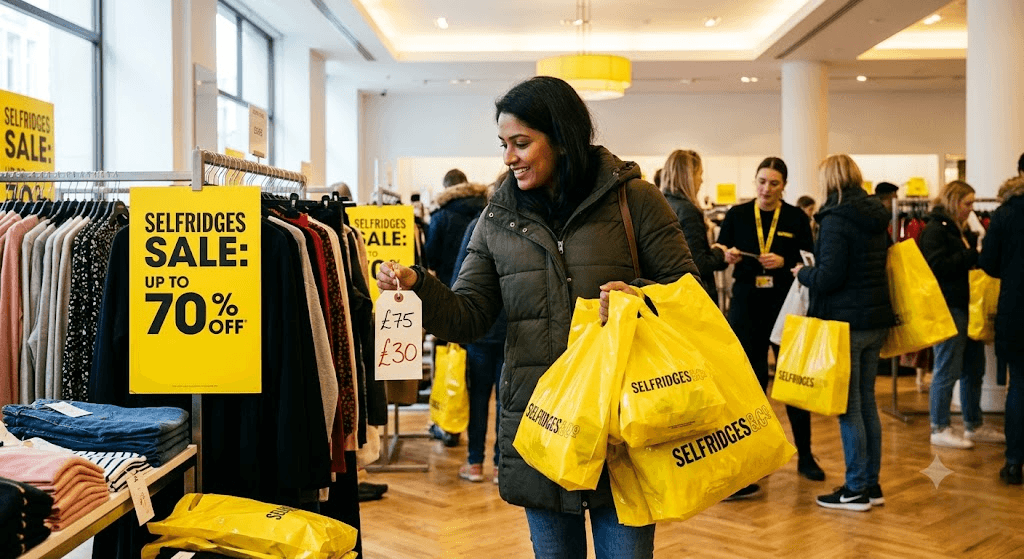
The reality is quite different. Selfridges hosts some of the most lucrative, high-yield sales in the European luxury market; they simply do not market them with the neon-tinted desperation of standard mid-market chains. Navigating a Selfridges markdown requires the tactical precision of an experienced personal shopper. From mastering the hidden rhythms of their online staging servers to exploiting the structural differences between ‘own-bought’ stock and brand concessions, this is your definitive roadmap to securing genuine luxury at a fraction of the recommended retail price.
The Master Sale Calendar: When Does Selfridges Actually Discount?
Unlike fast-fashion conglomerates that seem trapped in a perpetual cycle of fabricated “mid-season events”, Selfridges treats its major markdowns like rare celestial occurrences. If you miss the opening window, you miss the core stock. To shop strategically, you must build your personal retail calendar around four specific operational windows.
1. The Boxing Day Event (26th December)
This is the undisputed crown jewel of the Selfridges promotional calendar. While the physical stores historically open their doors early on the morning of December 26th to snaking queues along Oxford Street, the digital battle begins much earlier. The online Boxing Day sale almost universally goes live on Christmas Day itself, strictly between 12:00 PM and 4:00 PM GMT. This is the moment when seasonal autumn/winter inventory is given its first aggressive reduction, typically starting at 30% to 50% off contemporary fashion, footwear, and seasonal home accessories.
2. The Summer Sale (Mid-to-Late June)
Targeting the transition between spring/summer and autumn pre-collections, the Summer Sale is the optimal time of year to purchase high-end resort wear, sunglasses, designer luggage, and lightweight tailoring. Because British summers are notoriously unpredictable, high-value weather-dependent stock—such as linen separates by Jacquemus or open-toe woven mules by Loewe—often hits the sale rails in remarkably complete size runs.
3. “Christmas Comes Early” / The Autumn Event (Late November)
If you search the Selfridges website for “Black Friday”, you will find yourself met with a remarkably polite, blank screen. Out of historic brand positioning, the retailer refuses to use the traditional moniker. Instead, during the final week of November, they launch an event traditionally coded as “Christmas Comes Early” (historically triggered at the digital checkout by promotional codes like SELFCCE). Rather than clearing out dead seasonal stock, this event offers a blanket 20% off full-price fashion and homeware, and 10% off beauty and fragrance. It is the single most important week of the calendar year for purchasing non-sale staple items, such as a classic Max Mara camel coat, a Smeg stand mixer, or premium skincare bundles.
4. The Secret ‘Final Clearances’ (Late January and Late July)
Roughly four to five weeks after the main Summer and Boxing Day sales launch, the company quietly initiates its “Final Reduction” phase. Sizing at this stage is chaotic—you will predominantly find UK size 4 women’s shoes, men’s XXL knitwear, or niche runway pieces—but the discounts cross the threshold into 60% to 70% off territory. Furthermore, Selfridges frequently deploys a subtle “Take an extra 20% off all sale items” promotional weekend during this window to clear the stockroom floors for incoming new-season deliveries.
The Concession vs. ‘Own Bought’ Secret
To master the Selfridges floor plan, you have to look past the unified yellow branding and understand its internal real estate model. Selfridges operates a hybrid retail system consisting of Own Bought goods (inventory the store has purchased wholesale and holds the financial risk on) and Concessions (miniature boutique spaces leased to independent brands who manage their own staff, stockrooms, and pricing structures).
This structural distinction dictates exactly how discounts behave on the shop floor:
- The Hard Exclusions: Concessions belonging to the absolute apex of the luxury pyramid—such as Hermès, Louis Vuitton, Chanel, Cartier, and Goyard—operate under strict “never-on-sale” global mandates. You can visit the Wonder Room on Boxing Day morning, but the price of a timeless leather tote or a fine watch will remain stubbornly fixed.
- The Concession Lag: Brands like Gucci, Prada, and Saint Laurent operate concessions inside the building. When these design houses decide to initiate their own global seasonal sales, their Selfridges sub-boutiques will match that sale instantly, often several days before the master Selfridges department store sale begins. Befriending a specific brand specialist on the floor allows you to be added to their private client WhatsApp broadcast lists for these early-access pre-sales.
- The ‘Own Bought’ Goldmines: Because Selfridges absorbs the profit margin hit on the stock they bought wholesale, they are far more aggressive about clearing it. The true goldmines of the sale are found in the ‘Contemporary Edit’: brands like Ganni, Acne Studios, Stone Island, Needles, Zimmermann, and Ami Paris. These are marked down systematically and reliably by Selfridges’ central buying office.
Digital Warfare: How to Beat the Algorithm on Sale Drop Day
When a 50% off markdown hits a high-demand trainer or a viral handbag, the digital cart system experiences intense server strain. To ensure your order actually dispatches rather than bouncing back with an automated “Out of Stock” refund email forty-eight hours later, implement these three technical habits.
The Wishlist Staging Ground
The standard rookie mistake is placing coveted full-price items into your digital shopping basket the evening before a sale goes live. When the master database updates at midnight to reflect the new sale pricing, the shopping basket cache is routinely refreshed, dumping your saved items back into the public pool. Instead, park your targets in your Wishlist. The Wishlist interface allows you to view price drops instantly in a single, clean column, and features a one-click “Move to Bag” function that bypasses the high-traffic individual product description pages.
Exploiting the ‘Selfridges+’ Delivery Arbitrage
For £15 per annum, the Selfridges+ subscription offers unlimited, carbon-neutral next-day delivery across the United Kingdom. During a major sale, this is not a convenience feature; it is a vital economic weapon. When a highly sought-after item drops to an unmissable price, hesitation kills the transaction. If you pause to browse the site for an extra twenty minutes to build your basket up to a standard “free shipping” monetary threshold, the item in your specific size will be purchased by someone else. A Selfridges+ member can instantly check out a single £35 discounted t-shirt the exact second they spot it, paying zero shipping, and repeat that rapid checkout process five times over the course of the morning.
The 5:45 AM Restock Sweep
If an item shows as “Sold Out” at 8:00 AM on the launch morning of the sale, do not admit defeat. Selfridges’ automated warehouse management system re-allocates stock from failed online transactions, expired digital holding carts, and unverified credit card security checks twice daily. The absolute highest probability window to catch a “bounced” luxury item placed back into live inventory is precisely between 5:45 AM and 6:15 AM GMT.
In-Store Tactics: Navigating Oxford Street, Bullring, and Exchange Square
While the digital interface offers the supreme utility of filtering by your exact shoe size instantly, the physical brick-and-mortar stores hold a massive advantage for the dedicated bargain hunter: “ghost inventory”. This is stock that has been returned directly to a physical shop floor by an online shopper, or an item possessing a slightly damaged paper swing-tag, rendering it invisible to the digital web store’s stock scanner.
Hunt the ‘Red Dot’ Perimeter Rails
During the peak chaos of a seasonal sale, floor staff are tasked with keeping the central display tables and main brand walkways looking visually immaculate. Odd sizes, single leftover units, and final-clearance pieces are routinely migrated away from the high-traffic zones toward the extreme perimeters of the department floors. Look for the non-descript, densely packed chrome rails pushed right against the structural outer pillars of the Menswear and Womenswear designer galleries; these are the final resting places for 60% to 70% off hidden gems.
The Fragrance Counter Post-Christmas Sweep
The Beauty Workshop and main Fragrance Halls operate under strict aesthetic guidelines regarding “gifting presentation”. On December 27th, any luxury fragrance house (such as Penhaligon’s, Maison Francis Kurkdjian, or Tom Ford) that produced a hard-shell “Holiday Gift Set” containing a 100ml bottle alongside a complimentary travel spray must get it off the primary display counter to restore the permanent, minimalist brand aesthetic. Because the concession cannot manually break the sealed boxes to put the individual bottles back onto the standard shelves, these gift boxes are frequently slashed by 30% to 40%, meaning you can frequently acquire the entire gift set for significantly less money than the cost of the standalone perfume bottle.
The Food Hall Evening Yellow-Sticker Ritual
Tucked away on the ground floor of the London flagship is one of the capital’s most delightful epicurean secrets. The Selfridges Food Hall features an incredible array of fresh artisanal bakery goods, high-end charcuterie, bespoke sushi rolls, and delicate French patisserie items. Because the store operates strictly on a philosophy of absolute daily freshness, perishable goods undergo a rapid markdown process starting roughly ninety minutes before the physical store closes (typically around 7:30 PM on standard weekdays). You can routinely pick up hand-crafted sourdough loaves, luxury restaurant-quality meal pots, and gourmet deli platters for mere pennies on the pound.
Stacking the Savings: The Pro-Shopper’s Financial Toolkit
If you are simply relying on the printed red sticker on the ticket to dictate your discount, you are leaving your own money on the table. Astute British consumers utilize a secondary layer of financial engineering to artificially push a standard 20% sale item into a 30% or 35% net saving.
1. The Corporate Employee Portal Loophole
Selfridges does not offer a blanket public Blue Light Card discount or a universal student discount across the store. However, they participate heavily in closed corporate employee reward networks. If your workplace utilizes employee benefit portals like *Edenred*, *Perkbox*, *Reward Gateway*, or the official *Blue Light Card digital platform*, look up the “Gift Cards” or “Instant Vouchers” section. You can almost universally purchase a verified digital Selfridges e-Gift Card at an immediate 4% to 6% face-value discount.
If you purchase a £500 e-gift card for £470 through your corporate portal, and then apply that gift card at the digital checkout to buy a designer handbag that has already been reduced by 30% in the Summer Sale, you have successfully compounded your financial margins.
2. The ‘Damaged Box’ Inquiry
In the Cookshop, Home Technology, and Luxury Toy departments, retail presentation is tied directly to an item’s viability as a presentable gift. If you locate a premium kettle by Smeg, a high-end coffee machine, or an expensive Lego set featuring a crushed outer cardboard corner, a slightly torn flap, or a scuffed presentation sleeve, take the item directly to the department floor manager. Ask them this specific, polite question: “The outer structural packaging of this unit is compromised; are you authorized to apply an open-box markdown?” Floor managers possess discretionary point-of-sale till codes to knock an immediate 10% to 15% off the price tag to save themselves the arduous administrative process of sending the unit back to the central distribution warehouse.
3. Navigating Post-Brexit Tax-Free Shopping
Since the UK Government dismantled the standard VAT Retail Export Scheme for international tourists in 2021, many visitors and British expats residing abroad have assumed that tax-free shopping at Selfridges is completely dead. It is not dead; it has simply evolved its logistics. Selfridges operates a dedicated, highly streamlined service known as VAT Export via Shop & Ship.
If you hold a verified international residential address outside the UK, you can select your sale items on the physical shop floor, pay for them at the till point, and instruct Selfridges to ship the goods directly to your overseas residence via their secure courier partners. By doing so, the store will automatically strip the 20% British UK VAT off the final retail invoice at the exact point of transaction. While you will be required to cover a standard courier transit fee, on high-value discounted purchases (such as a £1,500 evening gown already marked down to £900 in the sale), the instant 20% tax deduction vastly outweighs the cost of the international shipping freight.
Demystifying the Beauty Hall Reductions
While high-end fashion and luxury footwear take the lion’s share of the promotional spotlight, the Selfridges Beauty Hall operates on a completely distinct, highly guarded markdown frequency. Standard cosmetics do not follow the traditional summer and winter clothing schedules.
True beauty markdowns are driven by three specific manufacturing occurrences: re-formulations, packaging updates, and limited-edition shade discontinuations. If a luxury brand like Charlotte Tilbury, La Mer, or Dior changes the visual font on a serum bottle, alters the milligram capacity of a face cream by 5ml, or tweaks the chemical binding agent in a foundation, international retail law dictates that the “old” stock must be completely purged from live distribution counters.
These re-formulation purges happen quietly, usually hitting the digital ‘Beauty Sale’ landing page on random Tuesday mornings mid-month. When shopping for beauty items in a Selfridges sale, always cross-reference the ingredients list of the discounted item against the full-price version on the brand’s official core website; nine times out of ten, you are buying the exact same high-performance product in an outgoing, slightly older cardboard box.
The Ultimate Psychological Trap to Avoid
The single greatest danger inside any Selfridges sale is the intoxicating aura of the physical retail environment itself. When a shopper is handed a garment inside an exquisite, softly illuminated fitting room by an impeccably dressed styling assistant, the human brain releases a dopamine surge that completely overrides logical mathematics. A £1,200 designer leather jacket marked down to £700 feels, in that specific sensory moment, like a profound financial triumph.
However, basic retail economics dictate a harsher truth: a £700 jacket that sits in your wardrobe completely unworn for three years is not a £500 financial saving; it is a pure £700 financial loss.
Before you tap your debit card or authorize an Apple Pay transaction during the sale rush, force yourself to execute the rigorous ‘Three-Outfit Rule’. Ask yourself: Can I instantly name three distinct, existing items of clothing currently hanging in my home wardrobe that seamlessly pair with this piece, and can I name the exact geographical location, date, and social occasion where I will physically wear it within the next thirty days?
If your internal justification relies on the phrase “eventually”, “for a future holiday I haven’t booked yet”, or “if I manage to drop half a stone”, hand the item gently back to the floor assistant. Take your empty, iconic yellow bag, walk out through the grand double doors into the crisp Oxford Street air, and congratulate yourself on executing the smartest luxury shopping maneuver of all: walking away.