 savingsspot.co.uk
 There is a distinct, almost cinematic romance to the idea of keeping peafowl. For centuries across Great Britain, the sight of an iridescent blue peacock trailing a five-foot train of magnificent feathers across a sweeping country lawn has served as the ultimate symbol of rural prestige. In recent years, the market for peacocks for sale has shifted from the exclusive domain of stately homes to private smallholders, enthusiastic poultry keepers, and rural homeowners looking to add a touch of the exotic to their paddocks.
However, type “peacocks for sale near me” into a search engine, and you step onto a fascinating but potentially precarious ladder. Purchasing peafowl is not akin to buying a trio of point-of-lay Warren chickens. These are large, semi-wild, highly vocal, and incredibly long-lived gamebirds. Before you hand over any pounds sterling, you need a crystal-clear understanding of what keeping these birds entails on British soil.
This guide explores the UK peafowl market, breaking down realistic pricing, the vital legal frameworks, the different colour mutations available, and the non-negotiable rules of settling a newly purchased peacock into its new habitat.
The Basics: Getting Your Terminology Right
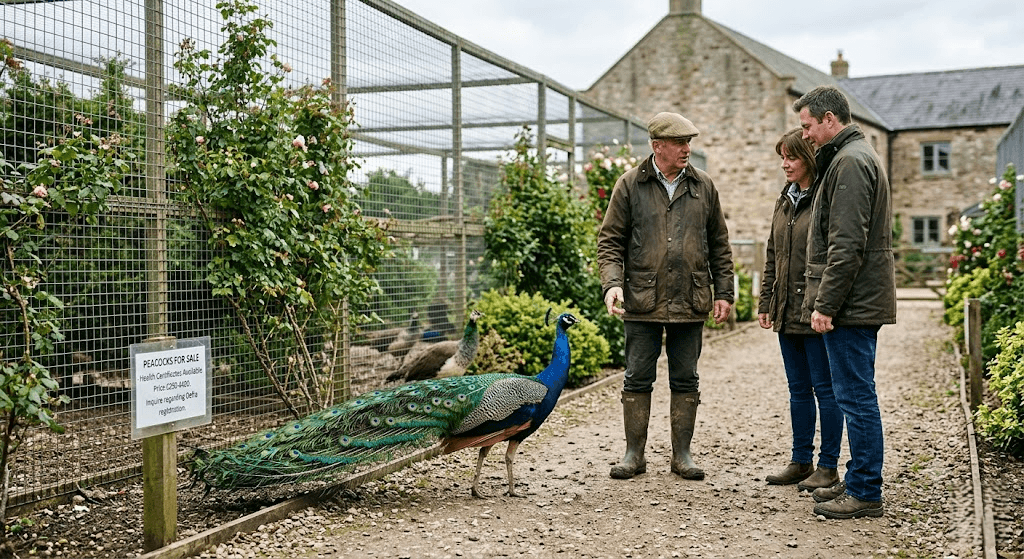
Before entering the marketplace, it is worth standardising your vocabulary. While the general public uses the word “peacock” as a blanket term, the species itself is correctly called peafowl. The vibrant males are peacocks, the more camouflaged, drab-toned females are peahens, and the downy offspring are peachicks. A collective group of them roaming your garden is brilliantly known as an “ostentation” or a “muster”.
Which Variety Should You Buy?
When browsing peafowl for sale in the UK, you will generally encounter four main variations of the traditional Indian Peafowl (Pavo cristatus). It is vital to stick strictly to this species; its tropical cousin—the Green Peafowl (Pavo muticus)—is highly sensitive to the cold, legally restricted under CITES regulations, and thoroughly unsuitable for a damp British winter.
- The India Blue: The quintessential peacock. Featuring a cobalt-blue neck, a bright fan of spotted tail coverts, and a hardy constitution that thrives in the British climate. This is the most widely available, resilient, and cost-effective variety to purchase.
- The Black-Shouldered: A naturally occurring genetic mutation of the India Blue. The male possesses solid, dark-iridescent wing covert feathers (rather than the standard barred grey), giving him a much heavier, more dramatic appearance. The peahens of this variety are paradoxically much lighter, appearing almost cream-coloured with dark speckling.
- The White Peafowl: Often mistakenly called albino, these birds carry a genetic condition called leucism, which inhibits pigment deposition. They possess normal blue eyes and are breathtakingly striking against a green lawn, though their pristine feathers require a relatively mud-free, well-drained environment to look their best.
- Pied and Silver Pied: These are patched birds showing irregular, random splashes of pure white across the classic blue plumage. Because the patterning is unpredictable, no two Pied peacocks look identical, making them an expensive favourite among specialist UK breeders.
How Much Does a Peacock Cost in the UK?
The price of peafowl in Great Britain varies wildly based on three factors: the bird’s age, its sex, and its colour mutation. Because peacocks do not grow their famous, magnificent tail trains until their third year, you pay a heavy financial premium for the luxury of instant gratification.
Below is a realistic guide to standard UK market prices during the recent breeding seasons:
- Hatching Eggs: £15 – £35 per egg. (High risk: peafowl eggs are notoriously difficult to incubate artificially compared to standard hen eggs, requiring very specific humidity drops).
- Unsexed Peachicks (Day-old to 6 weeks): £35 – £65 each. At this stage, you cannot visually tell the males from the females; you are playing a genetic lottery. They will also require a heat lamp for the first six weeks.
- Yearlings (12 to 24 months): £80 – £150 per bird. At this point, the sexes are easily distinguishable. Yearling males will have developed a bright blue neck, but their tails will still look like those of a standard large pheasant.
- Mature Peacock (3+ Years Old): £250 – £450+. This is a fully mature bird with a full 1.5-metre train ready for the spring display.
- Proven Breeding Pairs: £400 – £850. A bonded 3-year-old cock and a productive, laying peahen.
A note on mutations: If you opt for White, Black-Shouldered, or Silver Pied varieties, expect to add a 40% to 80% markup onto the standard India Blue figures listed above.
Before You Buy: The Four Golden Rules
It is shockingly common for a first-time buyer to spend £350 on a gorgeous, mature peacock, open the carrier crate in their garden, and watch £350 fly straight over the nearest oak tree never to be seen again. To stop your investment from becoming a local runaway, you must respect the four golden rules of peafowl husbandry.
1. The Six-Week Lockdown Rule
Peafowl have zero natural loyalty to a new postcode; their homing instinct is tied entirely to where they last roosted safely. When you bring your newly purchased birds home, they must be kept shut inside a fully enclosed, roofed aviary or barn for a minimum of six to eight weeks. During this time, they learn the sights, sounds, local wild bird alarms, and feeding routines of your property. If you let them out on day four, they will simply start walking in the direction of their old home.
2. The Noise Factor
Before checking the classifieds, check your relationship with your neighbours. Peacocks are exceptionally loud. During the breeding season (roughly March through July), the males emit a piercing, mournful two-syllable call that sounds uncannily like someone shouting “Help! Help!” or “May-Awe!”. They will do this at 4:30 AM when the morning sun breaks. If you live in a dense suburban development, a peacock will result in a visit from the local council’s environmental health officer within a fortnight. They belong in rural settings with wide acoustic buffers.
3. High-Level Roosting Needs
Unlike standard farmyard poultry that happily waddle up a wooden ramp into a low coop, peafowl are hardwired to roost as high off the ground as possible to escape foxes. In the wild, they sleep in the upper canopies of large trees. If you intend to house them overnight, your structure needs sturdy perches positioned at least 1.5 to 2 metres off the ground, with plenty of overhead clearance so a cock bird’s massive tail does not get crushed against the rear wall.
4. The “Mirror and Car” Warning
Peacocks are fiercely territorial during the spring. If a mature male catches his own reflection in the dark, polished door of your neighbour’s brand-new vehicle, he will assume it is an intruding rival male. He will proceed to attack the car with his sharp spurs and hard beak, causing thousands of pounds worth of deep scratch damage. Furthermore, peafowl love roosting on the warm bonnets of freshly parked cars. If you do not have a closed garage or a gated driveway, factor this into your decision.
UK Law: Peafowl Regulations and DEFRA
Legally speaking, the Indian Peafowl occupies a slightly grey, idiosyncratic space in British law.
You do not need a special Dangerous Wild Animal (DWA) licence or a local authority permit to purchase or keep an India Blue peacock. However, as a keeper, you are bound by the Wildlife and Countryside Act 1981. Under Section 9 of this Act, it is an offence to release, or allow to escape into the wild, any animal which is not ordinarily resident in, or a regular visitor to, Great Britain in a wild state.
Because peafowl are classified as an introduced non-native species, if your purchased birds wander off your property and establish a feral breeding colony in a local protected woodland, you can be prosecuted. You are legally responsible for containing them to your land.
Furthermore, peafowl fall under the strict jurisdiction of the Department for Environment, Food and Rural Affairs (DEFRA) regarding Avian Influenza (Bird Flu). If you keep 50 or more birds in total across your property (including your backyard chickens, ducks, and peafowl), you are legally required to register your premises on the GB Poultry Register. When national Avian Influenza Prevention Zones (AIPZ) are declared, you will be subject to mandatory housing orders, meaning you must have a covered, biosecure run large enough to comfortably lock your peafowl inside for months at a time.
Where to Safely Source Peafowl in Great Britain
When you are ready to buy, avoid generic, unmoderated free classified sites where scammers frequently post stolen internet photos of show-quality birds at suspiciously low prices. Instead, look to the following legitimate avenues:
- Dedicated UK Peafowl Farms: The UK is home to several highly professional peafowl breeding centres, predominantly located in the Midlands, Yorkshire, and the South West. Buying directly from a specialist breeder ensures you are getting birds that have been properly wormed, vaccinated against Newcastle disease where applicable, and handled competently.
- The Domestic Waterfowl and Poultry Association (DWPA): Reach out to official British breed societies. Their registered members hold high ethical standards and can put you in touch with reputable hobby breeders near your specific county.
- Livestock and Fur-and-Feather Auctions: Establishments like the Melton Mowbray market or traditional regional agricultural auctions occasionally feature peafowl. While purchase prices can be lower here, it is a high-stress environment for the birds, and you cannot view the sanitary conditions of the parent farm.
When viewing a bird for purchase, conduct a quick physical health check: The bird should have bright, clear, open eyes; its nostrils should be free of any clear crust or bubbling discharge; the feathers around its vent should be completely clean (matted, stained feathers indicate diarrhoea or a heavy internal parasite load); and the scales on its legs should lie flat and smooth without raised, crusty patches (which denote scaly leg mite).
Dietary Requirements: They Are Not Big Chickens
The fastest way to fail with a newly bought peafowl is to feed it standard layers’ mash. Peafowl are true gamebirds; their internal biological makeup is closer to a wild pheasant or a turkey than a Sussex hen.
They require a significantly higher protein intake to maintain their massive feather growth and dense musculoskeletal health. You should feed them a dedicated Gamebird Breeder Pellet (roughly 19% to 22% protein) or a commercial turkey grower pellet. This should be supplemented with mixed corn in the depths of winter to generate internal digestive body heat, alongside dark leafy greens.
In the British autumn, they will happily forage your grounds for blackberries, fallen windfall apples, and their absolute favourite garden delicacy: the common snail. They are phenomenal, methodical pest controllers for a large vegetable plot, provided you have placed rigid protective netting over your actual brassicas.
The Verdict
Acquiring a peacock is a profound commitment to land management. You are not buying a static garden ornament; you are adopting a creature with a distinct, uncompromising, primitive personality that will easily live for 20 to 25 years.
If you possess the rural acreage, the tolerant neighbours, the sturdy outbuildings required for an eight-week settling period, and a genuine appreciation for the wilder, more eccentric side of aviculture, buying a UK-reared peacock will transform your property. Take your time, prepare the aviary long before the transport crate arrives, source your stock from a transparent British breeder, and look forward to the morning your resident peacock opens its iridescent train to catch the April sun.