Mastering the UK Loyalty Landscape: A Strategic Guide to Maximising Reward Programme Deals
 savingsspot.co.uk
 In the evolving landscape of British personal finance, the humble high-street loyalty card has undergone a quiet revolution. Gone are the days when a creased paper booklet of green stamps or a stiff plastic card offered nothing more than a delayed, lukewarm discount on a future tin of baked beans. Today, the United Kingdom operates one of the most sophisticated, interconnected, and data-driven reward programme ecosystems in the world.
For the savvy consumer, these schemes are no longer just a passive afterthought at the checkout; they are an untaxed secondary income stream. However, the gulf between a passive points-collector and a strategic points-maximiser is vast. While the average shopper saves perhaps £20 a year on their Christmas shop, the optimised consumer is leveraging the exact same household expenditure to fund European city breaks, slash their monthly utility bills, and unlock premium dining experiences for pennies on the pound.
The Big Four: Decoding the Supermarket Giants
Because the vast majority of the average Briton’s disposable income flows through supermarket tills, mastering the grocery sector’s big four is the mandatory foundation of any reward strategy.
1. Tesco Clubcard: The Power of the ‘Partner Boost’
Tesco fundamentally altered the psychology of UK retail with the introduction of ‘Clubcard Prices’—a two-tier pricing model that effectively penalises non-members. While securing the lower shelf-price is the immediate incentive, the true wealth of the Clubcard lies in its base point accumulation (1 point per £1 spent) and its subsequent deployment.
The golden rule of the Tesco Clubcard is simple: never spend your points at the checkout. Redeeming a £5 voucher against your weekly groceries yields exactly £5 of value. However, transferring that same voucher into the ‘Clubcard Reward Partners’ portal instantly doubles its value. A £10 point balance becomes £20 to spend at Pizza Express, £20 towards an English Heritage membership, or £20 off a Hotels.com booking. By refusing the instant gratification of a minor grocery discount, you turn a standard 1% cashback scheme into an effective 2% return on all food shopping.
2. Sainsbury’s Nectar: The Avios Pipeline
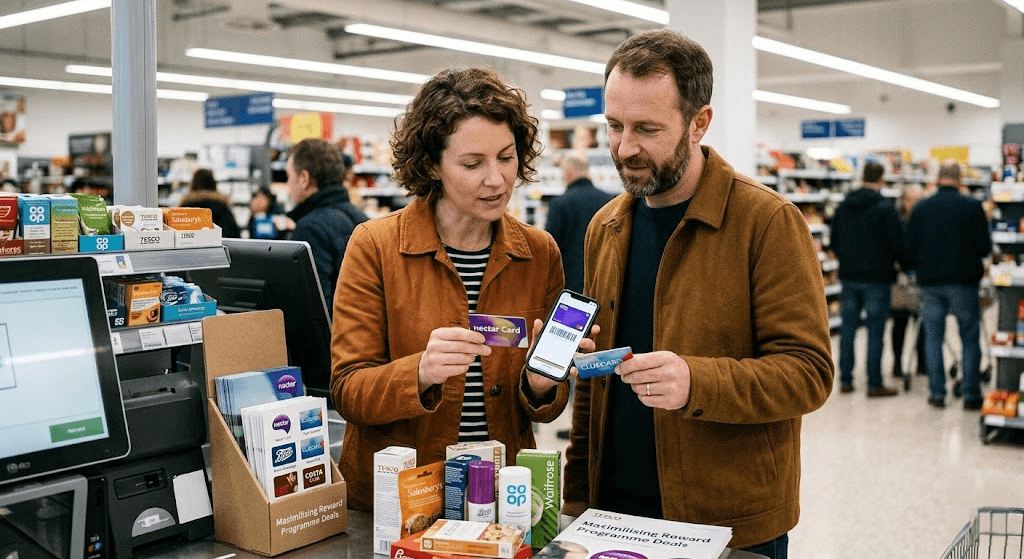
On paper, Nectar’s base offering looks relatively uninspiring: 1 point per £1 spent, with each point worth 0.5p (an effective return of just 0.5%). However, Nectar’s hidden superpower was unlocked when Sainsbury’s acquired Argos and subsequently forged a deep partnership with British Airways’ Executive Club.
Nectar points can be converted directly into British Airways Avios at a ratio of 400 Nectar points to 250 Avios (and vice versa). For those who know how to navigate the airline reward charts, an Avios point can easily be redeemed for a value of 1.2p to 1.7p when booking Reward Flight Savers or cabin upgrades. Furthermore, by using the Sainsbury’s ‘SmartShop’ app, users unlock ‘Your Nectar Prices’—algorithmically generated discounts tailored specifically to your frequent purchases, frequently undercutting rival supermarkets by up to 30% on brand-name items.
3. Boots Advantage Card: High-Margin Dominance
Historically the undisputed king of the UK high street, the Boots Advantage Card offers 3 points for every £1 spent (a 3% return). While this was slightly downgraded from its legendary 4-point era, it remains vastly superior to any standard supermarket return.
Because health, cosmetics, and fragrance carry massive retail markups, accumulating points at Boots should be reserved strictly for high-ticket luxury items. Furthermore, Boots has adopted the ‘Price Advantage’ model. By pairing the pink Advantage stickers with their frequent “£10 worth of points when you spend £50” weekend promotions, consumers can achieve an effective discount rate of over 23% on essentials like toiletries and baby products.
4. Asda Rewards: The Gamification of the ‘Cashpot’
Asda arrived late to the loyalty party, completely bypassing the concept of ‘points’ in favour of a digital ‘Cashpot’. Available purely via their smartphone app, Asda Rewards relies entirely on consumer gamification.
Instead of a flat percentage back on your total spend, money is earned by purchasing designated ‘Star Products’ (which return a fixed cash amount to your pot) or by completing ‘Missions’ (e.g., “Spend £40 on fresh fruit and vegetables across August to unlock £4”). The secret to Asda Rewards is discipline: do not alter your dietary habits to chase a mission. Instead, cross-reference their Star Products with your existing shopping list, cash out the pot immediately to offset your next bill, and avoid leaving digital cash sitting idle in the app.
The Masterclass: The Art of ‘Deal Stacking’
If joining a loyalty programme represents Level 1 of consumer savvy, ‘Deal Stacking’ represents Level 10. Deal stacking is the practice of layering multiple independent reward mechanisms over a single transaction so that they trigger simultaneously.
Consider a consumer purchasing a high-end £100 electrical appliance. A standard shopper walks into a shop, taps their debit card, and leaves with the item. An optimised deal-stacker executes the following sequence:
- Layer 1 (The Portal): They do not go to the shop’s website directly. They open a cashback portal like TopCashback or Quidco and click through to the retailer, tracking a 5% cash return (£5.00).
- Layer 2 (The Retailer Loyalty): At the digital checkout, they input their retailer loyalty number (e.g., collecting 300 points worth £3.00).
- Layer 3 (The Payment Method): They pay using a reward credit card—such as an American Express Cashback card or a Chase UK Mastercard—yielding an additional 1% cash return (£1.00).
- Layer 4 (The Passive Linked App): Because their payment card is digitally registered to a secondary passive app like Airtime Rewards (which automatically pays down your UK mobile phone bill based on tracked card spending), they trigger an invisible 4% bill credit (£4.00).
The net result? The consumer paid the same £100 upfront, but captured £13.00 in total value across four different ecosystems. The transaction took an extra forty-five seconds to orchestrate, resulting in an astronomical hourly rate for their time.
The Hidden Gems: High-Yield Niche Programmes
While the grocery giants dominate the headlines, some of the most mathematically generous reward deals in Great Britain belong to niche, specialist retailers.
Waterstones Plus
For the avid reader, the Waterstones Plus scheme is a masterclass in straightforward generosity. You earn 1 ‘Plus’ for every £10 spent. Once you accumulate 10 Plus, you receive a £10 voucher. This represents a clean, transparent 10% return on expenditure—a figure virtually unheard of in modern British retail. When combined with their frequent “Double Plus” promotional weekends, you can effectively buy books at a 20% future discount.
TK Maxx ‘Treasure’
TK Maxx operates a truly bizarre loyalty scheme that eschews monetary discounts entirely. Shoppers collect ‘Keys’ by making purchases or simply flashing their digital card in-store (limited to one key per day). Once five keys are collected, the user gets to pick a ‘Reward’ from a constantly rotating digital carousel.
The rewards range from the mundane (bamboo toothbrushes, herb seed packets) to the extraordinary (private chef experiences, VIP gig tickets, and hand-blown glassware). Because the cost of entry is so low—five minor purchases unlock a physical gift shipped to your door for free—it is the highest ‘surprise-and-delight’ return on the market.
O2 Priority & Vodafone VeryMe
Telecommunication loyalty schemes are frequently forgotten because they do not require point accumulation; they act as digital membership clubs. O2 Priority remains the gold standard, offering 48-hour pre-sale access to every major gig venue in the UK, alongside free weekly coffees from High Street chains, and £1.00 cinema tickets on weekends. If you are an O2 customer failing to check the Priority app on a Thursday morning, you are effectively leaving £150 of entertainment value on the table every year.
The Dark Side of Rewards: Four Pitfalls to Avoid
Retailers do not design reward programmes out of a sense of altruism; they design them to manipulate consumer behaviour. To ensure you remain the beneficiary rather than the victim of the system, you must police yourself against four common psychological traps.
1. The ‘Spend to Save’ Fallacy
This is the retailer’s holy grail. You receive an email stating: “You are only 150 points away from a £10 voucher! Spend £15 this weekend to unlock it.” If you buy £15 worth of items you did not genuinely need to acquire a £10 voucher, you have not ‘saved’ £10; you have wasted £5. Treat point thresholds as targets to be crossed organically, never artificially.
2. The Ghost of Devaluation
Points are an unhedged digital currency entirely controlled by a central authority. Retailers can—and routinely do—devalue them overnight. When Tesco dropped its Reward Partner exchange rate from 3x to 2x in 2023, millions of pounds in consumer purchasing power vanished in an instant. Loyalty points are not a savings account. Earn them, consolidate them, and spend them. Hoarding them over a three-year period guarantees you will lose value to ‘points inflation’.
3. The Auto-Conversion Trap
Several schemes offer the ability to automatically turn your points into charitable donations or auto-deduct them at the till the moment you hit a £2.50 threshold. Turn auto-convert off. Controlling the exact moment and medium of your redemption is the only way to ensure you capture the upper tier of the value multipliers.
4. The Privacy Trade-Off
Accept that when you scan a loyalty card, you are entering a bartered transaction: you are selling your household’s demographic data, dietary habits, and brand affinities in exchange for a 2% rebate. For most consumers, this is an entirely acceptable compromise. However, if you are purchasing sensitive items or simply value absolute digital anonymity, leave the card in your pocket.
The 2026/2027 Golden Playbook: 5 Rules to Live By
To turn these disparate concepts into an actionable daily routine, implement the following five principles into your household management:
- The Two-Card Rule: Do not try to collect every card in existence; mental fatigue will set in. Pick your primary Supermarket, your primary Fuel provider, and your primary Pharmacy. Put those three widgets on the home screen of your smartphone; relegate the rest to a digital folder.
- Audit the Family: Ensure that partners or spouses living at the same address are pooling their points into a ‘Household Account’ (available on British Airways, Nectar, and Tesco). Splitting spending across two separate accounts delays the velocity at which you reach high-value redemption thresholds.
- Set a ‘Point Goal’: Give your points a physical name. If you decide your Sainsbury’s Nectar points are strictly paying for the family’s Eurostar tickets to Paris next May, you will be far less tempted to waste them on a discounted bottle of gin on a dreary Tuesday in November.
- Check the ‘PPM’ (Pence Per Mile/Point): Before exchanging any point, do the basic division. Take the real-world cash price of the item, divide it by the number of points required, and find the value per point. If the figure is below 1.0p, it is a bad deal. If it is 1.5p or higher, pull the trigger.
- Embrace the Digital Wallet: Clear the physical plastic out of your leather wallet. Use dedicated aggregation apps like Stocard or the native Apple/Google Wallet to hold your barcodes. If the card isn’t instantly accessible in two clicks of your phone’s side button, you will inevitably hold up the queue, panic, and fail to scan it.
Ultimately, the UK’s reward deals are a game of margins. By shifting your mindset from passive acceptance to aggressive, calculated accumulation, you reclaim sovereignty over the retail margin—ensuring that every time the till beeps, a little bit of the shop’s profit slips quietly back into your own pocket.