 savingsspot.co.uk
 Every online shopper across the United Kingdom recognises the fleeting thrill of pasting a promotional string into a checkout box and watching the total basket price instantly drop. In the complex ecosystem of British e-commerce, discounts come in many shapes. However, while a 5 percent saving feels negligible and a 50 percent clearance reduction frequently raises suspicions regarding product quality or dead stock, the 20 percent off voucher occupies the absolute sweet spot of consumer retail. It is substantial enough to make a genuine, tangible difference to your bank balance, yet common enough that the savvy digital consumer should rarely have to pay the full Recommended Retail Price (RRP).
Whether you are upgrading your autumn wardrobe, investing in premium skincare, purchasing daily household essentials, or simply ordering a Friday night takeaway, mastering the acquisition and strategic application of the 20 percent discount is a foundational skill. This comprehensive guide lifts the lid on the mechanics of UK promotional codes, exploring how to reliably source them, how to compound their value through advanced stacking techniques, and how to sidestep the sophisticated retail traps designed to dilute your hard-won savings.
The Psychology of the 20% Discount: Why It Governs the Digital High Street
To understand why the 20 percent voucher is so ubiquitous across British online retailers, one must delve into the psychology of consumer decision-making and retail economics. Marketing experts frequently point to the ‘Rule of 100’, a behavioural principle popularised by academic Jonah Berger. This rule dictates that for items priced under £100, percentage discounts appear significantly more attractive to the human brain than absolute numerical discounts. For example, a £20 saving on a £100 coat feels mathematically standard, but a bold “20% OFF” banner creates an immediate sense of urgency and perceived value, despite the financial outcome being identical.
Furthermore, 20 percent represents the psychological threshold where British consumers feel they are securing a ‘legitimate’ bargain. A 10 percent code often does little more than cover the cost of standard UK delivery, leaving the buyer feeling as though they have merely broken even. Conversely, a 20 percent reduction actively cuts into the core cost of the physical goods. From the retailer’s perspective, it provides the exact amount of friction-reducing incentive required to prevent basket abandonment, whilst successfully protecting their gross profit margins.
Mastering the Hunt: Sourcing 20% Vouchers in the UK
The era of cutting paper coupons from the back of Sunday newspaper supplements is long gone. Today, voucher hunting is an agile, digital pursuit. If you want to consistently apply 20 percent reductions to your digital shopping baskets, you must move away from generic, ad-heavy coupon aggregators—which are frequently plagued by expired strings of text—and build a reliable framework across four key operational channels.
1. The Strategic Newsletter Alias
Virtually every major UK brand—from high street fashion titans like Marks & Spencer and Next to boutique homeware operators—offers an immediate incentive for joining their email marketing database. The industry standard for this introductory handshake is precisely 20 percent. However, yielding your primary personal or professional email address to dozens of marketing funnels results in unmanageable inbox clutter.
The savvy solution is to establish a dedicated ‘shopping alias’. Modern email providers allow you to create secondary addresses (or use the ‘+shopping’ suffix trick). By routing all brand registrations to a siloed folder, you can harvest 20 percent welcome vouchers at will. Once the unique code arrives, apply it at the checkout, and let the promotional emails accumulate out of sight until you require another discount down the line.
2. The Art of Basket Abandonment
Online retailers heavily monitor user journeys, and their most painful metric is ‘basket abandonment’—when a logged-in user selects items but exits the domain prior to authorising payment. Because customer acquisition costs in the UK are currently at an all-time high, digital storefronts employ automated re-engagement software to rescue these lost transactions.
To trigger this mechanism intentionally, ensure you are logged into your customer account, build your basket, populate the delivery screen, and then simply close your browser tab. Crucially, verify beforehand that you have opted into marketing communications in your account settings, otherwise General Data Protection Regulation (GDPR) rules prevent the retailer from emailing you. In 70 percent of cases, an automated nudge will arrive within 24 to 48 hours. If you hold your nerve through the initial “Did you forget something?” email, the subsequent follow-up will frequently generate a dynamic, one-time-use 20 percent voucher designed to close the sale.
3. Unlocking Demographic Discount Vaults
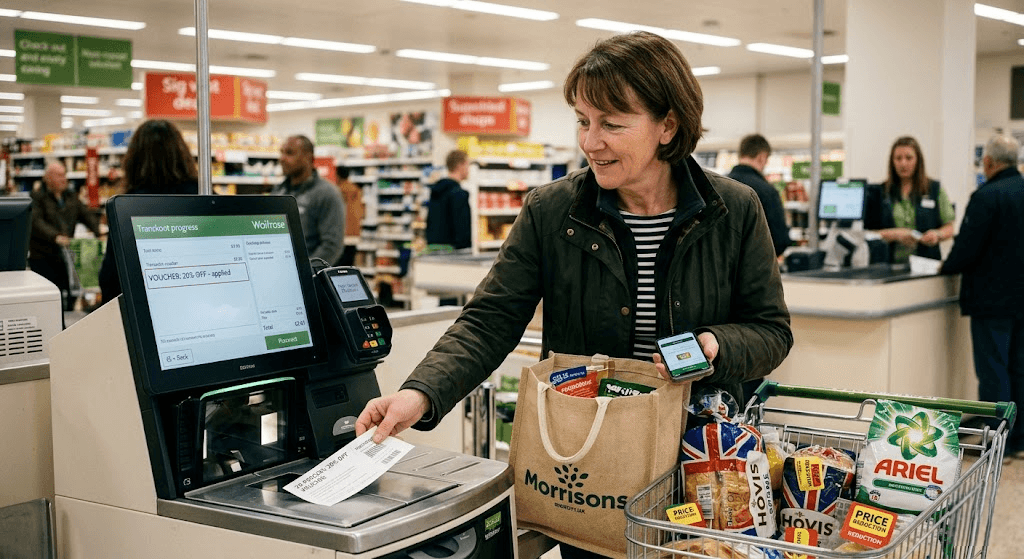
Millions of UK residents have continuous access to locked 20 percent discounts that remain entirely hidden from the general public. If you fall into specific professional or age demographics, registering with verified verification platforms is non-negotiable:
- Blue Light Card: The definitive lifestyle platform for NHS staff, emergency services, social care workers, and the armed forces. For a nominal £4.99 two-year membership fee, it unlocks permanent or revolving 20 percent codes for major high street dining chains, sportswear brands, and technology retailers.
- UNiDAYS and Student Beans: The twin pillars of UK student discount culture. Even if you are a part-time postgraduate or mature student, possessing an active `.ac.uk` academic email address grants access to persistent 20 percent discount tiers across ASOS, Lookfantastic, Apple, and national gym franchises.
- Age-Tiered Club Schemes: Senior shoppers should leverage specific demographic loyalty days. High street mainstays like Boots, Iceland, and various national garden centres host dedicated weekday events (typically Tuesdays or Wednesdays) where shoppers over the age of 60 automatically receive 20 percent off their entire transaction upon presenting a linked loyalty card.
4. Algorithmic Extensions and the Refurbished Market
Rather than manually typing dozens of speculative codes into a checkout box, modern consumers rely on automated browser extensions such as Pouch, Honey, or Coupert. When you navigate to a UK checkout page, these lightweight plugins systematically test every known promotional code in their global database in milliseconds, applying the single code that yields the deepest mathematical discount.
Additionally, do not ignore the digital marketplace giants. eBay UK runs legendary, highly publicised “20% off selected sellers” flash events every few months. These codes (often featuring phrasing like `SUPER20` or `SAVETWENTY`) are funded directly by the platform rather than the independent merchants, making them an incredible vehicle for purchasing refurbished tech, power tools, and high-end automotive parts from official brand outlets like Dyson, Simba, and Curry’s Clearance.
The Science of Stacking: Multiplying Your Discount
Acquiring a valid 20 percent voucher is only the baseline; how and when you deploy it dictates your ultimate financial triumph. The crown jewel of savvy shopping is ‘discount stacking’—the practice of applying a promotional code to a basket that has already undergone systemic financial reduction.
Most basic retail vouchers feature restrictive boilerplate terms stating: “Strictly applicable to full-priced items only; cannot be used in conjunction with any other offer.” However, during major seasonal shifts—such as Bank Holiday weekends, end-of-season clearances, and the chaotic Black Friday window—these operational rules are regularly suspended as retailers scramble to liquidate warehouse inventory.
When an online store launches an “Extra 20% off Sale” campaign, your purchasing power compounds dramatically. If an item originally priced at £100 is marked down by 30 percent in the seasonal clearance to £70, applying your 20 percent voucher to the reduced price brings the final cost down to £56. You have successfully achieved a net saving of 44 percent without compromising on the quality of the item.
Navigating Delivery Thresholds and Gift Card Double-Dipping
A classic pitfall of applying a voucher code is accidentally stripping away your qualification for complimentary postage. Consider a standard UK storefront that offers free delivery on orders over £50, charging £4.99 for orders below this mark. If your initial basket totals £55, applying a 20 percent voucher reduces your subtotal to £44. Automatically, the system tacks on the £4.99 delivery charge, meaning your actual cash saving is a meagre £6.01.
To bypass this, employ the ‘basket filler’ strategy. Seek out practical, non-perishable micro-items—such as a £6 pair of organic cotton socks, a travel-sized hand cream, or a pack of hair ties—to nudge your post-discount subtotal back over the £50 borderline. In this scenario, you secure the extra physical item entirely for free whilst preserving the full monetary integrity of your voucher.
For the ultimate masterclass in stacking, combine your 20 percent voucher with discounted digital gift cards and cashback portals. Platforms like JamDoughnut, Airtime Rewards, and corporate perks schemes (such as Reward Gateway) allow you to purchase digital gift cards for major UK retailers at an instant 4 to 8 percent discount. By clicking through TopCashback or Quidco, paying with a discounted gift card, and applying your 20 percent promotional voucher at the checkout, you effectively layer three independent financial mechanisms, pushing your true overall saving past the 30 percent mark.
Sector Breakdown: Where a 20% Voucher Hits Hardest
The financial gravity of a 20 percent discount shifts significantly depending on the industry sector. Recognising the underlying markup structures of different UK retail categories allows you to separate standard marketing noise from rare, high-value purchasing opportunities.
High Street Apparel and Cosmetics
The fashion and beauty sectors operate on famously wide profit margins. Consequently, a 20 percent voucher in this arena should be viewed not as a stroke of luck, but as your standard purchasing baseline. Brands like ASOS, Lookfantastic, Cult Beauty, and Boohoo circulate 20 percent promotional strings so aggressively through social media influencers, app push notifications, and weekend flash sales that paying full RRP is functionally unnecessary. If your preferred moisturiser or trainers are full price on a Tuesday, exercising basic patience guarantees a viable code will surface by the weekend.
Online Grocery and Food Delivery
Conversely, the British supermarket sector operates on razor-thin profit margins, typically hovering between 1 and 3 percent. Therefore, a 20 percent voucher here represents exceptional intrinsic value. Grocery giants like Sainsbury’s, Tesco, and Ocado heavily restrict 20 percent codes (or equivalent absolute values like £20 off a £80 spend) strictly to “first-time online delivery customers.” Sourcing these requires rotating your household shopping between different supermarket delivery networks every few months to absorb their aggressive customer acquisition budgets.
In the takeaway delivery space (Deliveroo, Uber Eats, Just Eat), 20 percent codes are driven by algorithmic user retention. If you order weekly, you will rarely see a discount. If you delete the app or leave your account dormant for three weeks, you will inevitably trigger an automated 20 percent reactivation voucher aimed at winning back your custom.
Consumer Electronics and Major Appliances
Genuine, non-restrictive 20 percent vouchers are practically non-existent when buying core hardware—such as Apple MacBooks, Sony PlayStation consoles, or OLED televisions—from primary outlets like Currys, Argos, or John Lewis. Because the wholesale margin on consumer tech is exceptionally tight, a blanket 20 percent discount would force the retailer to sell at a catastrophic loss.
When you encounter a 20 percent code in the electronics sphere, look immediately at the itemised exclusions list. The code will almost certainly apply strictly to high-margin accessories: HDMI cables, third-party laptop sleeves, screen protectors, and domestic white goods from proprietary, in-house brands. To secure 20 percent off branded tech hardware, your only viable route is the aforementioned platform-subsidised marketplace events (such as eBay’s 20% refurbished drops).
Spotting the Trapdoors: Terms, Conditions, and Illusions
Promotional codes are not charitable handouts; they are sophisticated conversion tools engineered to drive up the Average Order Value (AOV). To ensure you remain the genuine beneficiary of the transaction, you must train your eye to dissect the microscopic terms and conditions attached to every code.
The Minimum Spend Inflation Trap
A flashy banner proclaiming “20% Off Your Order” frequently conceals a crucial financial caveat in the small print: “…when you spend £120 or more.” If your original, deliberate intention was to purchase a £50 pair of trousers, but you find yourself frantically adding £70 worth of unwanted items to your basket merely to unlock a £24 discount, the retailer’s algorithm has won. You have not saved £24; you have mindlessly surrendered an additional £46. Always evaluate a discount code against your initial shopping list, refusing to let artificial minimum thresholds dictate your spending behaviour.
The Premium Brand Graveyard
Department stores and massive multi-brand platforms frequently issue site-wide 20 percent codes to celebrate bank holidays. However, navigating to the promotional terms reveals an exhaustive list of brand exclusions. High-end horology, luxury cosmetics (such as Chanel, Dior, and Tom Ford), premium audio equipment, and select designer concessions are universally walled off from global promotional strings. Verify that the discount has visibly detached cash from every individual line item in your digital basket before authenticating via Apple Pay or entering your card security code.
Artificial Urgency and Price Anchoring
Digital vouchers are inextricably linked to the creation of artificial panic. Blinking countdown timers ticking down to midnight and stark warning text declaring “Hurry, code expires soon!” are psychological levers designed to bypass your logical financial pre-frontal cortex. In the modern UK digital economy, promotional cycles are endless and cyclical. If a 20 percent voucher expires on Sunday night, historical data proves an almost identical promotion—perhaps rebranded as a ‘Payday Treat’ or ‘Mid-Week Steal’—will launch within ten working days. Never let a ticking clock force you into an unverified purchase.
Furthermore, remain vigilant against deceptive price anchoring. Unscrupulous merchants occasionally inflate the base price of a product by 20 percent a fortnight before releasing a “20% off” promotional code, ensuring the net cash price remains identical. Savvy British shoppers combat this practice by running product URLs through independent historical price-tracking tools like PriceRunner or CamelCamelCamel before applying a voucher, verifying that the baseline RRP is genuine and unmanipulated.
The Master Checklist: Your Pre-Checkout Protocol
Before you click ‘Confirm and Pay’ on any e-commerce checkout page in Great Britain, run your basket through this definitive five-point mental audit to ensure you are extracting maximum capital from the transaction:
- Have I executed a digital sweep? Never leave a promo box empty without querying an automated browser extension or checking your dormant shopping alias inbox for tailored re-engagement codes.
- Am I leveraging my demographic privilege? Check if your student status, NHS employment, armed forces history, or age bracket unlocks a superior, non-expiring baseline reduction via platforms like Blue Light Card or UNiDAYS.
- Is the delivery fee cannibalising my discount? Double-check your subtotal post-voucher application to ensure you haven’t slipped below the free shipping threshold. If you have, deploy a calculated, non-perishable basket filler.
- Have I stacked the payment layer? Ensure you have activated your transaction through a cashback portal (TopCashback/Quidco) and considered settling the balance using a pre-discounted gift card acquired via an instant savings app.
- Am I buying the discount, or the product? Strip away the red percentage banner and ask yourself: “If this item was priced at this exact final cash figure with no promotional framing, would I actively purchase it today?” If the answer is negative, close the tab.
By shifting your mindset from viewing voucher codes as fortuitous windfalls to treating them as standard, structured instruments of digital negotiation, you can permanently lower the cost of your digital lifestyle. The 20 percent off voucher is perpetually out there—circulating in automated email flows, locked behind demographic portals, and hidden within browser extension databases. You simply need to execute the strategy to claim it.