
 savingsspot.co.uk
 There is a quiet, highly specific sort of euphoria that comes with cracking open a brand-new notebook or testing the crisp, unbroken glide of a 0.5mm gel pen. But in an era where a single hardback dotted journal can easily set you back twenty quid on the high street, feeding a stationery habit—or simply outfitting a home office—can quickly turn into a costly exercise.
Whether you are a dedicated bullet journalist, a university student prepping for the autumn term, a remote worker trying to bring some aesthetic order to your desk, or someone frantically typing “stationary deals” into a search bar looking for paper pads that actually stay put, paying Recommended Retail Price (RRP) is a rookie mistake. The British stationery market is flooded with hidden clearance loops, seasonal dump-stock, and digital workarounds. If you know the terrain, you can secure premium Japanese fineliners, heritage German fountain pens, and heavyweight Oxford paper for a fraction of the standard ticket price.
The Golden Calendar: Timing Your Hauls
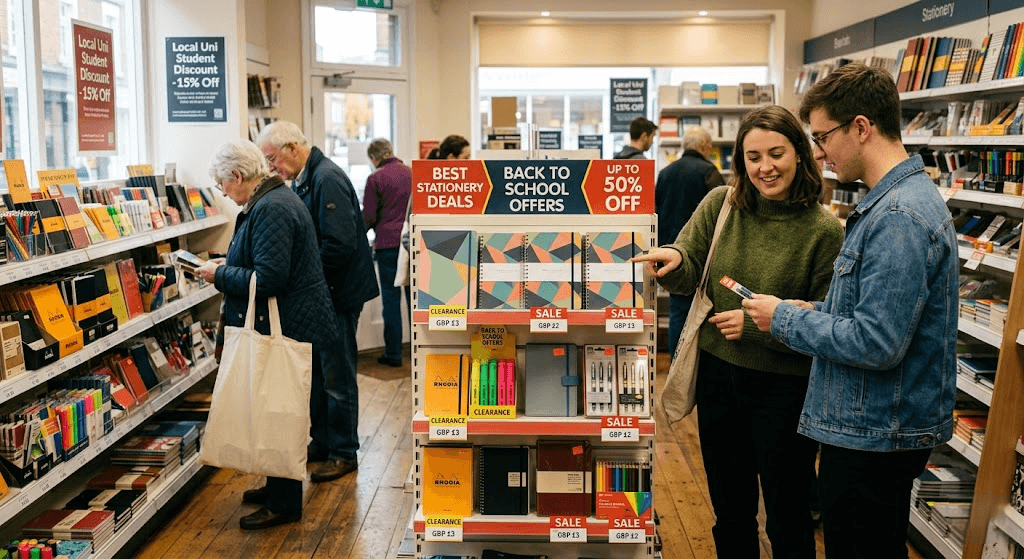
Most consumers buy stationery reactively: a pen runs out of ink, or a new project starts next Monday. This is precisely when retailers make their highest margins. To get the best deals on stationery in the UK, you have to buy counter-cyclically.
The Post-Back-to-School Slump (Late September to Mid-October)
From mid-July to the first week of September, UK supermarkets and high street stationers dedicate massive promotional space to ‘Back to School’. By the third week of September, store managers are under immense pressure to reclaim that floor space for Halloween and Christmas stock. This is your golden window. Multi-packs of Pukka Pads, Staedtler Noris pencils, and Casio calculators are routinely slashed by up to 70% just to get them out of the stockroom.
The ‘Failed Resolution’ Dump (Mid-February)
January sees a massive mark-up on academic diaries, daily planners, and leather-bound goal trackers. Come February 15th, the consumer appetite for self-improvement drops off a cliff. Retailers like Waterstones, Oliver Bonas, and independent boutique stockists liquidate their dated stock. If you don’t mind missing the first six weeks of the year—or if you use open-format, undated journals—you can regularly pick up £28 luxury planners for £5.
The Financial Year End (March and April)
This is the secret B2B (Business to Business) window. Commercial office suppliers like Viking Direct and Staples offer massive promotional codes to clear their inventory before the tax year wraps up. While aimed at corporate accounts, regular desktop consumers can almost always use guest checkouts to buy bulk reams of high-GSM printer paper or 50-packs of Pilot G2s at genuine wholesale rates.
Cracking the High Street: The Good, the Bad, and the TK Maxx
When British shoppers think of high-street paper and pens, a few legacy names immediately come to mind. However, navigating their physical shops requires very different tactical approaches.
TK Maxx and Homesense: The Red Sticker Lottery
If you buy your Moleskine or Leuchtturm1917 notebooks at full price, you are committing a minor retail crime. TK Maxx acts as the primary UK grey-market clearing house for surplus European stationery. You will regularly find Castelli Milano notebooks, Rhodia dot-pads, and imported Italian leather writing journals sitting in the homeware department at 60% off RRP.
The Insider Tip: Look at the digital code printed above the barcode on the shop’s price ticket. If you see the number ‘2’, it means the item is genuine surplus stock originally manufactured for a major brand, rather than a cheaper product manufactured specifically for TK Maxx. Furthermore, check the stationary clearance shelves on a Tuesday or Wednesday morning—this is historically when the yellow and red ‘final clearance’ markdown stickers are applied to the shelves.
The Tesco ‘Paperchase’ Hack
When the beloved high-street staple Paperchase collapsed into administration in 2023, supermarket giant Tesco swooped in and bought the brand’s intellectual property. What this means for the savvy shopper is that the vibrant, design-led aesthetic of Paperchase is now sitting in the middle of your local Tesco Extra. Because it is subjected to supermarket footfall logistics rather than boutique high-street rents, it regularly gets bundled into Tesco’s standard “3 for 2” Clubcard promotions or seasonal grocery markdowns, making it vastly cheaper than it ever was in its old Covent Garden or Glasgow standalone stores.
Ryman: The King of Stackable Discounts
On the surface, Ryman’s RRPs look standard, if not slightly steep. However, Ryman is arguably the most generous high-street retailer when it comes to discount stacking. They offer a permanent 10% discount for students (via UNiDAYS), they offer standard local business drop-discounts, and they regularly issue “£5 off a £20 spend” vouchers in their digital newsletters.
The trick: Walk straight past the front displays and head to the very back of the shop. Almost every Ryman has a bottom-shelf wire dump-bin labeled “Discontinued Lines.” This is where you find high-end Parker Quink refill cartridges, Pentel EnerGel pens in non-standard ink colours (like dark green or violet), and slight-second lever-arch files for 50p.
WHSmith: Proceed with Extreme Caution
A quick warning on WHSmith: their travel hubs (located inside train stations, service stations, and airports) operate on a hyper-inflated convenience pricing model. Never buy stationery at London Euston or Manchester Piccadilly unless it is an absolute emergency. Even in their standard high-street branches, their own-brand stationery is rarely a “deal.” Reserve your WHSmith visits strictly for the August Bank Holiday, when they routinely run legitimate “Buy One Get One Free” offers on branded Stabilo Boss highlighters and Sharpie permanent marker sets.
The Digital Underground: Best UK Online Stationery Hubs
Moving away from brick-and-mortar, the internet offers the truest form of price discovery for the modern desk worker.
Cult Pens (The Undisputed Champion)
Based out of Devon, Cult Pens is the UK’s largest independent online pen retailer. While they will happily sell you a £1,200 hand-painted Namiki fountain pen, they are simultaneously the best place in the country to get everyday stationery deals.
How to work their site: Ignore the flashy homepage banners. Scroll immediately to the website footer and click “Clearance & Offers.” Because Cult Pens imports directly from Japanese and German manufacturers, whenever a brand like Tombow, Zebra, or Kaweco updates its barrel packaging or phases out a specific pastel shade, Cult Pens dumps the “old” stock into this tab at 40% to 50% off. Additionally, they offer a permanent 10% discount on your first order—always clear your browser cache or use a secondary family email address if you are doing a massive annual desk restock.
Amazon UK: The ‘Keepa’ Rule
Buying a single pen or a solitary A5 notebook on Amazon UK is almost always a bad financial move due to the baked-in cost of Prime postage. The real deals on Amazon exist exclusively in the bulk multi-packs.
To win at Amazon stationery, you must use a free desktop browser extension called Keepa. This tool embeds a historical price graph directly onto the Amazon product page. Take the popular Oxford Campus A4 Wirebound Notebook (Pack of 5). Its “standard” listed price fluctuates wildly between £15.00 and £22.00. However, Keepa will show you that roughly once every 90 days, Amazon’s pricing algorithm automatically drops that exact 5-pack to £8.50 for a 36-hour window. Set a Keepa tracker alert for your preferred paper brand, sit back, and buy a year’s supply the moment the line dips into the green.
The ‘B-Grade’ Indie Market
The UK possesses a thriving ecosystem of independent stationery designers operating on platforms like Etsy or boutique Shopify storefronts (think of wonderful independent UK labels like Under the Rowen Tree, The Paper Mouse, or Meticulous Ink). Twice a year, usually in January and July, these creators run “Oopsie Bags” or “B-Grade Sales.”
When a small creator orders 1,000 foil-stamped notebooks from a printer, 40 of them will arrive with a slightly off-centre logo, a microscopic scratch on the back cover, or a lightly bumped corner. To the creator, these are unsellable at full retail price; to you, it is a fully functional, ultra-luxurious 160-GSM bamboo-paper notebook for £4 instead of £19. Search the phrase “B-grade stationery bundle UK” on Google or TikTok to uncover these hyper-local liquidations.
The “Buy Once” Math: Refillable Economics
Sometimes the absolute best stationery deal isn’t the cheapest item; it is the purchase that stops you from ever having to buy a replacement again. British office workers waste millions of pounds collectively buying 20-packs of cheap, scratchy ballpoint pens that dry up or snap inside a laptop bag after a fortnight.
- The Fountain Pen Pivot: A plastic Lamy Safari or a pocket-sized Kaweco Sport costs roughly £18 to £22 upfront. A 30ml glass bottle of Diamine writing ink (manufactured proudly in Liverpool) costs around £3.50. That single £3.50 bottle holds enough ink to refill a pen converter approximately 40 times. You have essentially locked in your premium writing costs at under 9p per refill for the next three years.
- The Rollerball Hack: If you love the heavy, wet, effortless glide of a luxury Montblanc or a Retro 51 Tornado rollerball, do not buy their branded refills at £8 a unit. Search online for the Schmidt P8126 or P8127 refill in bulk. This is the exact German-engineered liquid ink mechanism that luxury brands re-wrap and drop inside their expensive metal barrels, but unbranded, they cost roughly £2.20 each.
The Deal-Hunter’s Pre-Checkout Diagnostic
Before you hit ‘Confirm Payment’ on your next haul, run your basket through this four-step checklist to ensure you are actually getting a bargain:
- Check the GSM, not just the page count: If a notebook looks absurdly cheap, check the paper specifications. Anything under 80 GSM (Grams per Square Metre) will suffer from severe ghosting and ink bleed-through the moment a wet rollerball touches it, effectively rendering the back of every page useless. A true deal is 100+ GSM paper sold at an 80 GSM price point.
- Leverage the family tree: If you are not a student yourself, do you have a niece, nephew, or teenager in the family attending secondary school or university? Ask them to log into their Student Beans or UNiDAYS portal to generate a 10% to 15% discount code for your Paperchase, Ryman, or Muji checkout.
- Beware the “Curation Tax”: Never buy Japanese imported stationery (such as Midori MD paper, Traveler’s Company brass accessories, or Ohto Horizon pens) from an independent British “lifestyle or homeware” boutique without cross-referencing Cult Pens or Japan Craft first. Lifestyle shops routinely slap a 35% aesthetic mark-up onto imported stationery simply because it looks pretty sitting next to a monstera plant.
- Hunt for ‘Damaged Outer Box’ listings: Search your favourite high-end stationery item (for example, “Filofax A5 Leather Organiser”) on eBay UK, but force the search filter strictly to “Condition: New – Other.” This is the universal merchant code for: ‘The cardboard outer box got crushed by a forklift in the warehouse, but the £90 leather binder inside is completely untouched.’
High-quality stationery should never be a luxury reserved purely for starting a new job or celebrating a birthday. By shifting your spending habits away from reactive, high-street panic buying and leaning into seasonal stock gluts, automated price trackers, and the wonderful world of independent B-grade surplus, you can keep your desk stocked with the finest paper and ink the world has to offer—without putting a single dent in your monthly budget.