
 savingsspot.co.uk
 For decades, the traditional approach to acquiring a new language has been fundamentally flawed. Millions of students have sat in brightly lit classrooms, staring blankly at conjugation charts, memorising arbitrary vocabulary lists, and reciting stilted dialogues. Yet, after years of formal education, a staggering majority find themselves entirely incapable of ordering a coffee or asking for directions in the target language. The disconnect between academic pedagogy and genuine linguistic fluency is vast. The truth is, mastering a foreign dialect is not a mere academic exercise; it is a profound cognitive transformation, an emotional journey, and a physical rewiring of the brain.
Whether you are attempting to decipher the elegant intricacies of French, the tonal complexities of Mandarin, or the robust cadence of German, the modern approach to fluency relies far less on textbooks and far more on neuroscience, psychology, and strategic immersion. By shifting our perspective from ‘studying’ to ‘acquiring’, we can unlock the brain’s natural capacity to absorb and utilise new linguistic patterns. This article explores the evidence-based methodologies, lesser-known cognitive hacks, and psychological frameworks that separate successful polyglots from perpetual beginners.
The Neurological Magic of Bilingualism
Before diving into specific tactics, it is crucial to understand precisely what happens inside your cranium when you embark on this journey. Learning a new language is the cognitive equivalent of a full-body workout. It demands the simultaneous engagement of the auditory cortex, the motor regions responsible for articulation, and the prefrontal cortex, which handles executive function and decision-making.
Neuroimaging studies have consistently demonstrated that individuals who speak more than one language possess a denser concentration of grey matter in the brain’s information-processing centres. Furthermore, the white matter networks—the neural pathways that connect different brain regions—are remarkably more robust in bilingual individuals. This structural enhancement leads to what researchers call ‘cognitive reserve’.
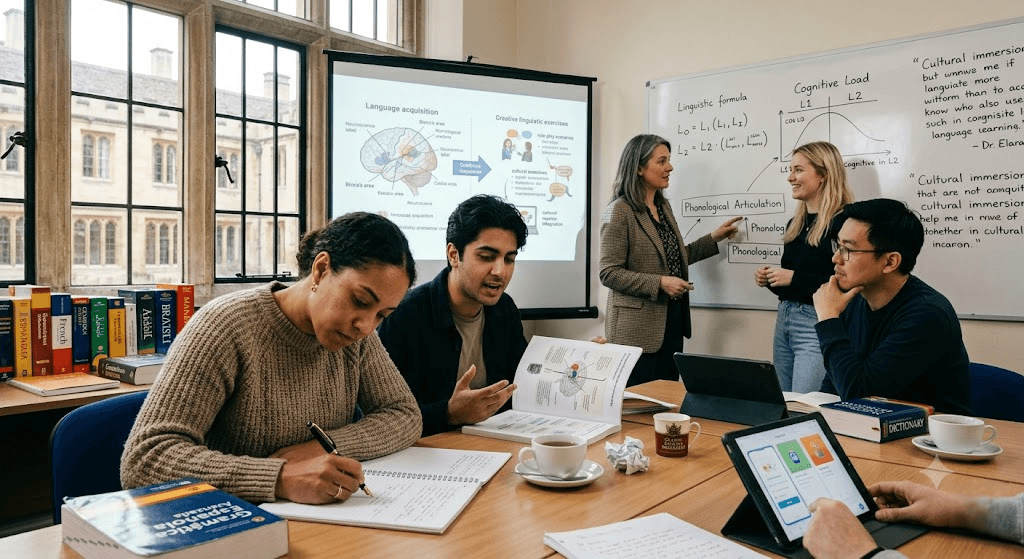
Perhaps the most profound neurological benefit is its protective effect against age-related cognitive decline. Pioneering research spearheaded by Dr. Ellen Bialystok has revealed that bilingualism can delay the onset of dementia and Alzheimer’s disease by an average of four to five years. This is a significantly more powerful effect than any currently available pharmacological intervention. The constant mental juggling required to suppress one language whilst speaking another acts as a lifelong resistance training programme for the mind, keeping the neural architecture flexible and resilient.
The Comprehensible Input Hypothesis
If there is one foundational pillar of modern language acquisition, it is the Comprehensible Input hypothesis, first popularised by the linguist Stephen Krashen in the 1980s. Krashen famously argued that human beings acquire language in exactly one way: by understanding messages. We do not acquire it by memorising grammar rules or forcing ourselves to speak before we are ready.
Consider how an infant learns their mother tongue. They are not handed a grammar workbook. They are immersed in a sea of context-rich, highly visual, and simplified language. Over thousands of hours of listening, their brains unconsciously map the sounds to meanings. Krashen posits that adults learn in much the same way, provided the input is ‘comprehensible’. This means you should be consuming content where you understand roughly 70 to 80 percent of the context, allowing your brain to naturally infer the meaning of the unknown words.
To implement this, learners must move away from flashcards and heavily rely on graded readers, podcasts designed for language learners, and children’s television programmes. The goal is massive, engaging exposure. If you find the material genuinely interesting—whether it is a true crime podcast in Spanish or a cooking show in Italian—your brain will lower its natural resistance and absorb the syntactical structures subconsciously.
Hacking Memory: The Spaced Repetition System
Whilst comprehensible input provides the broad foundation, there are times when targeted vocabulary acquisition is necessary. This is where the Spaced Repetition System (SRS) becomes an invaluable tool. In the late 19th century, the German psychologist Hermann Ebbinghaus discovered the ‘Forgetting Curve’, a mathematical formula that illustrates how rapidly we forget new information if it is not reviewed.
Spaced repetition directly combats the Forgetting Curve. It is an algorithmic approach to learning that schedules reviews of vocabulary at optimally expanding intervals. If you learn a new word today, the system will test you tomorrow. If you remember it, the next review will be pushed to three days, then a week, then a month. If you forget it, the cycle resets.
Applications like Anki and Memrise have digitalised this process, allowing learners to efficiently commit thousands of words to long-term memory with just ten to fifteen minutes of daily review. The secret to maximising SRS is to create your own digital flashcards. Instead of downloading pre-made lists, populate your decks with sentences and phrases you have encountered naturally during your reading and listening exercises. This ensures the vocabulary is relevant and anchored in a memorable context.
The Physicality of Speech: The Shadowing Technique
Many learners excel at reading and listening but freeze entirely when asked to speak. This is because speaking is not just a cognitive task; it is a highly physical one. Your tongue, lips, and vocal cords must develop new muscle memory to produce unfamiliar phonemes. To bridge the gap between comprehension and articulation, polyglots frequently employ a technique known as ‘Shadowing’.
Pioneered by the renowned linguist Professor Alexander Arguelles, shadowing involves listening to an audio recording of a native speaker and attempting to repeat the words aloud simultaneously, or just a fraction of a second behind them. It is akin to singing along to a song on the radio. Arguelles recommends performing this exercise whilst walking briskly outdoors, maintaining good posture, and projecting your voice.
Shadowing bypasses the analytical, translating part of the brain and forces you to mimic the natural rhythm, intonation, and melody of the target dialect. Over time, it dramatically reduces a foreign accent and trains the articulatory muscles to move fluidly, making spontaneous speech feel significantly less intimidating.
Overcoming the Dreaded Intermediate Plateau
Every language learner eventually hits the ‘Intermediate Plateau’. In the beginning stages, progress feels rapid. Moving from zero knowledge to stringing basic sentences together provides a massive dopamine hit. However, once you reach an intermediate level (roughly B1 or B2 on the Common European Framework of Reference), progress seems to grind to a halt. You can understand the gist of conversations, but native media remains overwhelming, and your vocabulary feels stubbornly stagnant.
Breaking through this plateau requires a drastic shift in strategy. You can no longer rely on textbooks or apps designed for beginners. The only way to breach the advanced levels is through sheer volume of native consumption. This is the time to transition to extensive reading—reading entire novels without stopping to look up every single unknown word.
It is also the stage where you must seek out idiosyncratic cultural nuances, slang, and humour. Start watching stand-up comedy, political debates, or reality television in your target language. These mediums use unfiltered, unscripted language that will push you out of the sterile environment of classroom learning. The plateau feels like wading through treacle, but consistent, massive exposure to authentic material will eventually break the dam.
Language Stacking: The Polyglot’s Secret
For those ambitious enough to tackle multiple languages, a fascinating and highly effective technique known as ‘Language Stacking’ (or ‘laddering’) can be employed. Once you have reached a strong intermediate or advanced level in your first foreign language, you stop using your native language as the base for learning the next one.
For instance, if a native English speaker learns French to a B2 level, and subsequently decides to learn Spanish, they should not buy an ‘English to Spanish’ textbook. Instead, they should purchase a ‘French to Spanish’ textbook. They should use French dictionaries to look up unknown Spanish words.
This method achieves two remarkable outcomes simultaneously. Firstly, it prevents the deterioration of the first foreign language by forcing the brain to use it as an operational tool rather than a passive subject. Secondly, it completely bypasses the native language, preventing the brain from constantly translating back to English. It cements a bilingual mindset and accelerates the acquisition of the third language.
The Affective Filter and Psychological Barriers
Often, the greatest barrier to fluency is not a lack of intelligence or poor study habits, but rather psychological friction. Stephen Krashen termed this the ‘Affective Filter’. When a learner is anxious, stressed, or self-conscious, this hypothetical filter rises, physically blocking the brain from processing input and producing output.
In traditional classrooms, where students are called upon to perform publicly and are harshly corrected for grammatical errors, the affective filter is sky-high. To acquire a language efficiently, you must artificially lower this filter. This involves cultivating an environment of low-stakes learning.
Embrace the identity of a ‘competent fool’. Accept that you will make thousands of mistakes, sound childish, and occasionally embarrass yourself. Language exchange partners, tutors on platforms like iTalki, or supportive online communities can provide safe spaces to practise without judgment. When the pressure to be perfect is removed, the brain’s natural pattern-recognition software operates at maximum efficiency.
Designing a Micro-Immersion Environment
A common excuse for failing to learn a language is the inability to travel to a country where it is spoken. However, in the digital age, physical location is largely irrelevant. You have the power to curate a bespoke immersion environment from the comfort of your own living room.
Begin with the low-hanging fruit: change the operating language of your smartphone, laptop, and social media accounts. This forces you to interact with the language hundreds of times a day in high-context, functional situations. Next, manipulate algorithms to your advantage. Create a separate YouTube profile dedicated exclusively to content in your target language. The algorithm will rapidly adapt, serving you a continuous stream of native vlogs, documentaries, and news.
Furthermore, utilise ‘dead time’. Commuting, washing the dishes, or walking the dog are perfect opportunities for passive listening. Even if you are not actively focusing on every word, having the rhythm and cadence of the language playing in the background helps your brain acclimatise to the auditory landscape. True immersion is not about buying a plane ticket; it is about ruthlessly defending the linguistic borders of your daily environment.
Sleep: The Unsung Hero of Linguistic Fluency
Finally, we must address the most overlooked component of language acquisition: sleep. The obsession with ‘hustle culture’ often leads learners to sacrifice rest in favour of late-night cramming sessions. This is counterproductive in the extreme.
When you encounter new vocabulary or grapple with complex grammatical structures during the day, the information is temporarily stored in the hippocampus. It is highly volatile and easily forgotten. It is only during deep, slow-wave sleep that the brain initiates a process called memory consolidation. The neural connections are transferred from the short-term hippocampus to the neocortex for long-term storage.
Furthermore, during REM (Rapid Eye Movement) sleep, the brain engages in abstract problem-solving and pattern recognition. Have you ever struggled to formulate a sentence in a foreign language, only to wake up the next morning finding the phrasing comes effortlessly? That is the result of overnight neural processing. Prioritising eight hours of quality sleep is quite literally the most efficient ‘study’ technique available to the human body.
Final Thoughts on the Linguistic Journey
Mastering a foreign language is a profound undertaking that fundamentally alters how you perceive the world. It provides a unique lens through which to view history, culture, and human interaction. It is not a sprint, nor is it a simple linear progression. It is a messy, deeply rewarding journey characterised by sudden leaps of intuition and frustrating plateaus.
By stepping away from outdated academic models and embracing neuroplasticity, comprehensible input, spaced repetition, and digital immersion, anyone can achieve fluency. Remember that consistency will always trump intensity. Fifteen minutes of focused, enjoyable daily engagement is vastly superior to hours of gruelling weekend study. Trust the process, engage with content that sparks your curiosity, and allow your brain to do what it has evolved over millennia to do: connect, comprehend, and communicate.