 savingsspot.co.uk
 There is a quiet, elemental magic in taking a scoop of wet river mud, shaping it with your bare hands, and subjecting it to the violent heat of a furnace, only to pull out a stone object that will outlive the rise and fall of civilisations. This is ceramics: humanity’s oldest synthesis of art, geology, and chemistry.
In the United Kingdom, our relationship with clay runs straight into the bedrock. From the coarse, hand-pinched beaker vessels of the Bronze Age to the thrumming, bottle-kiln skylines of 19th-century Stoke-on-Trent, ceramics have mapped our domestic habits, our global trade routes, and our industrial ambitions. Yet, for several decades, the craft was quietly relegated to dusty museum display cases or the back of the kitchen cupboard. Today, we are witnessing a profound revival. In a culture dominated by frictionless, backlit glass screens, the cool, stubborn resistance of wet earth has become the ultimate modern sanctuary.
The Holy Trinity of Clay

To truly understand ceramics, one must first dismantle the misconception that ‘clay’ is a singular, uniform substance. In the studio, clay bodies are generally divided into three distinct families, dictated by their mineral composition and the precise temperature at which they surrender to the fire.
Earthenware: The Warm Foundation
Earthenware is the most democratic of clays. Found in abundant deposits across the British Isles, it is fired at relatively low temperatures (typically between 950°C and 1,100°C). Because the heat inside the kiln is not intense enough to fully fuse the raw mineral particles—a transformative process known as vitrification—earthenware remains porous after its initial firing. To hold water, it requires a glass-like glaze. Terracotta garden pots, rustic Mediterranean tableware, and traditional English slipware all belong to this family. It holds a soft, earthy warmth, but it chips easily under rough domestic duress.
Stoneware: The Impervious Workhorse
When you push a kiln past the 1,150°C threshold, climbing toward 1,300°C, the nature of the earth changes fundamentally. Stoneware clays contain higher percentages of silica and feldspar. Under intense heat, the clay vitrifies; it shrinks, the microscopic spaces between the particles seal up entirely, and the material becomes waterproof, even without the application of a glaze. Muted in raw colour—often firing to rich buffs, duns, and stormy greys—stoneware is dense, chip-resistant, and inherently functional. It is the vessel of the traditional farmhouse kitchen, the heavy-bottomed fermentation crock, and the contemporary artisan studio.
Porcelain: The White Gold
For centuries, Europe looked upon imported Chinese porcelain with an almost superstitious envy. True high-temperature porcelain requires a very specific primary clay called kaolin (or china clay), which remains stark white when fired to a blistering 1,260°C to 1,400°C. At this extreme temperature, the body becomes so vitrified that it turns translucent. If you hold a fine porcelain teacup to the morning light, you can see the shadow of your fingers through the wall. It is notoriously temperamental to throw on a potter’s wheel—craftspeople often compare working with raw porcelain to throwing wet cream cheese—but its fired state yields a resonance that rings like a struck bell.
The British Saga: From Staffordshire Smoke to Studio Serenity
While the Chinese perfected porcelain centuries before the West arrived at the party, Britain’s contribution to the ceramic timeline is an extraordinary tale of industrial espionage, brilliant chemistry, and astute commercial marketing.
By the mid-18th century, the six towns that make up modern-day Stoke-on-Trent earned the permanent, smoky moniker of “The Potteries”. The local geography was serendipitous: the Staffordshire soil offered abundant firing clay, the nearby coalfields provided the fuel for the insatiable bottle kilns, and the newly carved Trent and Mersey Canal allowed fragile, finished wares to be transported to the ports of Liverpool without being rattled to dust over rutted turnpike roads.
Josiah Wedgwood and the Birth of Modern Commerce
At the epicentre of this industrial explosion stood Josiah Wedgwood. While art history remembers him for his iconic pale-blue Jasperware, economic historians revere him as the grandfather of modern marketing. Wedgwood realised early on that the British aristocracy dictated the purchasing tastes of the burgeoning middle class. When Queen Charlotte accepted a cream-coloured earthenware tea service from him in 1765, Wedgwood shrewdly requested permission to brand the line “Queen’s Ware”.
He did not stop at royal endorsements. Wedgwood invented the concept of the illustrated mail-order catalogue, pioneered buy-one-get-one-free promotions, and introduced the world’s first formal ‘money-back guarantee’. If a dinner service arrived chipped in Glasgow or Boston, Wedgwood replaced it without a quibble, absorbing the short-term loss to cement an unshakeable, generational brand loyalty.
The Uniquely British Innovation: Bone China
Concurrently, a few miles away, a rival potter named Josiah Spode was attempting to solve a frustrating British problem: true hard-paste porcelain imported from Asia was wildly expensive, but native British soft-paste imitations tended to crack the moment boiling tea was poured into them. Around 1790, Spode hit upon a morbidly brilliant solution. He took standard porcelain recipe ingredients and added up to 50% calcified bone ash derived from ox bones sourced from London abattoirs.
The bone ash acted as a powerful flux. The resulting material—Bone China—fired at a slightly lower temperature than true porcelain, possessed a warm, milky whiteness, and exhibited a freakish mechanical strength. A fine bone china saucer could be dropped onto a wooden floor and bounce where standard earthenware would shatter into a dozen pieces. It quickly became the default, world-renowned canvas for the great British afternoon tea.
The 20th Century: The Studio Counter-Revolution
As Staffordshire’s automated mass production reached its zenith in the early 20th century, a philosophical, soul-searching pushback was brewing in the far West of England. In 1920, Bernard Leach returned from Japan and set up the St Ives Pottery in Cornwall alongside master Japanese potter Shoji Hamada. Leach fundamentally rejected the hyper-refined, perfectly uniform output of the industrial factories. He championed the “ethical pot”—hand-thrown, wood-fired stoneware that celebrated human imperfection, earthy glazes, and the visible, honest mark of the maker’s fingers.
Decades later, an Austrian émigré named Lucie Rie arrived in London, fleeing the rising Nazi regime. Working out of a tiny, sunlit studio in Albion Mews, Paddington, Rie introduced a sharp, continental modernism to British ceramics. Where Leach’s pots were heavy, brown, and deeply rustic, Rie’s bowls were weightless, urban, finely sgraffito-scratched, and glazed in vibrant, volcanic yellows and peacock blues. Together, these two opposing creative forces defined the British Studio Ceramics movement, proving to the fine art establishment that a functional vessel could hold immense intellectual weight.
The Science of the Skin: What Happens in the Kiln
When an uninitiated observer looks at a glazed ceramic bowl, they see a coat of paint. In reality, a glaze is a bespoke layer of molten glass fused directly to the ceramic body at a molecular level. Crafting a successful glaze is less like painting a canvas and more like conducting a highly controlled geological event.
A standard studio glaze relies on three foundational components:
- The Glass Former: Silica (usually introduced as ground quartz or flint). This is the structural skeleton of the glass, but on its own, it requires a staggering 1,713°C to melt—a heat that would turn standard studio kilns into glowing puddles of liquid metal.
- The Flux: To bring that impossible melting point down to a manageable 1,200°C, the potter adds a flux, such as feldspar, whiting (calcium carbonate), or washed wood ash.
- The Refractory: Alumina (usually supplied via powdered clay). Alumina acts as the stiffening agent; without it, the molten glass would simply slide off the vertical walls of the pot during the firing and glue the vessel permanently to the kiln shelf.
The Magic of Atmosphere: Oxidation versus Reduction
Once the base glass recipe is balanced, powdered metal oxides are added to summon colour. Yet, the final hue is entirely at the mercy of the kiln’s invisible internal atmosphere. In a standard electric kiln, the atmosphere is rich in oxygen (an oxidation firing). If you drop a small percentage of copper oxide into this environment, it yields a pleasant, highly predictable grass green.
However, if a potter uses a gas or wood-fired kiln and deliberately chokes the oxygen intake at peak temperature (a reduction firing), the fire becomes starved and desperate. To keep burning, the flames physically rip the oxygen atoms directly out of the metal oxides sitting inside the glaze. Deprived of its oxygen, that exact same mundane green copper oxide transforms instantly into a volatile, deep oxblood red—a legendary, unpredictable glaze known historically as Sang de Boeuf. It is this element of high-stakes chemistry that gives rise to the universal studio superstition of the “kiln gods”; no matter how precise your digital scales, the fire always claims the final edit.
The Muddy Antidote to the Digital Age
Over the past ten years, the demographic of the British pottery studio has undergone a total transformation. Once lazily stereotyped as the gentle preserve of retirees in smocks making wonky pinch pots, urban open-access ceramics studios in Manchester, Bristol, Edinburgh, and London now command multi-year waiting lists populated overwhelmingly by professionals in their twenties and thirties.
Part of this cultural shift can be attributed to the “Great Pottery Throw Down effect”—the warm, tear-filled televised celebration of the craft that did for the potter’s wheel what the Great British Bake Off did for the sourdough starter. But the root cause is far more existential.
We are a generation suffering from a quiet deficit of tactility. Many of us spend forty hours a week typing lines of code, shifting digital cells in spreadsheets, or manipulating pixels that do not physically exist in the real world. At the end of the working week, there is zero tangible, physical evidence of our labour. Clay offers the exact, grounding inverse. It has undeniable mass, weight, temperature, and a stubborn memory. If you force a piece of clay into a shape it does not wish to hold, it will remember the insult and split open during the firing.
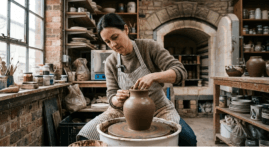
Furthermore, the potter’s wheel demands an absolute, unmedicated physical presence. The precise moment your mind wanders to an unread work email or an upcoming social obligation, your thumbs apply uneven pressure, the centrifugal force takes over, and your elegant, rising cylinder collapses instantly into a wet, spinning mound of ruined slurry. You cannot multi-task with mud.
From Teacups to the Cosmos: Advanced Technical Ceramics
While studio potters seek grounding in ancient, slow-living techniques, modern materials scientists are looking to ceramics to build the high-tech infrastructure of the future. We instinctively associate the word ‘ceramic’ with fragility—the tragic, sharp clatter of a dropped dinner plate—yet advanced technical ceramics are some of the toughest, most heat-resistant substances known to human science.
When raw, dug clay is stripped of its water and replaced with ultra-pure, synthetically engineered powders like silicon carbide, aluminium oxide, or zirconia, the physical rules change entirely. These non-metallic, inorganic compounds possess extreme mechanical hardness and a near-total refusal to expand or warp under sudden thermal shock.
It is advanced ceramic matrix composites that line the glowing exhaust cones of British-built Rolls-Royce jet engines, allowing them to operate at internal temperatures that would turn standard structural titanium into liquid soup. It is ultra-smooth, biocompatible ceramic that forms the indestructible, frictionless ball inside a modern artificial hip replacement. When a Formula One driver slams on the brakes going into a tight corner at Silverstone, they rely on ventilated carbon-ceramic discs to absorb the colossal spike in friction. Most poetically of all, when a returning spacecraft hits the Earth’s upper atmosphere at Mach 25, it is a lightweight blanket of silica ceramic tiles that absorbs the 1,650°C friction of re-entry, keeping the human beings inside sitting at a comfortable, room-temperature 21°C.
The Permanent Record
There is a deeply poignant, almost philosophical symmetry to the lifecycle of ceramics. The cheap plastic containers we manufacture today will slowly shred into insidious micro-particles that pollute our watercourses; our vast digital archives risk vanishing entirely into the silent ether of an unmaintained, obsolete cloud server; our grandest iron bridges and steel monuments will inevitably surrender to the slow, orange rust of the damp British winter.
Yet, if a hobbyist potter working in a garden shed in Shropshire drops a poorly thrown stoneware mug onto the floor tonight and tosses the fired bisque shards into the compost heap, those broken fragments will sit in the topsoil, chemically and structurally unchanged, for twenty thousand years. When the confused archaeologists of an unimaginably distant future sift through the compacted geological strata of the early 21st century, it will not be our software codes they judge us by, nor our social media profiles. It will be the gentle sweep of our handles, the depth of our cobalt glazes, and the silent, enduring testimony of our fired earth.