
 savingsspot.co.uk
 We have all been there: it is a rainy Tuesday morning, your favourite jeans are feeling a fraction too snug, and you decide today is the day you finally commit to a gym. You open a few tabs, look at the monthly Direct Debit prices, factor in the “joining fees,” and quietly close your browser. Keeping fit in the UK has started to feel like a luxury lifestyle choice, with some high-street and premium clubs demanding the equivalent of a monthly utility bill just to let you use their treadmills.
However, the UK fitness market is currently experiencing one of the most hyper-competitive periods in its history. From the massive expansion of 24-hour budget chains to local council leisure trusts fighting for footfall, the power has shifted entirely to the consumer. You do not have to choose between your physical health and your bank balance. If you understand the sales cycles, the corporate loopholes, and the legalities of UK gym contracts, you can routinely slash your fitness costs by anywhere from 20% to 50%.
This is the savvy consumer’s roadmap to navigating the UK gym landscape, bypassing the standard rack rates, and securing the best possible membership deals.
1. Decoding the UK Gym Tier System
Before trying to find a deal, you have to establish which tier of the UK fitness ecosystem actually matches your routine. Overpaying usually happens when people buy into a tier that offers facilities they never use.
The Budget Giants (£15 – £30 per month)
Dominated by operators like PureGym, The Gym Group, and JD Gyms. Their business model relies on high volume and automated entry. They operate 24/7, rarely enforce minimum term contracts, and offer massive open-plan free weight and cardio zones. The catch? You will not find swimming pools, saunas, or fluffy towel services, and peak hours (5:00 PM to 7:30 PM) can feel like a contact sport.
The Mid-Market & Community Operators (£35 – £60 per month)
This tier includes franchise models like Anytime Fitness, regional operators like Village Gym, and charitable leisure trusts such as Better (GLL) or Everyone Active. These venues offer the best middle ground: they almost always feature a 25-metre pool, steam rooms, structured group exercise timetables, and far more breathing room on the gym floor than the budget tier.
The Country Club & Premium Tier (£75 – £150+ per month)
The domain of David Lloyd, Nuffield Health, and Virgin Active. You are no longer just buying a place to sweat; you are buying a lifestyle hub with dedicated remote-working lounges, indoor tennis courts, boutique spa facilities, and high-end cafes. Negotiating here requires a completely different playbook.
2. The Calendar Hacks: When to Actually Buy
Gym memberships behave exactly like airline tickets: the price fluctuates wildly depending on the day of the week and the month of the year. If you walk in on a whim, you will pay the highest possible price.
The January Illusion
It is a common misconception that January is the best time to find a gym deal. While gyms spend millions on marketing in January, they rarely offer their lowest recurring monthly rates because demand is at its peak. They will frequently slap a “No Joining Fee” banner on the door, but the base monthly rate is locked at its highest tier. The real New Year deals arrive in the last week of February. By this point, the resolution-crowd has begun to drop off, sales targets are slipping, and area managers start issuing aggressive flash discount codes to make up the shortfall.
The “End of the Month” Squeeze
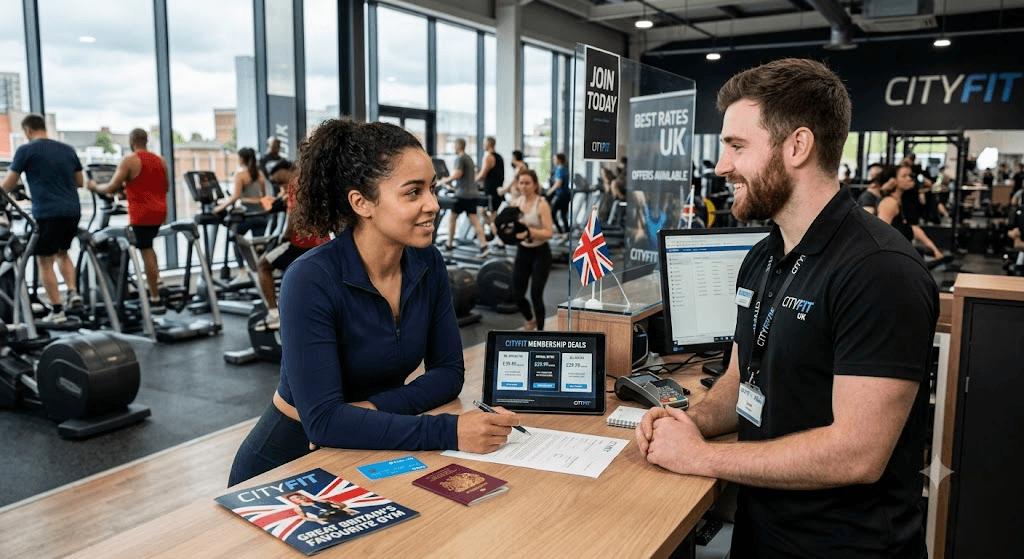
If you are looking at a mid-tier or premium gym that employs human membership consultants, never visit them before the 25th of the month. Membership consultants operate on strict monthly commission cycles. If a consultant is three contracts short of their tier-two bonus on the 28th of the month, they will pull out every discretionary discount code their system allows to get your signature on the dotted line.
The Summer Slump (July and August)
This is the UK fitness industry’s bleakest period. People are on holiday, students have gone home, and anyone who wants to exercise is doing it outside in the sunshine. Premium and mid-market gyms grow desperate during the summer slump. You will routinely see “Get 6 Weeks Free” or “Pay Nothing Until September” offers deployed during these months.
3. Seven Insider Strategies to Lower Your Monthly Rate
Strategy 1: The Vitality Health Insurance Loophole
This is arguably the single best open secret in the UK personal finance and fitness world. If you take out a private health insurance or life insurance policy with Vitality, you gain access to their rewards programme. Vitality offers its members up to 50% off monthly gym memberships at Nuffield Health, Virgin Active, and PureGym.
Because basic Vitality life insurance policies can be secured for as little as £10 to £15 a month depending on your age, and a 50% discount at Nuffield Health can save you £40 a month, the insurance policy actually pays for itself while leaving you £25 a month better off. Furthermore, you get the peace of mind of having private medical or life cover.
Strategy 2: Exploit the “No Joining Fee” Wave
Paying a £20 to £40 “admin” or “joining” fee at a digital budget gym like PureGym or The Gym Group is a completely voluntary tax. These chains run on an automated promotional algorithm. Roughly every 14 to 21 days, they toggle a 72-hour flash sale waiving the setup fee. If you go to the website and see a joining fee, simply close the tab, follow their local branch on Instagram, and wait two weeks. A promo code (usually something like ZERO or SAVE) will inevitably appear.
Strategy 3: Check Your Workplace “Salary Sacrifice” Portal
Thousands of British employers are signed up to corporate wellness aggregators like Wellhub (formerly Gympass) or Hussle for Work. Because these schemes are often run through salary sacrifice or corporate pre-tax purchasing, the savings are immense. Wellhub, for instance, groups gyms into pricing tiers; a Tier 1 pass might cost you £15 a month deducted straight from your payslip, but grants you unlimited access to dozens of different mid-tier commercial gyms that would normally charge £35 individually.
Strategy 4: Pivot to an “Off-Peak” Membership
If you work from home, work shift patterns, or enjoy working out at 8:30 PM, you should never pay a standard membership rate. Almost every mid-range and luxury operator offers an “Off-Peak” tariff that is typically 30% to 40% cheaper than the full pass. Standard UK off-peak hours generally permit entry between 9:00 AM and 4:00 PM, and any time after 8:00 PM on weekdays, alongside full unrestricted access on weekends.
Strategy 5: The “Single Club” Downgrade
When you sign up for chains like Better, David Lloyd, or Anytime Fitness, the default option pre-selected on the web portal is often the “National” or “All-Club” pass. Ask yourself honestly: are you actually going to drive to a gym three towns over just to try a different cross-trainer? Select the “Single Club” or “Local” tier. It immediately knocks between £5 and £15 off the monthly direct debit.
Strategy 6: The Blue Light Card & Student Portals
If you work in the NHS, emergency services, social care, or armed forces, you should possess a Blue Light Card (costing £4.99 for two years). The Gym Group, PureGym, and JD Gyms offer permanent 10% to 20% direct debit reductions and zero joining fees via the Blue Light portal. Similarly, university students should never sign up via a gym’s main homepage; always route your sign-up through UNiDAYS or Student Beans to unlock fixed 9-month academic year passes that save roughly 25% compared to rolling monthly contracts.
Strategy 7: Look to the Local Authority Trusts
Private gyms spend heavily on stylish mood lighting and sleek marketing, but local council gyms—operated by non-profit trusts—reinvest their surpluses directly into the equipment. Facilities run by operators like Better or Everyone Active frequently house top-tier, Olympic-standard Eleiko lifting platforms and brand new Technogym cardio suites. Because they are heavily subsidised by local authorities to promote public health, their non-contract, all-inclusive memberships (gym, swim, and classes) sit at a very agreeable £25 to £35 price point.
4. The Art of Haggling at Premium Gyms
You cannot haggle with an iPad kiosk at PureGym, but you can absolutely negotiate with a human being at Nuffield Health, David Lloyd, or Bannatyne. When entering a high-end club, use this three-step negotiation sequence:
- Step 1: The Competitor Leverage. Research the exact price and current promotional offer of their nearest high-end competitor. When sitting down with the membership rep, say: “I love the pool here, but Nuffield down the road is currently waiving their joining fee and offering two months at half price. What can you do to close the gap?”
- Step 2: Pivot to Soft Benefits. If the sales rep claims their software literally will not allow them to manually override the monthly direct debit price, accept it—but pivot immediately to “soft inventory.” Ask them to throw in four free Personal Training vouchers, a book of 10 guest passes for your friends, or free permanent towel hire. This costs the gym virtually nothing to issue, but delivers tangible cash value to you.
- Step 3: The “Think About It” Walkaway. Never sign up on the day of your tour. Thank them, tell them you need to look over your monthly outgoings, and walk out. In 80% of cases, you will receive a phone call or an email within 48 hours offering to drop the joining fee or offering a bespoke “corporate match” rate to get you back in the building.
5. Surviving the Fine Print: Know Your Legal Rights
The UK fitness industry used to be notorious for trapping consumers in iron-clad, inescapable multi-year contracts. Following landmark interventions by the Competition and Markets Authority (CMA), the legal landscape is now firmly on your side, provided you know the rules.
The “One Full Calendar Month” Trap
This is the most common way British consumers lose money when quitting a gym. If your contract dictates “one month’s notice,” this almost universally refers to one full calendar month. If you give notice to cancel your membership on the 3rd of October, your notice period does not end on the 3rd of November. Your notice period covers the entirety of November, meaning your Direct Debit will still be taken on the 1st of November, and your access will finally cease on the 30th of November. Always hand your notice in roughly five days before the end of the current month.
The Relocation Clause
Under CMA guidance, a gym must release you early from a fixed-term 12-month contract if you move house, provided your new permanent address is located an “unreasonable distance” from any of their branches (typically interpreted as more than 5 to 10 miles). You will need to provide proof, such as a new council tax bill or a signed tenancy agreement, but they cannot legally force you to pay out the remainder of the year.
The “Freeze” Option
If you are suffering from a documented medical issue, redundancy, or are going backpacking for three months, do not cancel your membership if it required a high upfront joining fee. Request a “membership freeze.” Most UK operators are legally obliged to offer a medical freeze free of charge upon sight of a doctor’s note, or a standard lifestyle freeze for a nominal placeholder fee of £5 a month.
6. The “Serial Trialist” Method (Free Fitness)
If you are in a transitional phase—perhaps moving to a new city or waiting for a new job to start—and need a stopgap, you can legitimately train for over a month in most UK towns without paying a single penny.
Almost every major gym chain offers a digital guest pass system to entice new prospects. You can methodically work your way through your local market using:
- Nuffield Health: Offers a free 1-day pass via their website.
- Anytime Fitness: Routinely issues a free 1-day or 3-day trial pass.
- Better Leisure: Offers a free “Try Before You Buy” day pass at most community locations.
- Village Gym: Frequently offers a free 1-day leisure pass download.
- PureGym / The Gym Group: While day passes usually cost £5 to £10, they frequently run localized social media ads offering free 3-day trial codes to residents within a specific post-code radius.
By staggering these trials, you get to thoroughly test the water pressure of the showers, the busyness of the squat racks at 6:00 PM, and the general atmosphere of every gym in your local area before committing a single pound of your hard-earned income.