 savingsspot.co.uk
 There is an old, slightly weathered adage tossed around the car parks of the Lake District and the muddy trailheads of Eryri: “There is no such thing as bad weather, only unsuitable clothing.” It is a lovely sentiment, usually delivered by someone wearing a four-hundred-pound Gore-Tex Pro shell to someone shivering in a high-street hoodie. The unspoken truth of the British outdoors is that acquiring the “suitable clothing” required to survive a sideways November downpour on Helvellyn can feel like trying to fund a small space programme.
Technical outdoor kit is undeniably expensive. Research and development, proprietary membranes, ethical down sourcing, and rigorous laboratory testing all command a hefty Recommended Retail Price (RRP). However, the UK outdoor retail market is also one of the most fiercely competitive, over-stocked, and seasonally predictable retail sectors in the country. If you are paying full RRP for your rucksacks, walking boots, or waterproofs, you are essentially paying a voluntary tax for impatience.
This is the definitive guide to systematically dismantling the cost of top-tier outdoor gear in Great Britain, separating the genuine high-performance bargains from the false economies.
1. The Golden Rule: Disregard “Cheap”, Hunt “Discounted”
Before looking at where to buy, we have to establish the fundamental economic law of the hills. Buying a £20 unbranded waterproof jacket that wets out after twenty minutes is not a saving; it is a £20 down payment on hypothermia. Conversely, buying a £300 mountain jacket reduced to £165 is a profound victory.
True value lies in the depreciation of premium brands—Rab, Berghaus, Montane, Mountain Equipment, Patagonia, and Arc’teryx. These brands build kit designed to survive a decade of granite abrasion and gales. When their prices drop by 40%, the hydrostatic head rating doesn’t drop with them; only the retailer’s profit margin does.
2. Cracking the UK Retailer Ecosystem
The British outdoor retail landscape is broadly split into four distinct tiers. Knowing how each operates is the key to knowing when to strike.
The Big Box “Club” Giants
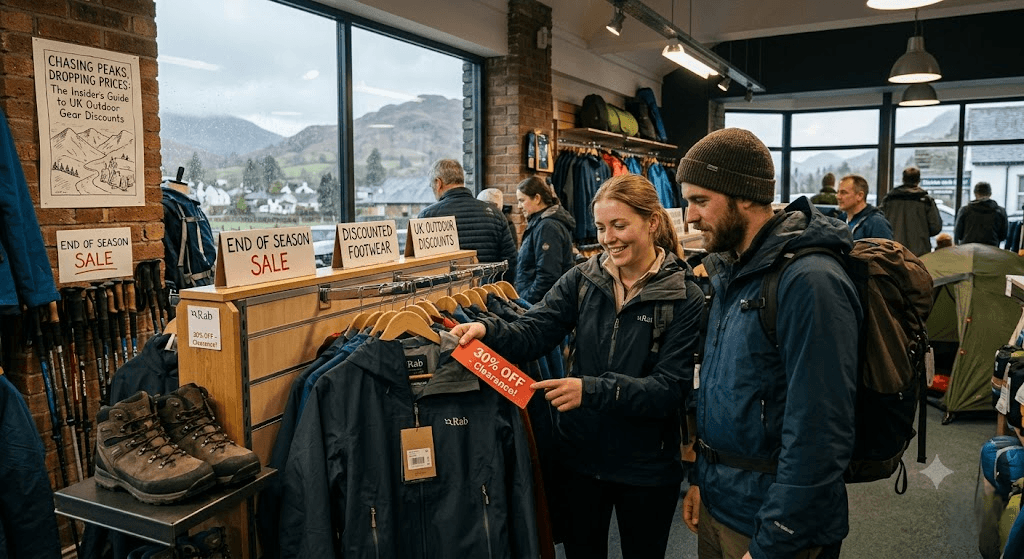
Stores like Go Outdoors and Millets (both part of the JD Outdoor conglomerate) operate on a high-low pricing model. The golden ticket here is the Go Outdoors Member’s Card (currently £5 per year). Never look at the standard price on the shelf; it is a purely fictional anchor designed to make the “Member’s Price” look like a rescue mission.
The Pro-Tip: Go Outdoors operates a “Price Match Plus 10%” policy. If you find a Rab jacket online at a niche Scottish climbing shop for £150, show it to the Go Outdoors till staff. Not only will they match the £150, they will take a further 10% off that matched price, bringing it to £135. Because their physical footprint is immense, you can walk out with the jacket that same afternoon.
The Private Flash-Sale Aggregators
If you have not registered an account with SportPursuit, you are missing the single greatest clearinghouse of outdoor kit in Europe. Operating behind a mandatory (but free) login wall, they bypass brand pricing agreements by running time-limited “flash sales” on excess stock. It is routine to find top-tier Scandinavian and British mountaineering brands marked down by 50% to 70%.
The catch: Delivery can take up to three weeks because they often wait for the flash sale to close before importing the bulk order from the manufacturer’s central European warehouses. This is for the forward-planner, not the person going to the Brecon Beacons this Friday.
The Baseline Disruptor: Decathlon
While this guide focuses on discounting premium kit, we must acknowledge the French behemoth. Decathlon’s in-house mountaineering brand, Simond, and their trekking brand, Forclaz, do not offer “discounts” in the traditional sense because their base RRP is already set at the factory cost of their competitors. If you need a 100% merino wool baselayer or a pair of lightweight trekking poles, check Decathlon’s standard prices before spending three days scouring the web for a discounted branded equivalent.
3. The “Affiliation Loophole”
A staggering percentage of British walkers walk right past guaranteed, year-round 15% discounts because they forget what is sitting in their wallets. The major high-street specialist retailers—most notably Cotswold Outdoor, Snow+Rock, and Ellis Brigham—maintain permanent discount partnerships with almost every major UK outdoor body.
You can claim an instant 15% off full-price items (and sometimes 10% off already discounted items) if you hold an active membership with:
- The Ramblers: At ~£38.50 a year, the membership pays for itself the moment you buy a pair of £260 Meindl or Scarpa walking boots.
- The British Mountaineering Council (BMC): Vital for climbers and hill walkers alike.
- The National Trust: Yes, your standard family pass to look at stately homes and eat Victoria sponge entitles you to 15% off technical mountain kit at Cotswold Outdoor.
- The Duke of Edinburgh’s Award (DofE): Both participants and leaders get digital cards.
- Blue Light Card / Defence Discount Service: Available to all NHS, Emergency Services, and Armed Forces personnel.
4. Master the Rhythm of the Seasonal Drift
Outdoor brands operate on a strict, rigid two-season manufacturing cycle: **Spring/Summer (SS)** and **Autumn/Winter (AW)**. Retailers have finite stockroom space; when the AW stock arrives in late August, the SS stock becomes a physical liability that costs them money to store.
The February/March Deep Freeze
This is the optimum window to buy heavy down jackets, 3-layer Gore-Tex winter shells, four-season sleeping bags, and crampon-compatible boots. The winter peak has passed, the lowland mud is starting to dry out, and shops are desperate to clear out bulky 800-fill down parkas to make room for ultra-lightweight running vests.
The August Bank Holiday Pivot
Conversely, late August is the death knell for family camping gear. Multi-room tunnel tents, double-burner gas stoves, camp beds, and summer-weight synthetic sleeping bags undergo aggressive markdowns to prevent them sitting in a damp Midlands warehouse until the following May.
The “Colourway Tax”
When shopping end-of-season sales, filter strictly by your size, and then *abandon all aesthetic vanity*. Manufacturers produce classic “Core” colours (usually Black, Navy, and Forest Green) year after year; these rarely get deeply discounted. However, every season they release “Seasonal” colours—think *‘Sulphur Yellow’*, *‘Burnt Ochre’*, or *‘Electric Magenta’*.
When the season turns, the Stealth Black version of a Montane jacket will sit proudly at £220, while the exact same jacket, cut from the identical waterproof roll of cloth, will sit next to it in ‘Acid Lime’ for £115. Embrace being visible to search and rescue teams; it saves you a hundred quid.
5. The Second-Life & Factory Outlet Underground
The most profound shift in the UK outdoor market over the last five years has been the formalisation of the “circular economy”. Because technical garments use non-biodegradable synthetic polymers, the industry has faced immense pressure to stop old kit going to landfill.
Brand-Direct Refurbished Platforms
Rather than scouring standard second-hand sites, head to the official brand “Re-Use” hubs.
- Rab ‘Second Stitch’: Sold directly via their website or their factory shop. These are items that suffered a torn baffle or a broken zip, were sent to Rab’s world-class Derbyshire repair centre, professionally mended with contrasting “honest repair” stitching, and put back up for sale at 40–50% off.
- Patagonia ‘Worn Wear’: A meticulously graded online platform where you can buy used, industrially cleaned, and repaired Patagonia fleeces and shells. Because Patagonia’s sizing remains historically stable, the risk of a bad fit is minimal.
- Cotswold Outdoor ‘Repair & Care’: Keep an eye out for their ex-demo and repaired stock rail, usually tucked away near the boot-fitting area in their larger out-of-town stores.
The Derbyshire Holy Grail: Factory Shops
If you live within driving distance of the East Midlands, make a pilgrimage to the **Rab Factory Shop in Alfreton**. It is an unglamorous industrial estate unit filled with raw sample rails, prototypes, minor cosmetic seconds, and previous-season overruns. It is entirely possible to walk out with an expedition-grade sleeping bag with a microscopic, inconsequential weaving flaw in the inner lining for less than half its retail value.
6. The “Where to Splurge, Where to Scrimp” Matrix
When operating on a budget, you have to deploy your capital where the physics of the outdoors demands it, while ruthlessly cutting corners where it doesn’t.
SPLURGE ON: Footwear and your Outer Shell.
If your feet develop deep-tissue blisters five miles into the Cairngorms, or your shell leaks cold rain into your insulating layers, your trip is functionally over. Never compromise on the fit of a boot to save £30. Go to a shop, get measured on a Brannock device, try them on with the exact loop-stitched merino socks you intend to walk in, and pay the price required to secure the right box.
SCRIMP ON: Mid-layers and Fleece.
A high-end, £140 recycled-polyester brand-name fleece offers almost zero thermal advantage over a £15 Craghoppers microfleece or a surplus British Army olive-green “woolly pully”. Fleece is fundamentally just trapped air inside knitted plastic; do not pay for a logo on a mid-layer.
SCRIMP ON: Hydration systems.
A £40 branded plastic water bladder does the exact same job as two 1-litre Smartwater bottles bought from a petrol station for £1.50 each, with the added benefit that the Smartwater bottles are virtually impossible to puncture and weigh significantly less.
7. Setting Your Digital Tripwires
To catch the absolute bottom of the market, you must remove the human element of manual browsing. Set up automated tracking using the following methodology:
- Identify the exact piece of kit you need (e.g., “Osprey Talon 33 Rucksack, Size L/XL”).
- Go to **PriceRunner.com** or **Google Shopping**.
- Locate the product page and click “Set Price Alert”.
- Input your target price (calculate 40% off the standard RRP).
- Set the alert to ping your email directly.
When a mid-sized independent outdoor retailer in North Wales or Cumbria decides to run a 48-hour “Flash 20% off everything” code to boost their cash flow at the end of a quiet month, the algorithm will catch the price drop instantly. You click, you buy, and you go back to planning your route up the hill.