 savingsspot.co.uk
 Every time you visit the mobile website of a well-known British retailer, the digital nagging begins. A polite but persistent banner slides down from the top of your screen: “Download our app and get 15% off your first order.” To the casual shopper, this looks like a stroke of corporate generosity. To a digital marketer, however, it is an aggressive land grab for the most valuable real estate in the modern British economy: the home screen of your smartphone.
We live in an era of digital fatigue, where standard promotional vouchers are routinely swallowed by expired coupon sites or blocked by browser extensions. Yet, the “app discount code” remains a bizarrely protected species. Brands are willing to take a significant financial hit on your first transaction—sometimes offering up to 30% off or free delivery—purely to get their icon sitting next to your WhatsApp and Spotify widgets. Understanding the mechanics behind this ecosystem allows the savvy UK consumer to turn a corporate customer-acquisition strategy into a reliable system for lowering the cost of living.
The Hidden Economics: Why Retailers Pay You to Download
To understand how to exploit app discount codes, you first have to understand why they exist. When you buy a pair of trainers or your weekly groceries via a standard web browser, you are a transient visitor. You might have arrived via a paid Google search ad (which cost the retailer £1.50), or through an affiliate link (which costs them 8% of your basket value). Next week, when you want to buy something else, they have to pay those digital gatekeepers all over again to win you back.
Once their app is installed on your device, the financial math flips entirely:
- Zero-Cost Re-engagement: They no longer need to bid on Google AdWords to catch your eye; they can send a rich push notification directly to your lock screen for a fraction of a penny.
- Frictionless Checkout: Apps store your Apple Pay, Google Pay, or debit card details permanently, alongside your UK delivery address. This reduces “cart abandonment” by roughly 40% compared to mobile web browsing.
- First-Party Data: An app can request location permissions, track how long you linger on a specific product category, and map your shopping habits with a granularity that standard browser cookies no longer permit.
Because the “Customer Lifetime Value” (CLV) of an app user is statistically double that of a web-only user, British marketing departments are given massive budgets strictly designated for app-acquisition vouchers. They are not giving you 20% off because they like you; they are buying a direct pipeline to your wallet. Your goal should be to collect the entry fee, make your purchase, and strictly manage the relationship thereafter.
The Heavy Hitters: Where to Find the Best UK App Promos
While almost every major high street brand now utilizes mobile software, certain sectors operate in a permanent state of high-intensity promo warfare. Knowing which sectors are bleeding margin to acquire users tells you where to look first.
1. The Takeaway and Grocery Titans
The battle between Uber Eats, Deliveroo, and Just Eat is legendary, but the real app-discount gold lies in the “rapid delivery” and supermarket loyalty sectors. Supermarkets have realized that physical plastic loyalty cards are dead. To push users toward digital portals, applications like the Tesco Clubcard App and Lidl Plus offer app-exclusive pricing that doesn’t even require a typed code at checkout—the app itself acts as a master cryptographic discount key. Furthermore, independent takeaway aggregators like Foodhub systematically offer 10% to 15% off standard app orders purely because they operate on a 0% commission model for the restaurants, passing the saved overhead directly to the app user.
2. High Street Fashion and Apparel
Fast fashion relies entirely on impulse buys, a psychological state triggered infinitely better by a glossy native app than a sluggish mobile Safari tab. Giants like ASOS routinely drop heavy app-exclusive codes (historically utilizing variations like APP15, APP20, or surprise weekend drops like HAPPYSAD). High street staples such as H&M, Zara, and Uniqlo offer static “Welcome to the Club” vouchers—usually £5 off a £30 spend—the moment you generate an account via their application.
3. Travel, Transit, and Ticketing
In the UK, booking train tickets via standard desktop sites often results in creeping booking fees. Apps like Trainline frequently run zero-booking-fee promotions exclusively for mobile users. Meanwhile, the aggressive competition between ride-hailing apps (Uber vs. Bolt vs. FREE NOW) means that keeping all three apps sitting in a designated folder on your phone allows you to play their push-notification algorithms against one another; if you ignore Bolt for three weeks, an automated script will almost certainly generate a bespoke 30% off ride code to woo you back.
The Advanced Playbook: Four Hacks to Unearth Active Codes
Typing “Brand Name + app discount code” into Google will almost certainly land you on a graveyard of fake affiliate portals displaying simulated success rates. To get the genuine, high-value codes, you need to use behavioral triggers.
Hack 1: The Digital Pouting Technique (Basket Abandonment)
Retail apps are wired to a central Customer Relationship Management (CRM) system—usually powered by heavyweight software like Braze or Salesforce. These systems monitor user sessions in real-time. To trigger an automated discount code:
- Download the target app and create a fresh account.
- Spend five minutes browsing, add three or four high-margin items to your basket, and proceed to the very final stage of checkout (stopping just short of double-clicking Apple Pay).
- Force-close the app entirely. Do not just minimize it; swipe it off your active screen dashboard.
- Wait 24 to 48 hours.
In roughly 60% of cases, the CRM will flag your session as an “abandoned high-intent cart” and fire an automated email or push notification containing a unique, one-time-use code (e.g., COMEBACK10) to nudge you over the finish line.
Hack 2: Intercepting the “Welcome Back” Algorithm
If you have already used a brand’s first-time app discount, your account is marked as ‘converted’. However, marketing algorithms hate dormant data. If you have an app on your phone that you haven’t opened in six months, delete it. Re-download it a fortnight later. The system registers a “re-installation event” and will frequently treat you as a lost sheep, issuing a re-engagement discount code directly to your inbox to celebrate your return.
Hack 3: The Deep-Link Reddit Sweep
Standard coupon sites use static scraping tools that miss dynamic app links. When modern brands launch app-exclusive influencer codes, they use deep-links (URLs that automatically force the app to open on your phone and inject the promo code into the checkout cache silently). To find these, bypass Google and go to Reddit. Search the target brand’s name alongside site:reddit.com/r/UKFrugal or look for recent threads in student subreddits. Users frequently paste the raw, un-indexed deep-links shared by micro-influencers on TikTok.
Hack 4: Exploiting the “Refer-a-Mate” Infinite Loop
App developers know that peer-to-peer recommendation is the cheapest form of user acquisition. Almost every major food, fintech, or transport app features a “Share and Earn” tab. Crucially, many UK apps do not cap the number of referral bonuses you can stack. By dropping your unique referral link into niche community forums, hyper-local Facebook groups, or shared workplace Slack channels, you can transform a single app download into a rolling balance of £10 credit vouchers.
The Technical Barrier: Why “Dummy Accounts” Fail
A few years ago, the ultimate UK consumer trick was the “Gmail +1” hack. If Deliveroo offered £10 off your first app order, you simply signed out, registered a new account as [email protected], and kept the cheap pad thai flowing indefinitely. Today, attempting this will result in a cold, hard digital rejection: “This promotional code cannot be applied to this device.”
Modern retail apps utilize sophisticated Device Fingerprinting. When you install an application, it takes a digital impression of your hardware. It registers your smartphone’s unique Advertising ID (IDFA on Apple, AAID on Android), your exact screen resolution, your operating system build, your carrier, and—crucially—your payment card’s digital token. Even if you use a totally new name, a fresh SIM card, and a brand new email address, the moment you try to pay with the same Monzo card or Apple Pay wallet you used on your “banned” account, the app’s fraud-detection API flags the link and kills the voucher.
To genuinely reset your status as a “new user” for high-value app codes, you must cross three separate data streams simultaneously:
- A fresh physical device: (e.g., using an iPad sitting in the living room rather than your main iPhone).
- A fresh payment method: (e.g., generating a disposable virtual card via Revolut or Starling Bank specifically for the transaction).
- A clean network handshake: (Disconnecting from your home Wi-Fi and using a 5G mobile data connection to ensure your home IP address isn’t associated with the old account).
The Masterclass: How to “Stack” App Codes
The greatest mistake British shoppers make is assuming that using an app discount code means forfeiting other forms of digital rebate. In reality, you can “stack” up to three separate discounts on a single mobile transaction if you orchestrate the checkout sequence correctly.
Layer 1: The Cashback Bridge
Normally, opening an app breaks the tracking cookies used by UK cashback giants like TopCashback and Quidco. However, both platforms now have their own native mobile apps engineered with “app-to-app tracking”. If you open the TopCashback app on your phone, search for *ASOS*, and click “Get Cashback”, your phone’s operating system will execute a handshake, instantly flipping you over to the native ASOS app while carrying the tracking ID in the background. You are now earning 6% cash back.
Layer 2: The Native App Code
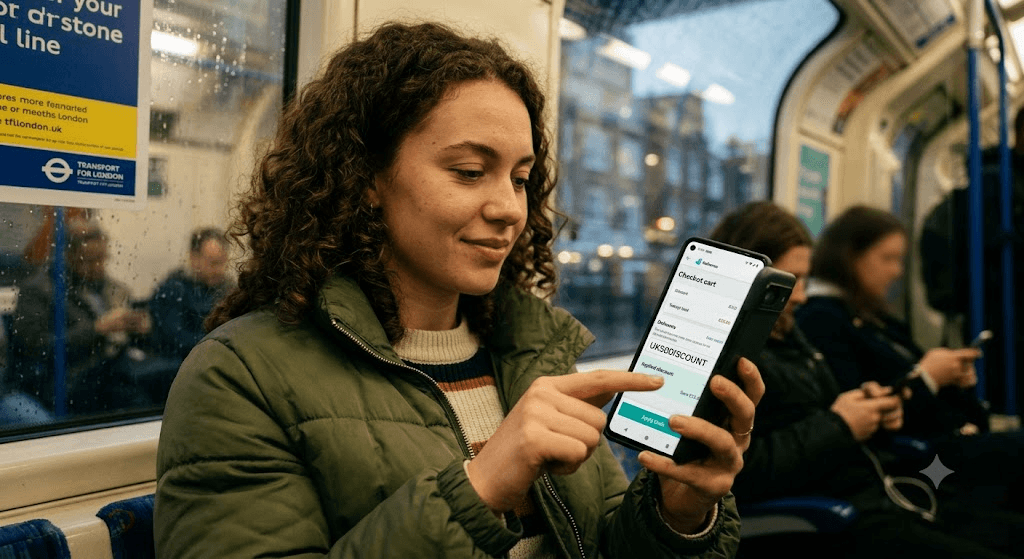
Once inside the retailer’s app via the cashback bridge, you navigate to the checkout and paste your app-exclusive promo code (e.g., APP20 for 20% off). Because the retailer’s system sees a valid internal code, it applies the markdown to the basket.
Layer 3: The Discounted Gift Card Rail
Instead of clicking “Pay with Visa”, you open a third app: JamDoughnut or Airtime Rewards. These are instant UK gift-card portals that offer instant guaranteed cashback (usually between 3% and 10%) when you buy a digital gift card for major retailers like Costa, Airbnb, ASOS, or Primark. You buy the exact balance of your newly discounted basket on JamDoughnut, copy the generated 16-digit voucher code, flip back into the retailer’s app, and paste it into the “Pay by Gift Card” box.
The Final Math: A £100 jacket is reduced to £80 via the App Promo Code. You earn £4.80 back via TopCashback tracking. You paid for the £80 balance using a JamDoughnut gift card that yielded 5% (£4.00) in instant points. Your net cost for the £100 jacket is £71.20, achieved entirely on a 6-inch screen while sitting on a standard British sofa.
The Consumer Trap: When an App Code Costs You Money
While the savings are real, consumers must remember that commercial entities do not operate registered charities. The app ecosystem contains several psychological “dark patterns” specifically designed to make you give back the money you just saved.
The most dangerous phenomenon is Dynamic Price Discrimination. Because an app functions inside a closed environment, a retailer can show you a completely different base price than the one displayed on their public web URL. It is increasingly common in the travel, airline, and hotel booking sectors for an app to advertise a “10% mobile-only discount”, while subtly raising the baseline room rate by 12% for mobile users. Before applying a high-value app voucher to a major purchase (such as a holiday or a television), always open a private “Incognito” browsing window on a separate laptop to verify that the “pre-discount” price matches the open market reality.
Furthermore, you must exercise strict post-purchase hygiene. The moment your discounted order is confirmed, go into your smartphone’s system settings and execute the following:
- Revoke Location Access: Change the app’s setting from “While Using” to “Never”. There is no legitimate reason a high street clothing brand needs to know when you walk past their physical store in Leeds.
- Kill the Push Notifications: Turn off badges, banners, and sounds. If you leave them on, the app will use predictive AI to ping your phone at 8:15 PM on a Tuesday—the exact statistical window where UK consumers are most prone to boredom-induced “retail therapy”.
- Offload Unused Apps: Both iOS and Android allow you to “Offload” apps—deleting the heavy software while keeping your login data saved in the cloud. This saves your battery life and keeps your home screen clear of digital temptation until you actively decide you need to buy from them again.
Frequently Asked Questions
Can I use a UK app discount code on a standard desktop computer?
No. Retailers use “User-Agent sniffing” and dedicated API endpoints to ensure the request is coming from their validated software package. If you try to force an app-only code into a standard desktop checkout box, the server will return an invalid promo error.
Why does my unique app welcome code say “Expired” immediately after downloading?
This is almost always caused by hidden checkout exclusions. UK consumer law allows retailers to exclude specific items from promotional codes. Check the small print: most high street fashion apps exclude “Sale Items”, “Third-Party Brands” (e.g., buying Nike trainers inside the ASOS app), or set a strict minimum spend threshold (e.g., valid only on baskets over £50 excluding delivery fees).
Do student discount codes (UNiDAYS / Student Beans) stack with App introductory codes?
Generally, no. Most modern UK retail apps feature a single promo entry field engineered to operate on a “best value wins” logic. If you enter a 15% UNiDAYS code and then apply a 20% new-app-user code, the system will simply overwrite the student code with the higher value one. However, the “Cashback Bridge” and “Gift Card Rail” mentioned in the stacking guide above will *always* work alongside a student code.