 savingsspot.co.uk
 In an era where the cost of the weekly shop seems to tick upward with every passing season, the definition of a “good shopper” has fundamentally shifted. It is no longer about simply denying yourself the things you enjoy; it is about outsmarting the retail machinery. British supermarkets, high street giants, and digital marketplaces invest millions of pounds into behavioural psychology to make us spend more. To keep your hard-earned money in your bank account, you have to employ a little psychology of your own.
Whether you are trying to shave twenty pounds off your weekly grocery bill, secure a high-end appliance at a fraction of its recommended retail price, or make your online spending work for you passively, the modern UK retail landscape offers countless loopholes. Here is a masterclass in modern British shopping hacks, designed to turn you from a passive consumer into an elite, strategic buyer.
1. Outsmarting Supermarket Psychology
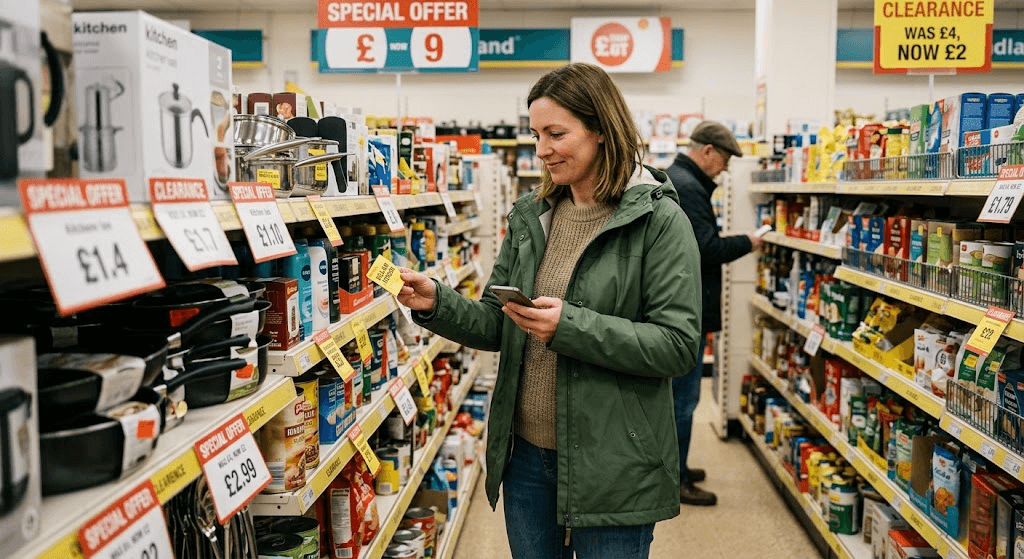
The average British supermarket is not laid out by accident; it is an obstacle course designed to maximise your “dwell time” and force impulse buys. Milk and bread are placed at the far back corners so you have to walk past three aisles of promotions to get to them. Once you understand the geography of the store, you can bypass the traps.
The “Brand Downshift” Challenge
Most supermarket stock is segmented into four distinct tiers: Premium (e.g., *Taste the Difference* or *Finest*), Branded (e.g., Heinz or Kellogg’s), Own-Brand, and Value/Essentials. Marketing conditions us to believe that a lower price equals an inferior product. Take the “Downshift Challenge”: for one weekly shop, drop every item you buy down by one single tier. If you normally buy branded oats, buy the supermarket’s standard own-brand. If you buy standard own-brand chopped tomatoes, drop to the basic ‘Essentials’ range.
In blind taste tests conducted by consumer watchdogs, the vast majority of shoppers cannot tell the difference between standard own-brand and branded staple goods, yet the price difference can be up to 60%. If you downshift an entire trolley and decide you genuinely dislike the lower-tier version of a specific item, you can shift that single item back up next week. Most people find they permanently stick with roughly 70% of their downshifted goods, saving an average of £1,500 a year for a family of four.
Mastering Yellow Sticker Timings
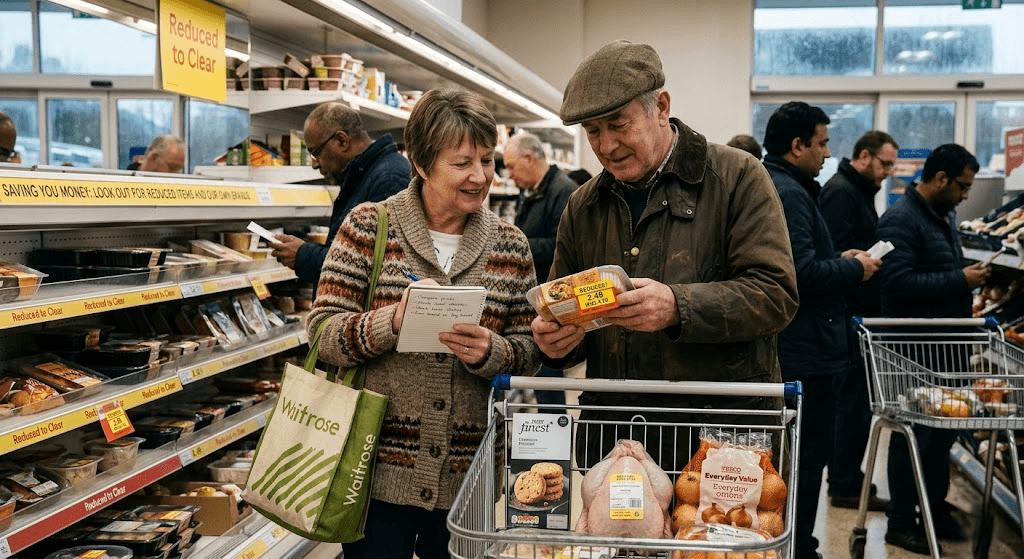
The “yellow sticker” clearance section is the holy grail of reduced grocery shopping, but rocking up at random times yields amateur results. Supermarkets have strict internal schedules for manually marking down items approaching their display “use by” dates.
- Marks & Spencer: The first wave of 20% reductions usually happens soon after the morning rush (around 10:30 AM), but the real magic happens between 5:00 PM and 6:30 PM, where items are slashed by up to 75% to clear the shelves before closing.
- Sainsbury’s: Reductions are heavily store-dependent, but the major final markdowns (often down to 10p or 20p) reliably occur between 7:00 PM and 8:00 PM.
- Tesco: The morning sweep catches items expiring that day at roughly 25% off. The golden hour for the massive 70% to 80% markdowns begins at 6:00 PM.
- Waitrose: Historically the most generous with their final markdowns. Visit two hours before the store closes; it is not uncommon to find high-end ready meals and organic meats reduced from £6.00 to 80p.
Pro-Tip: Never buy a yellow-sticker item just because it is cheap. If you wouldn’t have bought it at full price, and you cannot immediately freeze it or eat it tonight, buying it is a waste of money, not a saving.
The Unit Price Reality Check
Retailers love to play visual tricks with “Bulk Buy” or “Family Pack” promotions. A giant 1kg tub of branded yoghurt plastered with a “Great Value!” banner will frequently sit right next to a 450g pot of the exact same yoghurt. Because of promotional anomalies or supply pricing, the smaller pot is quite often cheaper *per 100g* than the bulk pack.
Train your eyes to ignore the main bold price tag and look at the tiny print underneath it: the **Unit Price** (e.g., *£0.24 per 100g* or *£1.12 per 100ml*). This is the only legally mandated, un-spinnable metric of true value on a supermarket shelf.
2. The Art of the “Double-Dip” (and Triple-Dip)
If you are paying for an item online or on the high street by simply taking out your standard high-street bank debit card and tapping it, you are leaving free money on the counter. Elite shoppers treat every transaction as a multi-layered cake of rewards.
The Three-Tier Stacking Method
When making any planned purchase—whether it is a new toaster from Currys or a hotel booking—you should aim to hit three separate collection points simultaneously:
- The Gateway (Cashback Sites): Never go directly to a retailer’s website. Open a cashback portal like *TopCashback* or *Quidco* first, search for the retailer, and click through their tracked link. This generates a percentage return (often between 2% and 12%) deposited back into your account just for using their digital door.
- The Payment Vessel: Pay using a dedicated reward or cashback credit card (such as an American Express Cashback card or the Barclaycard Rewards card), or a high-return digital debit card like Chase UK (which offers 1% standard cashback on daily spending). Make sure the credit card is set to be paid off *in full* by direct debit every month to avoid interest wiping out your gains.
- The Retailer Loyalty Scheme: Scan the retailer’s own loyalty card at the digital or physical checkout (e.g., Boots Advantage Card, Tesco Clubcard, or Nectar).
By using this stack, a £500 laptop purchase can easily yield £35 from the cashback portal, £5 from your credit card provider, and £5 worth of store loyalty points—effectively bringing the real cost down to £455 with about forty seconds of extra effort.
Maximising Loyalty Point Valuations
The single biggest mistake consumers make with loyalty points like Nectar or Tesco Clubcard is spending them at face value at the supermarket checkout. One hundred Clubcard points equals £1.00 off your groceries. However, if you take those same points into the Tesco Clubcard app and convert them into “Reward Partner” vouchers, their value instantly doubles.
That £10 worth of saved grocery points turns into £20 worth of vouchers for *Pizza Express*, *Hotels.com*, *Eurotunnel*, or an *English Heritage* annual pass. Treat store loyalty points as a currency specifically reserved for leisure, travel, and dining out.
3. The Digital Arsenal: Beating the Algorithms
Online shopping is governed by complex algorithms designed to track your behaviour, test your willingness to pay, and create artificial urgency. You can turn these algorithms back on the merchants.
The Abandoned Basket Strategy
If you are shopping for clothing, homeware, or lifestyle goods with major online retailers (such as ASOS, New Look, Boden, or Dunelm), do not rush the checkout. Create an account, log in, add the items you want to your digital basket, proceed to the final payment screen so the system logs your intent, and then simply close the browser tab.
Roughly 60% of modern e-commerce platforms have automated “basket recovery” routines. Within 24 to 48 hours, you will frequently receive an automated email saying: *”Did you forget something? Here is 10% off to complete your order.”* If you hold out for 72 hours, some systems automatically upgrade the nudge to a 15% discount or free next-day delivery.
Historical Price Checking
During massive retail events like Black Friday, Boxing Day, or Amazon Prime Day, retailers frequently engage in “price anchoring.” They will raise the price of a television to £899 in October, only to “slash” it to £599 in November, claiming a £300 saving. In reality, the television was selling for £550 in August.
Before buying anything on Amazon, paste the product URL into a free tracking website called **CamelCamelCamel**. It will instantly generate a clear, historical line graph showing you every price fluctuation that specific product has experienced over the last five years. You will immediately know whether you are looking at a genuine bargain or an engineered optical illusion.
Dynamic Pricing Counter-Measures
Airlines, train booking apps (like Trainline), and dynamic hotel aggregators track your cookies and your IP address. If you check the price of a return train from London to Edinburgh on Tuesday morning, and check it again on Tuesday afternoon, the site knows you are eager and will often bump the displayed price up by 15% to panic you into booking.
Always do your initial travel research in standard browsing mode. When you are ready to pull the trigger and enter your card details, open a completely fresh “Incognito” or “Private Browsing” window, or switch off your home Wi-Fi and use your smartphone’s 4G/5G mobile data to secure a clean, untracked IP address. You will frequently watch the inflated price drop right back down to the baseline.
4. High Street and Fast Fashion Insider Rules
While brick-and-mortar retail has taken a beating from the digital world, the physical high street holds secrets that online shopping cannot replicate—provided you know the secret visual language of the shops.
Decoding Zara’s Geometric Tags
Anyone who shops at Zara knows the frustration of carrying six items into the fitting room only to discover that a “Medium” in one jacket fits like an XL, while a “Medium” in a blouse feels like a child’s size. Look closely at the cardboard price tag hanging off the garment; near the top hole, you will see a tiny printed geometric shape: a **Triangle**, a **Circle**, or a **Square**.
- The Triangle: Indicates the garment belongs to the *Zara TRF (Trafaluc)* collection. This range is cut for a younger demographic and runs notoriously small. You should almost always size up.
- The Circle: Indicates the *Zara Woman* collection. These pieces use classic, relaxed, or oversized tailoring. Sizing down is generally safe here.
- The Square: Indicates the *Zara Basic* line. These items are constructed to standard, strict European sizing metrics; buy your true size.
The Outlet “Made-for-Outlet” Trap
Brits love a trip to retail outlet villages like Bicester Village, Cheshire Oaks, or the Ashford Designer Outlet, believing they are buying last season’s luxury surplus at a 50% discount. While genuine surplus does exist, up to 70% of the clothing sold in modern designer outlets is actually “Made-for-Outlet” (MFO) stock.
Brands like Ralph Lauren, Coach, Tommy Hilfiger, and Hugo Boss manufacture separate, lower-tier lines specifically to sit in outlet stores. These items use cheaper polyester blends, inferior stitching, and lower-grade hardware, but are tagged with a fake “RRP” to make the outlet price look like a steal. To spot an MFO item, check the internal wash-care label inside the left seam. Genuine boutique transfer stock will have standard retail codes; MFO stock almost always features unique internal factory symbols (for example, Gap Outlet uses three small squares on the inner label, while standard Gap uses none).
5. The UK Retail Calendar: Buying in the Troughs
Every product category experiences predictable pricing peaks and troughs throughout the calendar year based on trade shows, new model releases, and warehouse clearance cycles. Buying out of season is the easiest way to secure a permanent 20% discount.
- January: *The White Sales.* This is historically the best time to buy bed linen, high-end duvets, towels, and mattresses as retailers look to clear bulky warehouse stock. It is also the cheapest month to buy gym equipment (ironically, to capture the New Year’s resolution crowd, competition forces prices down).
- March & April: *Digital Cameras and Smartphones.* The major global tech conventions take place in January and February. By March, brands are shipping their new flagship models to UK stores, meaning the previous year’s “top-of-the-range” models are suddenly subjected to aggressive factory-backed discounts.
- July & August: *Garden Furniture and BBQs.* Buying a patio set in May is financial suicide. By late July, retailers are desperate to clear their garden floor space to make room for Autumn/Winter stock and Halloween displays. You can easily pick up a £600 gas barbecue for £250.
- September: *Laptops and Office Gear.* Driven by the “Back to School” and university intake rush, manufacturers flood the market with bundled deals, offering free software, extended warranties, or heavy cash-back incentives on mid-range laptops.
- Late December: *The Winter Coat Sweep.* Buy your heavy winter wool coat on December 27th, not October 10th. High street fashion brands drop their winter wear by 50% immediately after Christmas to prepare the floor for Spring pastels.
6. Consumer Power: Legal Shields and Soft Negotiation
The British consumer possesses some of the strongest statutory protections in the Western world, yet most people are too polite or uninformed to exercise them.
Section 75: The £100.01 Superpower
Under **Section 75 of the Consumer Credit Act 1974**, if you pay for an item or a service that costs between £100.01 and £30,000, and you pay for even *one single penny* of it on a credit card (putting the rest on a debit card or paying in cash), your credit card provider becomes **jointly and severally liable** with the retailer.
If the retailer goes bust before delivering your sofa, if an airline goes into administration while you are sitting in the departure lounge, or if a rogue trader fits a faulty boiler and ignores your calls, you do not have to fight the retailer. You simply call your credit card company and demand a full refund under Section 75. They are legally obliged to pay you back and take on the fight with the merchant themselves.
The Live-Chat Haggle
Haggling inside a British John Lewis or Currys can feel culturally uncomfortable for many, but doing it digitally via a website’s “Live Chat” widget carries zero social awkwardness and works surprisingly often.
When you are sitting on a checkout page for a high-value item, open the live chat bubble in the corner. Connect to a human agent and type the following script:
“Hi there, I have the [Product Name] in my basket and I am ready to buy it today. However, I noticed that [Competitor Name] has it for slightly less / offers a free two-year warranty with it. I would much prefer to buy directly from you guys—do you happen to have a discretionary promotional code or a free delivery voucher you could apply to my basket to help me close this out?”
Customer service agents working on live chat are frequently monitored on their “conversion rates” (how many chats result in a completed sale). Merely asking politely will result in the agent generating a unique 5% or 10% override code off their own dashboard roughly four times out of ten.
Summary: The Mindset of the Conscious Consumer
Adopting these shopping hacks does not require you to become a penny-pinching recluse who spends four hours a night clipping physical coupons. True consumer savvy is about structural efficiency: setting up your browser extensions once, getting the right payment cards in your wallet, memorising a few store layouts, and shifting your buying windows by a few weeks.
When you combine the Double-Dip cashback method with an out-of-season purchase, protected by Section 75, you cease being a target for high-street marketing algorithms. You transform retail shopping from a drain on your household income into a controlled, highly rewarding game of skill.