 savingsspot.co.uk
 For millions of homes across Great Britain, the phrase ‘cost of living’ has transitioned from a transient news headline into a permanent framework for daily housekeeping. We scrutinise our direct debits, turn the thermostat down a notch, and hunt for supermarket yellow stickers. Yet, one of the most lucrative areas for household savings is sitting right under our noses, often tucked away in the kitchen corner or at the bottom of the garden: our waste.
We have been culturally conditioned to view the lifecycle of a physical item as a strict, one-way street: purchase, consume, discard. When we put an item in the bin, we mentally write its value down to zero. But shifting your perspective from waste disposal to resource capture changes the mathematics of running a home. By understanding the quirks of the UK’s circular economy, you can stop paying to throw things away, start getting paid to hand them back, and drastically reduce the volume of new goods you need to buy.
1. High Street Take-Back Schemes: Turning Empties into Currency
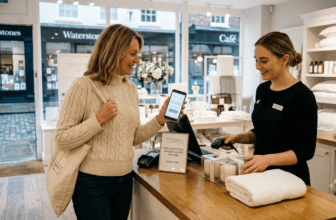
The British high street has quietly undergone a quiet revolution over the last five years. Driven by incoming Extended Producer Responsibility (EPR) regulations and a more eco-conscious consumer base, major retailers now treat your used goods as a valuable raw commodity. If you are throwing your empty shampoo bottles or worn-out t-shirts into the standard council bin, you are effectively throwing away store credit.
To capitalise on this, establish a ‘returns station’ in your home—a simple canvas bag or dedicated cupboard shelf—and sort your expired items for the following high street drop-offs:
- The Health and Beauty Loop: High-end cosmetic packaging, toothpaste tubes, and make-up palettes are notoriously difficult for local councils to process due to mixed plastics and mirrored glass. The Recycle at Boots scheme allows you to scan empty products on your smartphone, drop them into a store deposit box, and receive 500 Advantage Card points (worth £5) when you spend £10. Similarly, John Lewis offers £5 off your next beauty purchase when you return five empty cosmetic containers to their counters.
- The Textile Trade-In: Fast fashion is an intense drain on the household purse. When garments are damaged beyond the point of charity shop donation, take them to H&M. Their Garment Collecting programme accepts clothes or home textiles of any brand, in any condition (even torn bedsheets or single odd socks), handing you a digital £5 voucher towards your next purchase of £25 or more. Retailers like Schuh operate a parallel ‘Sell Your Soles’ scheme, giving you £5 off a new pair of shoes for handing over an unwearable pair.
- The Tech Graveyard: Most British homes have a designated ‘drawer of doom’ containing tangled USB-A cables, obsolete MP3 players, and dead smartphones. Currys runs a ‘Cash for Trash’ initiative that takes any broken or redundant small electronic item—from a toasted sandwich maker to an old electric toothbrush—and hands you a voucher, typically worth at least £5 off your next technology spend.
2. Mastering the Kerbside Economy
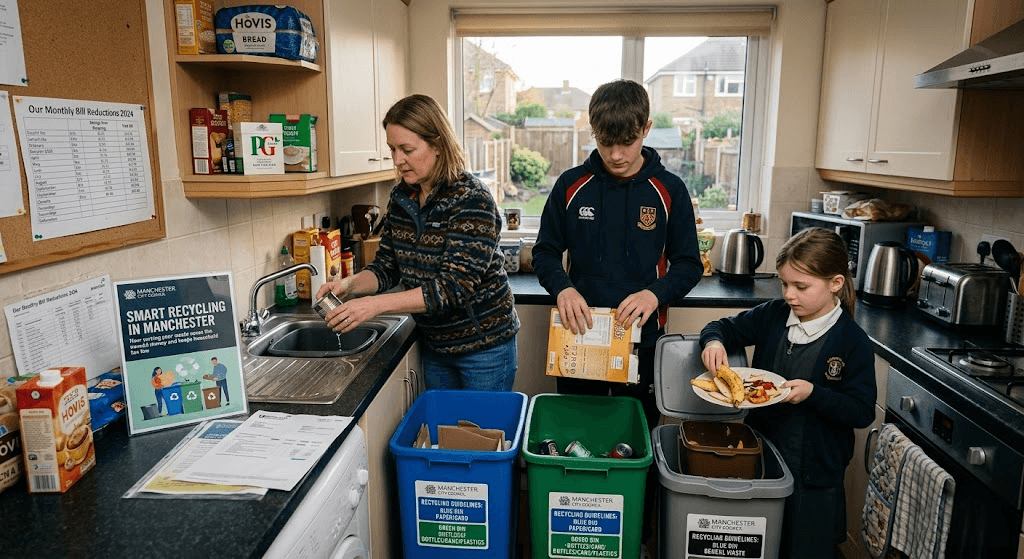
It is a quintessential British winter experience: standing on a dark, wet pavement in your slippers, peering into a wheelie bin trying to work out if a black plastic meat tray is accepted by your specific local authority. The UK’s council recycling network is famously fragmented; what gets recycled in Leeds might get rejected in Lewisham.
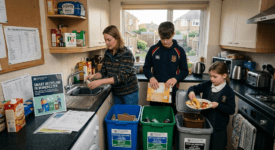
Getting your kerbside recycling wrong carries a hidden financial sting. When households engage in ‘wish-cycling’—throwing greasy takeaway pizza boxes or unwashed baked bean tins into the recycling in the vague hope that the machine will sort it out—the entire lorry load can be flagged as contaminated. Local authorities spend millions of pounds annually diverting contaminated recycling loads to standard landfill or incineration. This massive logistical overhead is baked directly into your annual Council Tax bill.
You can protect your local services and streamline your own kitchen by adopting two rigid rules:
First, strip all soft plastics out of your kerbside bins. Bread bags, frozen pea wrappers, the thin film over fruit punnets, and crisp packets cannot be handled by standard council sorting facilities as they wrap around the automated spinning cogs. Instead, collect them in a single large carrier bag and drop them into the dedicated collection cages situated at the front of almost every major Tesco, Sainsbury’s, and Co-op. Doing this instantly frees up roughly 30% of the space in your home kitchen bin, reducing the rate at which you get through black bin liners.
Second, implement the ‘Scrunch Test’ for wrapping paper and card. If you scrunch a piece of paper into a tight ball and it holds its shape, it goes in the paper bin. If it unfolds itself, it contains a hidden plastic or foil laminate and belongs in the general waste.
3. The Kitchen Ledger: Conquering the £700 Food Drain
According to data published by the Waste and Resources Action Programme (WRAP), the average UK family throws away approximately £700 worth of entirely edible food every single year. Imagine walking up to a storm drain every Friday morning and dropping a ten-pound note down the grate; that is the precise reality of the modern British food waste epidemic.
Saving money here does not require you to eat mouldy bread; it requires you to treat your kitchen appliances as active financial management tools.
Re-evaluating the Domestic Freezer
For many, the freezer is an icy graveyard where leftover bolognese goes to develop freezer burn. Instead, treat it as a ‘pause button’ for your weekly grocery budget. Almost anything that is about to tip past its ‘Use By’ date can be suspended in time:
- Hard Cheeses: Grate blocks of Cheddar or Red Leicester that are turning hard, and freeze them in a reusable tub. You can scatter the frozen shards directly onto pasta bakes or into toasties without thawing.
- Fresh Herbs and Pastes: Wilting coriander, parsley, or leftover tomato purée can be packed into standard ice cube trays, topped with a few drops of olive oil, and frozen. Pop a cube straight into a hot frying pan when starting a curry or soup.
- The ‘End of the Loaf’: Never throw away the crusts or the dry final three slices of a loaf of bread. Drop them into a dedicated freezer bag. Once the bag is full, tip the contents into a food processor to create instant free breadcrumbs for coating chicken, topping macaroni cheese, or thickening winter stews.
The Peer-to-Peer Surplus Network
When you cannot consume what you have bought, lean on the UK’s hyper-local digital infrastructure. The smartphone app Olio connects neighbours to give away surplus food for free. If you are heading off on a two-week holiday to Spain and have a fridge full of half-open milk, fresh broccoli, and yoghurts, take three photos and list them on Olio. Within an hour, a neighbour will knock on your door to collect them.
Conversely, use Too Good To Go to purchase the ‘Magic Bags’ of surplus stock from your local high street bakeries, coffee shops, and carvery pubs. A £3.50 to £4.00 investment routinely secures £15 worth of high-quality, freshly prepared food that the venue would otherwise be legally obliged to throw in the commercial skip at closing time.
4. The Library of Things: Escaping the One-Use Trap
There is a famous, slightly absurd statistic regarding the modern consumer landscape: the average domestic power drill is used for a grand total of just thirteen minutes across its entire working lifespan. Yet, millions of British homeowners have spent £60 to £100 to own one, sacrificing valuable under-stair storage space to house a heavy green plastic case.
To genuinely save money, we must decouple the concept of use from the concept of ownership. Across Great Britain, a booming network known as the Library of Things has taken root, operating out of community centres, shipping containers, and local libraries in hubs from South London to Edinburgh.
Instead of buying a heavy-duty carpet cleaner for £200 to lift a single coffee stain, you can borrow one from your local Library of Things for roughly £12 a day. The inventory of these hubs is tailored to the exact items that drain household savings during occasional life events: extra-tall step ladders for clearing autumn gutters, pressure washers for spring patio cleans, thermal imaging cameras to spot winter window draughts, and even heavy-duty bell tents for summer camping trips.
5. Pragmatic Upcycling: Beyond the Glass Jam Jar
When the word ‘upcycling’ is mentioned, it often invokes images of uninspired weekend craft projects—mason jars wrapped in garden twine or shipping pallets hastily turned into profoundly uncomfortable garden sofas. However, true, functional upcycling is a cold, calculated exercise in avoiding retail spending.
Consider the British housing stock, which is officially the oldest and most draughty in Western Europe. Rather than spending £35 on custom thermal draft excluders for your living room doors, look inside your wardrobe. An old pair of heavy denim jeans with a blown-out knee can be cut at the thigh, sewn or tightly tied at one end, stuffed with old unmatched woollen socks and shredded packaging paper, and sealed. You have instantly manufactured a bespoke, highly effective thermal barrier that keeps the ambient heat inside the room, allowing your boiler to cycle off much sooner.
In the garden, the cost of propagation equipment, cloches, and seed trays has surged. You can bypass the garden centre entirely by raiding your blue recycling bin:
- Clear two-litre fizzy drink bottles, with the bottom three inches carefully sliced off with a craft knife, function as individual micro-greenhouses when placed over vulnerable young tomato or courgette seedlings, protecting them from late May frosts and slugs.
- Cardboard toilet roll tubes, when stood upright inside a plastic mushroom punnet and filled with soil, create the ultimate biodegradable seed-starting pots for sweet peas and runner beans. When the plant is ready to move outside, you plant the whole cardboard tube directly into the earth; the card rots down naturally, completely avoiding root disturbance.
6. Wardrobe Velocity and the Digital Clothes Rail
The United Kingdom buys more clothes per person than any other nation in Europe. Consequently, our wardrobes are acting as physical vaults of trapped capital. If you want to run a financially optimised household, you must treat your clothes rail as a revolving balance sheet rather than a static storage unit.
The platform Vinted has fundamentally changed the UK second-hand market because it removed the psychological barrier that crippled eBay for casual sellers: seller fees. If you sell an old jumper for £8 on Vinted, you receive £8 into your bank account; the buyer absorbs the tiny transaction and postage fees.
Adopt the strict household rule of ‘One In, One Out’. If you wish to purchase a new autumn coat or a pair of walking boots, you must finance that purchase by liquidating two or three unworn items from your existing collection. Spending a single rainy Sunday afternoon photographing ten neglected garments can easily generate £60 to £80 of clear funds. You are not merely decluttering your home; you are transforming inert cotton and wool back into liquid cash to offset your necessary seasonal spending.
The Circular Household Balance Sheet
Ultimately, transforming your household’s relationship with waste is not an exercise in extreme, joyless frugality. You do not need to wash and hang up your tin foil to dry, nor do you need to spend three hours a night repairing unfixable appliances.
Real, sustainable saving is about identifying the points in your daily routine where value is quietly slipping into a black bin liner. It is about intercepting a cardboard box before it hits the recycling bin to see if it can organise a messy kitchen drawer; it is about looking at a browning banana and seeing tomorrow morning’s pancake batter rather than tonight’s food waste; it is about remembering that the high street chemist owes you five pounds for the plastic tub sitting on your bathroom windowsill.
When you stack these small, frictionless habits together, the financial results compound. The pound notes stay inside the structural perimeter of your property, rather than being wheeled out to the kerbside every Thursday morning for the council lorry to take away.