
 savingsspot.co.uk
 Have you ever wondered what happens to the thousands of winter coats left sitting in a retailer’s warehouse when the spring collections arrive? Or where the mountain of 50-inch 4K televisions goes when a brand launches its slightly updated next-generation models? They do not vanish into thin air. Despite high-profile historical scandals involving luxury brands destroying old stock, the vast majority of it gets funnelled directly into the UK’s booming overstock market.
For the savvy British shopper, overstock represents the sweet spot of modern retail: buying brand-new, factory-sealed, completely legitimate products at a fraction of their original Recommended Retail Price (RRP). However, navigating this space requires a sharp eye. The internet is flooded with misleading ‘clearance’ banners and phantom discounts. To truly unlock the best overstock deals in the UK, you have to understand the mechanics of the surplus supply chain.
The Nuance of Discounted Stock: What Actually is Overstock?
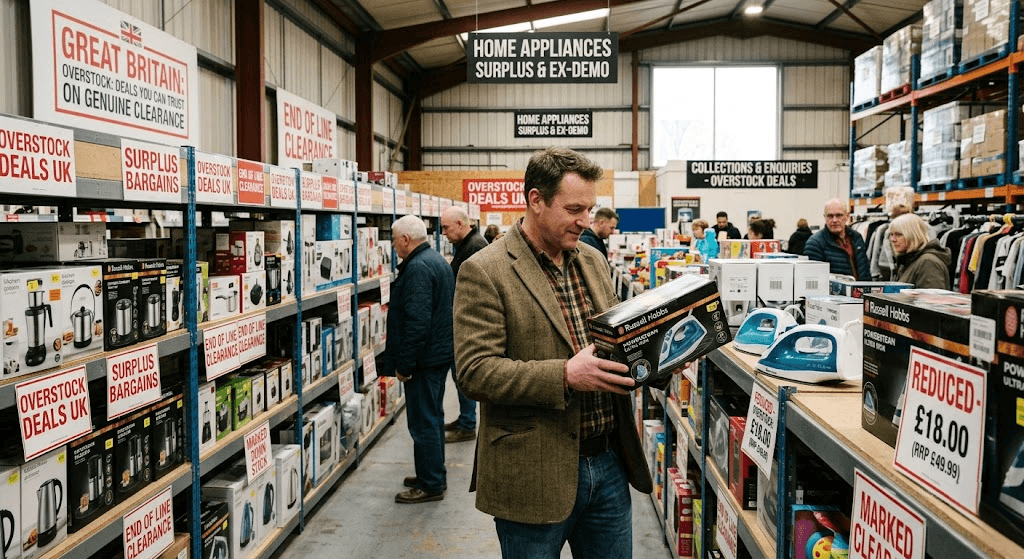
Before handing over your bank card, it is vital to establish what ‘overstock’ actually means. Retailers often lump various types of discounted inventory into the same digital bargain bin, but legally and practically, they represent vastly different propositions:
- True Overstock (Surplus): This is brand-new inventory that has never been purchased, never left the master carton, and never sat in a customer’s home. The retailer simply ordered 10,000 units and only managed to sell 7,000.
- Open-Box Stock: The item inside is pristine, but the outer cardboard packaging was crushed by a warehouse forklift or scored by a Stanley knife during pallet unpacking.
- Customer Returns (Graded Stock): A consumer bought the item, opened it, decided they did not like the colour or fit, and exercised their 14-day distance-selling rights to send it back.
- Refurbished: The item developed a fault, was returned, repaired by a contracted technician, re-tested, and put back onto the market.
When hunting specifically for overstock deals, your target is strictly the first category. You are securing the exact same retail standard as the customer who bought the item at full price six months prior, minus the premium price tag.
Why UK Warehouses are Drowning in Surplus Inventory
To find the best discounts, it helps to follow the logistical panic. Why do major high-street names end up with so much excess stock in the first place? In the United Kingdom, the answer comes down to a volatile mix of supply chain lag and the punishing reality of British commercial real estate.
Warehouse space across the UK—particularly within the vital logistics ‘Golden Triangle’ in the East Midlands—is at an absolute premium. Business rates on massive storage facilities are notoriously high. For a retailer, holding onto a pallet of unsold slow-cookers for an extra twelve months costs them more in cubic storage fees than the profit margin of the appliances themselves. It is cheaper for them to sell the stock at a 60% discount than it is to let it gather dust.
Furthermore, consumer demand forecasting is an inherently inexact science. If a department store chain predicts a freezing British winter and orders 50,000 heavy tog duvets, but the country experiences a mild, damp January, they are instantly landed with thousands of cubic metres of dead weight. Their only viable financial escape hatch is rapid liquidation.
The Secret Ecosystem: Where to Find UK Overstock
You will rarely find genuine, steep overstock discounts promoted on the primary landing page of a major retailer; doing so would instantly cannibalise their full-price sales. Instead, excess inventory is quietly diverted into secondary digital channels. This is where the smart money goes:
1. The ‘Hidden’ Digital Outlets
Several top-tier UK retailers operate quiet digital storefronts alongside their main web addresses. For example, Amazon Outlet (which is entirely separate from Amazon Warehouse) is a dedicated sub-section of the platform reserved exclusively for overstocked, brand-new items that the algorithm has flagged for immediate clearance. Similarly, the digital clearance tabs for high-street stalwarts like Argos and Currys act as holding pens for discontinued product generations.
2. Official Brand Outlets on eBay
If you still view eBay purely as a digital car boot sale for second-hand goods, you are missing out on the UK’s largest formal overstock clearing house. Major brands bypass the immense costs of setting up their own physical clearance infrastructure by operating verified “Direct From Brand” eBay storefronts. You can purchase surplus, sealed stock directly from the official outlets of Dyson, Superdry, Joules, and Office Shoes, complete with full statutory consumer protection and standard manufacturer guarantees.
3. Dedicated Off-Price Digital Retailers
For high-end fashion, beauty, and homeware, platforms such as Secret Sales and BrandAlley operate on an ‘off-price’ model. They purchase the excess seasonal inventory of premium brands in massive bulk, passing the savings onto registered users through time-limited flash sales. Because they act as a release valve for the high street’s excess stock, genuine discounts of 50% to 70% off RRP are standard.
4. The High Street Surplus Kings
It is impossible to analyse UK surplus without looking at TK Maxx. While casual shoppers often assume the store sells made-to-order cheap clothing, its core business model relies on opportunistic overstock acquisition. When a major European department store cancels an order of designer Italian cookware at the eleventh hour, TK Maxx buyers step in, purchase the cancelled inventory with cash at a massive discount, and distribute it across their British retail network.
Sector-by-Sector Bargain Hunting Strategies
The rules of engagement change depending on what type of surplus product you are trying to buy. Mastering these sector-specific rhythms will dramatically improve your strike rate.
Consumer Tech and Electronics
In the technology sector, overstock is governed entirely by the annual product release cycle. When a major brand announces a new smartphone or laptop in September, the retail value of the sealed, previous-generation inventory drops overnight. The optimum window for tech overstock is two to four weeks following a major brand keynote. Look toward specialist tech distributors such as Laptops Direct, who maintain dedicated, year-round surplus clearance directories.
Ambient Groceries and Household Goods
The surplus food market is dictated by the “Best Before” clock. Specialist British online supermarkets like Approved Food and Clearance XL buy up massive quantities of surplus dry groceries, soft drinks, and domestic cleaning products. Stock becomes surplus here for remarkably trivial reasons: a brand updates its logo, a supermarket changes its promotional display, or a factory produces too much of a limited-edition flavour. Provided the items are past their ‘Best Before’ date—which is a measure of peak quality rather than a strict health safety warning like a ‘Use By’ date—they can be legally traded in the UK for pennies on the pound.
Home and Garden Infrastructure
The golden rule for securing homeware surplus is shopping in the ‘anti-season’. Garden centres and home retailers take delivery of outdoor furniture, stone firepits, and solar lighting in February. By mid-August, warehouse directors are under immense pressure to clear those bulky boxes to make room for autumn indoor ranges and Christmas stock. Searching for surplus outdoor living gear during the first week of September yields the steepest genuine discounts of the retail calendar.
Four Rules to Avoid the ‘Phantom Overstock’ Trap
As consumer appetite for discounted goods has surged, some retailers have developed artificial methods to protect their profit margins. To verify that an overstock deal is genuine, subject it to these four tests:
- Spot the ‘Made for Outlet’ Illusion: In the fashion sector, several prominent brands manufacture lower-tier apparel specifically to be sold in outlet tabs and discount villages. These garments never hung in a standard high-street boutique; they were manufactured using cheaper blends and lower stitch densities specifically to be sold at a permanent “simulated discount”. Check the interior garment care tags: authentic overstock will feature the standard, unedited high-street retail codes.
- Interrogate the RRP: Retailers frequently anchor a clearance price against an artificially inflated Recommended Retail Price. A coffee machine reduced from “£150 to £60” looks irresistible, but if that machine was sold at £65 for 95% of its natural market life, your actual saving is five pounds. Always run the product model through independent UK price tracking engines like PriceRunner or CamelCamelCamel to check its true historical value.
- Audit the Warranty Terms: Under the UK Consumer Rights Act 2015, any item you buy must be fit for purpose and of satisfactory quality. However, voluntary manufacturer guarantees can occasionally be invalidated if the item is acquired through an unvetted third-party liquidator. Ensure the listing explicitly states that the standard UK manufacturer warranty remains intact.
- Calculate the ‘Laid-Down’ Cost: A frequent trick deployed by low-grade clearance platforms is pricing an item at an eye-catching £3.50, only to attach an inescapable £9.99 “heavy package dispatch fee” at the final checkout screen. Always evaluate the total cost required to get the item across your threshold before declaring it a triumph.
The Enterprise Level: Buying UK Overstock Pallets
For an enterprising demographic of the British public, overstock is no longer just a method of keeping household costs down; it is an active secondary revenue stream. The rise of digital side-hustle culture has brought the wholesale joblot market into the mainstream.
When a major brand fails to clear its excess inventory through its own secondary channels, it bundles the remaining stock onto raw, shrink-wrapped wooden pallets and sells them to commercial liquidators such as Wholesale Clearance UK, Marthill, or Gem Wholesale. Everyday consumers can register for basic trade accounts on these portals and purchase an unvetted pallet of surplus stock for anywhere between £250 and £2,000.
While the cost-per-unit on these pallets can be astonishingly low—often working out to 10% or 15% of the original retail value—it is an exercise in manual logistics. You must possess the physical space to unpack a pallet, the patience to test and photograph dozens of individual items, and the digital literacy to list them item-by-item across platforms like Vinted, eBay, and Facebook Marketplace. It is a highly viable way to generate an income, but it requires treating the surplus market like a structured logistics business rather than a get-rich-quick scheme.
The Future of Smart British Purchasing
The tradition of paying maximum suggested retail price purely for the convenience of clicking a primary homepage link is fading. Pressed by the UK’s ongoing economic shifts and armed with transparent digital tracking tools, the modern British consumer holds the advantage.
By stepping off the beaten retail track, embracing anti-seasonal buying patterns, exploiting verified brand outlet hubs, and rigorously checking price histories, you can access the exact same premium goods as the high-street shopper at a fraction of the financial outlay. The surplus stock is sitting in a distribution facility right now; all that remains is for you to go out and collect it.