
 savingsspot.co.uk
 Across Great Britain, the accumulation of surplus belongings, obsolete commercial assets, and general waste is an inevitable byproduct of modern life. Whether navigating the emotional complexities of a family bereavement, upgrading a corporate office space, or simply reclaiming a severely overgrown garden, the logistical challenge of disposing of bulky items can quickly become overwhelming. This is where professional clearing services step in. Far beyond the traditional, informal ‘man with a van’ operations of the past, today’s legitimate clearance industry is a highly regulated, environmentally conscious, and systematically efficient sector designed to handle everything from domestic de-cluttering to complex hazardous waste extraction.
For homeowners, landlords, and business operators alike, understanding the mechanics of professional clearing services is essential. Navigating the legalities of waste disposal, evaluating the cost structures, and ensuring your discarded items do not end up illegally fly-tipped down a country lane requires clear insight. This comprehensive overview explores the full spectrum of clearing services across the UK, detailing your legal obligations, the environmental journeys of your waste, and how to successfully manage any clearance project.
1. The Core Spectrum of Clearing Services
Property clearance is not a one-size-fits-all undertaking. Professional firms typically divide their expertise into distinct operational categories, each requiring specific equipment, legal compliance, and handling protocols.
Domestic and Probate House Clearances
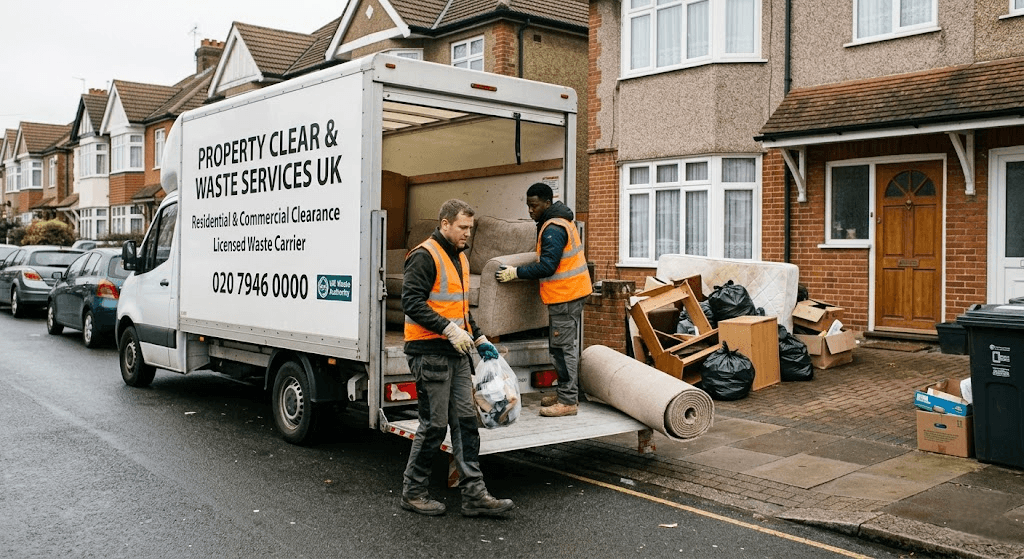
Domestic clearances range from clearing a single cluttered loft or garage to emptying an entire multi-bedroom property. A significant portion of domestic work involves probate or bereavement clearances. In these sensitive scenarios, professional crews are trained to operate with absolute discretion, empathy, and methodical care. They work alongside executors to identify and set aside sentimental items, important financial documents, and valuable chattels that may need to be valued for inheritance tax purposes, before efficiently clearing the remaining furniture, carpets, and household sundries.
Commercial and Office Clearances
Business relocations, liquidations, and technological upgrades require rapid, high-volume clearing to minimise operational downtime. Commercial clearances involve the extraction of heavy modular desks, ergonomic seating, and substantial volumes of Waste Electrical and Electronic Equipment (WEEE), such as servers, monitors, and desktop computers. Furthermore, commercial clearances often mandate certified, secure document shredding and data destruction to ensure absolute compliance with the UK’s General Data Protection Regulation (GDPR).
Void Property and End-of-Tenancy Clearances
Letting agents, local housing associations, and private landlords frequently rely on void property specialists to turn around abandoned or severely neglected homes. These properties may contain biohazardous materials, accumulated food waste, or substantial remnants left by previous occupants. Clearance teams restore the shell of the property to a safe, neutral baseline, allowing independent cleaning and maintenance contractors to step in immediately.
Garden and Outbuilding Clearances
Over time, outdoor spaces can become dumping grounds for dismantled sheds, rotting decking, broken concrete slabs, and dense green waste. Garden clearing services utilise heavy-duty tools to dismantle dilapidated outbuildings, safely extract rusted metalwork, and bag up heavy green waste, soil, and rubble that would otherwise ruin the interior of a domestic vehicle during a trip to the local tip.
2. UK Waste Legislation: Your Duty of Care
Perhaps the most critical, yet frequently overlooked, aspect of hiring a clearing service in the UK is the strict legal framework governing waste disposal. Under Section 34 of the Environmental Protection Act 1990, every citizen and business in the UK has a statutory ‘Duty of Care’ regarding the waste they produce.
This law dictates that you are legally responsible for ensuring your waste is transferred to an authorised person for safe, legal disposal. If you hire an unlicensed operator—often found offering remarkably cheap rates on local social media groups—and your waste is subsequently found illegally fly-tipped in a layby or woodland, you can be traced through identifying items (such as addressed envelopes or delivery receipts) and prosecuted. Local councils routinely issue Fixed Penalty Notices of up to £400 to homeowners who fail to exercise their due diligence, and severe cases can lead to unlimited fines and a criminal record.
Verifying Waste Carrier Licences
To protect yourself, you must ensure any clearing firm you engage holds a valid Upper Tier Waste Carrier Licence issued by the Environment Agency (in England), Natural Resources Wales, or the Scottish Environment Protection Agency (SEPA). Legitimate operators will gladly provide their registration number upon request, allowing you to verify their credentials instantly via the government’s online public register.
The Impact of POPs Regulations
Recent regulatory enforcement changes in the UK have dramatically impacted the clearing industry. The Environment Agency strictly enforces regulations concerning Persistent Organic Pollutants (POPs). These dangerous chemical fire retardants were heavily used in the manufacture of upholstered domestic seating—including sofas, armchairs, futons, and padded dining chairs—until relatively recently. Under current laws, waste containing POPs cannot be sent to conventional landfill sites; it must be completely segregated from general waste during transport and sent for specialized destruction via high-temperature incineration. Professional clearing companies must now factor in the distinct handling and elevated processing fees for any upholstered seating they remove.
3. Skip Hire vs. Professional Clearing Teams: A Logistical Comparison
When faced with a significant volume of waste, many property owners automatically consider hiring a skip. However, deploying a professional clearing crew offers distinct logistical, financial, and physical advantages depending on your specific circumstances.
| Consideration | Skip Hire | Professional Clearing Service |
|---|---|---|
| Physical Labour | Entirely DIY. You must break down, lift, and carry all heavy items out of the property and into the skip. | Fully inclusive. The crew handles all heavy lifting, carrying, dismantling, and loading directly from the rooms. |
| Permits & Access | Requires an expensive local council permit and safety lighting if placed on a public road or parking bay. | No permits required. The clearance vans simply park safely outside, load up, and drive away on the same day. |
| Restricted Items | Strict bans on mattresses, fridges, paint, tyres, TVs, and plasterboard. Heavy surcharges apply if hidden. | Can handle almost all restricted domestic items legally, itemising the exact transparent disposal cost for each. |
| Security & Timelines | Skips sit outside for days or weeks, frequently attracting unauthorised fly-tipping from opportunistic neighbours. | Jobs are completed in a matter of hours. The property is cleared, swept clean, and secured immediately. |
| Pricing Efficiency | Fixed cost regardless of whether you fill the skip to 50% capacity or find yourself running out of room. | Pro-rata pricing. You pay strictly for the exact volume (in cubic yards) and weight of the waste loaded. |
4. The Ethical Disposal Journey: Beyond the Landfill
A common misconception regarding professional clearance firms is that their vehicles drive straight from your property to the nearest landfill site. In reality, modern waste management operates strictly under the principles of the Waste Hierarchy: Prevention, Preparing for Re-use, Recycling, Other Recovery, and finally, Disposal.
Asset Realisation and Charitable Diversion
High-end clearing services often operate with a robust network of local auction houses, second-hand furniture dealers, and charitable organisations (such as the British Heart Foundation, Shelter, or local community hospices). If a property contains items of distinct re-sale value—such as mid-century modern teak sideboards, quality white goods, or collectable ceramics—reputable firms will often offset the estimated value of these chattels against the final cost of the clearance invoice. Usable, everyday furniture and textiles that lack auction value but retain structural integrity are systematically donated, ensuring they benefit local low-income households rather than contributing to environmental degradation.
Material Recovery Facilities (MRFs)
Once re-usable items are salvaged, the remaining unsorted material is transported to a commercial Material Recovery Facility. Here, massive industrial trommels, powerful overband magnets, optical sorters, and manual picking lines separate the waste into distinct commodities. Clean timber is chipped for use in biomass power generation or manufacturing particleboard; metals are smelted down for infinite re-use; inert rubble is crushed into aggregate for UK construction projects; and rigid plastics are granulated for remanufacturing. Top-tier clearing providers frequently achieve zero-to-landfill diversion rates exceeding 90%.
5. Navigating Difficult, Bulky, and Hazardous Waste
Certain items commonly found during property clearances require highly specialised treatment due to environmental hazards or structural density. Knowing how these are processed underscores the value of expert intervention.
- Refrigeration Equipment: Fridges, freezers, and air conditioning units contain ozone-depleting substances, specifically Chlorofluorocarbons (CFCs) or Hydrofluorocarbons (HFCs), within their insulation foam and cooling circuits. They must be safely transported to a dedicated degassing plant where these dangerous gases are captured under vacuum before the metals and plastics are shredded.
- Mattresses: Owing to their complex mix of steel springs, dense foam, synthetic fibres, and organic flock, mattresses are notoriously difficult to process. Specialized shredding facilities must be used to mechanically strip the outer layers and separate the metal springs for recycling, avoiding the massive landfill space these bulky items otherwise consume.
- Waste Electrical and Electronic Equipment (WEEE): Cathode-ray tube (CRT) televisions and older monitors contain significant quantities of lead, while fluorescent lighting tubes contain toxic mercury vapour. Professional clearers ensure these items are sent to Approved Authorized Treatment Facilities (AATFs) to prevent heavy metal leaching into the water table.
- Paint, Solvents, and Household Chemicals: Liquid wastes are strictly banned from standard landfill. Clearance crews isolate half-empty paint tins, garden pesticides, and cleaning chemicals, taking them to hazardous waste transfer stations where they are chemically neutralized or used for secondary liquid fuel blends.
6. Understanding Clearance Quotes: How Pricing is Structured
To budget effectively for a clearance project, it is helpful to understand how operators calculate their estimates. Legitimate pricing is transparent and typically built around four fundamental variables:
First, the Volume of Waste is measured in cubic yards. One cubic yard is roughly the size of two standard domestic washing machines sitting side-by-side. Most commercial clearance vehicles are 3.5-tonne Luton vans with box bodies capable of carrying between 12 and 14 cubic yards of volume. Second, the Aggregate Weight is considered. While a van may hold 14 cubic yards of bulky, lightweight cardboard or bedding, filling the same space with dense garden soil, wet timber, or concrete rubble would massively overload the vehicle’s legal weight limit. Heavy materials are therefore quoted by weight rather than sheer volume.
Third, operators must factor in Location and Parking Constraints. If your property is situated in central London or a congested city centre, the quote must account for Congestion Charges, Ultra Low Emission Zone (ULEZ) compliance fees, parking meter suspensions, or the extended time required if crews must carry items long distances due to double yellow lines outside the building. Finally, Supplementary Item Charges are added transparently to cover the mandatory third-party recycling tariffs for hazardous items like POPs-contaminated sofas, mattresses, fridges, and car tyres.
7. Essential Checklist for Procuring a Clearance Partner
When selecting a company to handle your property clearance, applying a rigorous vetting process will ensure a stress-free experience and full legal compliance. Keep the following checklist in mind during your procurement process:
- Demand Licence Proof: Explicitly ask for their Environment Agency waste carrier registration number and verify it online before allowing them onto the premises.
- Request a Written, Itemised Quote: Avoid operators who offer vague estimates over the phone. Ensure you receive a formal quotation detailing volume tiers, labour, and specific surcharges for hazardous items.
- Verify Insurance Cover: Ensure the contractor possesses adequate Public Liability Insurance (typically a minimum of £2 million to £5 million). This protects your property against accidental structural damage during the extraction of heavy goods.
- Enquire About Triage and Recycling: Ask the company to explain their disposal route. A reputable firm will speak proudly of their charitable partnerships and their commercial transfer station diversion rates.
- Check Independent Reviews: Scrutinise third-party review platforms such as Trustpilot or Checkatrade. Look specifically for comments regarding punctuality, transparency of billing upon completion, and the respectful demeanour of the staff.
Ultimately, engaging a professional clearing service transforms an exhausting, legally precarious, and emotionally taxing chore into a streamlined, ethical, and manageable operation. By partnering with a licensed, transparent, and eco-conscious clearance firm, property owners across Great Britain can seamlessly reclaim their living and working spaces while actively supporting the nation’s vital transition toward a circular, sustainable economy.