 savingsspot.co.uk
 Standing at the supermarket till watching the customer in front of you tap their smartphone and instantly shave fifteen quid off their weekly shop is a peculiarly modern form of British envy. In the UK today, carrying the right digital plastic is no longer an optional hobby for extreme couponers; it is an economic necessity.
We have officially entered the era of the two-tier high street. From the grocery aisles of Tesco to the pharmacy counters of Boots, standard retail prices have essentially become “opt-out fines” paid only by those who refuse to hand over their data. Yet, despite almost every adult in the country holding at least three loyalty accounts, the vast majority of us are using them wrong. We treat them as digital piggy banks to be smashed once a year for a free tub of Christmas chocolates, entirely missing the compounding mechanics that can save a household upwards of £500 annually.
This guide bypasses the generic “remember to scan your card” advice to unpack the algorithmic realities, the hidden conversion loops, and the extreme stacking strategies of the UK’s major loyalty schemes.
The Great Gatekeep: Understanding Two-Tier Pricing
To master the modern loyalty landscape, you must first understand the fundamental psychological pivot UK retailers made at the turn of the decade. Historically, schemes like the Sainsbury’s Nectar card or the early Tesco Clubcard operated on a *deferred gratification* model: you spent £100, you earned 100 points, and three months later you got a paper voucher worth £1 in the post.
Today, the model is *instant gatekeeping*.
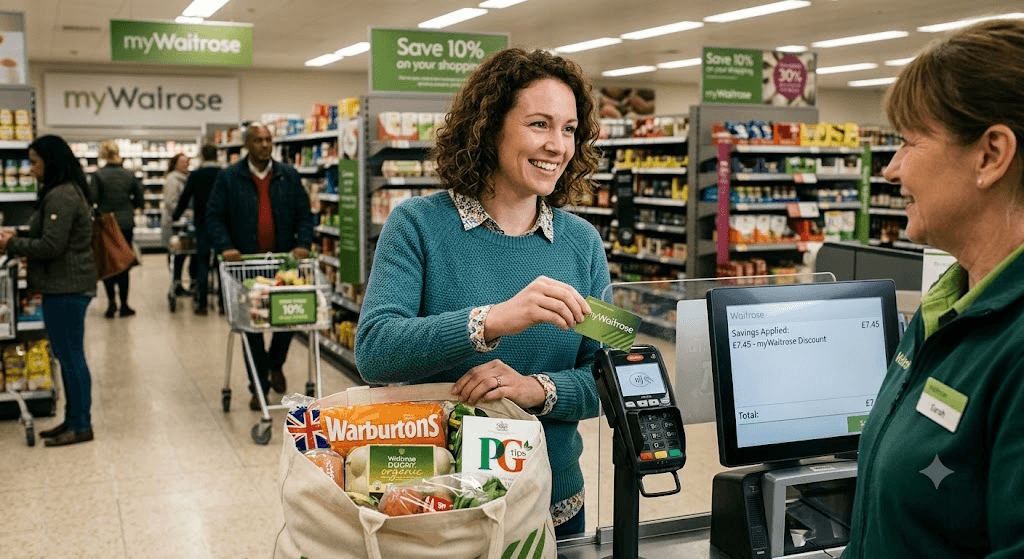
When you see a jar of branded instant coffee priced at £6.50 for standard shoppers and £4.50 for Clubcard members, the supermarket hasn’t generously discounted the coffee by two pounds. They have raised the baseline price to an artificial ceiling, reserving the “true” market price exclusively for loyalty members.
Why? Because a customer’s real-time basket data is worth infinitely more to a supermarket’s Retail Media Network (RMN) than the margin on a jar of Kenco. Supermarkets anonymise, package, and sell your purchasing habits to global consumer brands. Heinz, Unilever, and Cadbury pay millions to know that a 34-year-old in Leeds who buys oat milk on a Tuesday also consistently buys non-bio laundry detergent. Your discount is simply your cut of that data brokerage fee.
The Big Five: Deconstructing the UK Ecosystem
1. Tesco Clubcard: The Multiplier Arbiter
The grandfather of British loyalty remains the most mathematically powerful scheme in the country, provided you obey its golden rule: **never spend Clubcard vouchers in Tesco.**
While a £5 Clubcard voucher takes £5 off your grocery total at the till, Tesco’s “Reward Partners” scheme offers a 2x multiplier when traded for experiences, dining, or travel. That same £5 voucher instantly becomes £10 to spend at Pizza Express, English Heritage sites, or towards a Railcard.
The Insider Hack: Keep an eye on your “Voucher Expiry” dates inside the app. If you have £20 of vouchers expiring at the end of the month that you aren’t ready to use, go onto the Clubcard portal and buy a 50p restaurant voucher. The system will deduct the 50p, cancel the old voucher, and reissue the remaining £19.50 as a brand-new digital voucher with a fresh 24-month lifespan.
2. Sainsbury’s Nectar: The Avios Pipeline
On the surface, Nectar’s basic return rate is a miserable 0.5% (one point per £1 spent, with each point worth 0.5p). If you simply collect points on normal groceries and spend them at the till, it is the weakest major card on the market.
Its hidden superpower, however, lies in its two-way partnership with British Airways Executive Club. Nectar points can be converted into Avios (and vice versa) at a standard rate of 400 Nectar points to 250 Avios.
The Insider Hack: Do not rely on standard aisle shopping to collect Nectar points; rely on the **SmartShop app’s Friday refresh**. Every week, Sainsbury’s algorithm scans your historical purchases and generates bespoke “Your Nectar Prices” on 10 to 12 items you actually buy, frequently undercutting both Aldi and Lidl on those specific goods. Combine this with the “Nectar Connect” feature inside the app—which gives you points for shopping at third-party retailers like Costa or Just Eat simply by linking your normal Visa/Mastercard via Open Banking.
3. Asda Rewards: The Psychology of the “Cashpot”
Launched much later than its rivals, Asda bypassed the concept of “points” entirely, opting for a system that deposits real cash values into a digital “Cashpot”.
Because humans struggle to convert abstract metrics (e.g., “What is 450 points actually worth?”), Asda’s explicit “Earn £1.50 back on this £6 pack of chicken” drives far higher conversion. The scheme relies heavily on “Missions”—step-based gamification that rewards you for hitting spending thresholds across a calendar month.
The Insider Hack: The **Christmas Saver Cashpot**. Between August and November, Asda allows you to transfer your standard cashpot balance into a locked Christmas fund. Crucially, Asda pays a cash bonus on top of your savings depending on your tier (e.g., locking away £40 nets you a free £5 cash top-up). If you do your weekly shop there anyway, it is a risk-free guaranteed return of over 12% on your stored digital change.
4. Boots Advantage Card: The High-Margin Pivot
For two decades, Boots offered the undisputed king of high-street returns: 4p back for every £1 spent. In 2023, they quietly downgraded this to 3p per £1.
To soften the blow, they introduced “Price Advantage”—mimicking Tesco’s two-tier pricing on roughly 2,000 health and beauty products. Because cosmetics and skincare carry massive retail markups, the instant discounts on Boots’ digital shelf labels are routinely the steepest on the high street, sometimes slashing £15 off a £35 high-end face cream.
The Insider Hack: Always check if you qualify for a “Parenting Club” or “Student” status tag on your card. Boots Parenting Club members receive a staggering **8 points per £1 spent** on baby products until the child turns three. Even if you only buy nappies and wipes, that equals an 8% cashback return to spend on yourself.
5. Lidl Plus & Co-op: Gamification vs. Community
Lidl Plus offers zero baseline points, operating almost entirely on a digital “scratchcard” and monthly milestone model. Spend £250 in a month, get a 10% off voucher. It is an all-or-nothing scheme designed to force you into doing your *entire* monthly shop under one roof rather than splitting it with the Tesco down the road.
The Co-op, conversely, runs on a hyper-localised member pricing system. While their standard convenience store prices are famously high, scanning a Co-op Member card drops the price of a standard meal deal to match the big out-of-town supermarkets, while simultaneously funneling a micro-percentage of your spend directly into a local community charity of your choice inside the app.
Next-Level Stacking: The “Double-Dip” Protocols
The true art of UK consumerism is “stacking”—the practice of triggering two, three, or four separate financial incentives on a single trip to the checkout. If you are paying for your discounted loyalty goods using a standard high-street debit card, you are leaving money on the counter.
Protocol A: The Gift Card Sandwich
Instead of tapping your bank card at the Sainsbury’s or Asda till, use an instant cashback app like **JamDoughnut** or **Cheddar**.
- While standing in the checkout queue, open JamDoughnut and check the current supermarket rate (usually between 2.5% and 3.5%).
- Type in the exact estimated cost of your trolley (e.g., £84.50) and buy a digital gift card instantly via Apple Pay.
- You instantly receive roughly £2.70 into your JamDoughnut wallet.
- Scan your Nectar/Asda card at the till to get your member discounts, then scan the barcode of the gift card you bought ten seconds ago to pay. You have just double-dipped the retailer.
Protocol B: The Airtime/Card Link Network
Download **Airtime Rewards**, an app backed by the major UK mobile networks (O2, EE, Vodafone, Three). You type in the long 16-digit numbers of your normal Visa and Mastercards.
When you spend at partner retailers (which frequently includes Boots, Argos, and Greggs), the system tracks the transaction via the card network and automatically knocks 3% to 5% off your next monthly mobile phone direct debit. This happens entirely in the background; you still scan your Boots Advantage card at the till as normal.
The Data Audit: Protecting Your Digital Footprint
With great discounts comes immense digital surveillance. Because these apps require permanent background location access to trigger “in-store mode,” and map your digital receipts to your home address, your consumer profile is razor-sharp.
If you wish to practice “data hygiene” without forfeiting £20 a week at the checkout, adopt the **Household Pod System**:
Create a single, dedicated “Family & Friends” email address specifically for shopping apps. Register one Tesco account, one Nectar account, and one Asda account under this alias. Have every member of your household log into the exact same app account on their respective phones.
Not only does this confuse the predictive profiling algorithms—because the system sees a single user buying size 10 men’s boots, vegan dog food, baby formula, and 60-denier tights in three different postcodes simultaneously—but it pools the family’s fractional point gatherers into one account, hitting the high-value reward thresholds three times faster.
The 2026 Golden Rules of UK Loyalty
- Never buy physical gift cards at the supermarket till: If you buy a £50 PlayStation store card off the rack at Tesco, you get zero Clubcard points for it. If you buy it via an app like JamDoughnut, you get £1.50 cash back.
- Treat “Auto-Convert” with suspicion: Apps will constantly prompt you to turn on “Auto-convert to vouchers”. Leave it off. Keeping your balance as raw points gives you the liquidity to wait for a 2x boost promotion or transfer them to a travel partner when an offer drops.
- Audit your phone screen monthly: If you haven’t opened a retailer’s app in 45 days, delete it. The 40p you saved on a pastry at a regional bakery once a year is not worth the constant background API pings draining your smartphone’s battery and selling your device ID to third-party ad trackers.
- Ignore the “Point Balance”, check the “Unit Price”: Do not let the promise of 50 bonus points trick you into buying a £4 branded item when the un-promoted supermarket own-brand equivalent sits on the shelf below for £1.10. A point is worth roughly half a penny; never spend a real pound to chase two pence.