 savingsspot.co.uk
 There is a universal law of British domestic life: a washing machine will only ever break down on a wet Tuesday in November, with the laundry basket overflowing and a clean school uniform required for the following morning. When this panic strikes, the immediate impulse is to jump online, find the first big yellow “SALE” banner, and type in your card details. This is precisely how the white goods industry makes its highest margins.
Finding a genuine washing machine deal in the UK requires stepping back from the flashing red discount tags and understanding the subterranean mechanics of appliance retail. Whether you are replacing a dead machine, upgrading to an energy-saving model to fight rising bills, or fitting out a brand new kitchen, this guide will show you how to strip away the marketing fluff, decode the price anchors, and secure an appliance that genuinely leaves change in your pocket.
1. The “Price Anchor” Illusion: Don’t Believe the RRP
If you see a washing machine listed at “£399, Was £599,” your brain instantly registers a £200 saving. Retailers rely heavily on this cognitive bias, known as price anchoring. Under UK consumer protection regulations, a retailer can legally claim a product “was” a higher price as long as it was offered at that higher price for 28 consecutive days in the previous six months.
What this creates in practice is the classic “yo-yo” pricing strategy. A manufacturer releases a machine with an artificially inflated Recommended Retail Price (RRP) of £649. It sits at that price for a quiet, low-volume month in February where almost nobody buys it. Come the Easter Bank Holiday, it drops to £449 with a massive “SAVE £200” graphic slapped across the digital listing. In reality, £449 was its true, intended market value all along.
To defeat this, you must look at historical price graphs rather than the current promotional tag. Before putting any washing machine in your digital basket, paste its exact model number into an independent price tracker like PriceRunner or use the Google Shopping ‘Price Insights’ feature. If the graph looks like a heartbeat monitor—oscillating between £400 and £600 every few weeks—you are not getting a special deal; you are simply buying it on its normal down-swing.
2. The Secret Retail Calendar: When Do Prices Actually Drop?
While Black Friday dominates the retail headlines, white goods operate on a slightly different seasonal rhythm to televisions and smartphones. If you have the luxury of timing your purchase, targeting specific windows will yield far superior discounts.
The March/April Model Rollout
Major appliance manufacturers like Bosch, Samsung, LG, and Hotpoint operate on strict product cycles. New ranges typically land in UK distribution centres in late spring. To physically make room in the racking for these incoming models, retailers are forced to clear out the previous year’s stock. During March and April, you will routinely find last year’s flagship models discounted to entry-level prices. Because washing machine technology advances at a glacial pace—a 2024 drum spins a cotton shirt just as well as a 2026 drum—buying the “outgoing” model is the single sharpest value play in the market.
The Bank Holiday Scramble
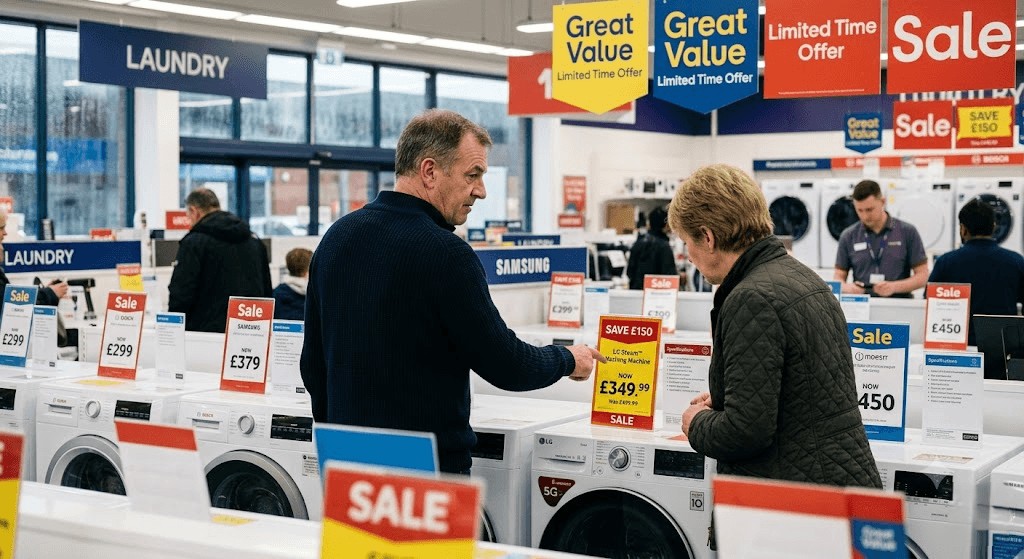
The UK’s three major Bank Holiday weekends (Easter, late May, and late August) trigger aggressive price wars between Currys, AO.com, Argos, and John Lewis. Because these long weekends correlate heavily with consumers undertaking home DIY and kitchen renovations, retailers deploy high-value, site-wide promo codes (for example, “Enter WASH50 at checkout for £50 off any machine over £400”). Crucially, these general codes almost always stack on top of individual product discounts.
3. Buying for Utility: Stop Paying for “Gimmick” Specs
When browsing deals, it is dangerously easy to get seduced by a machine that features a full-colour touch screen, plays a customized melody when the cycle finishes, or connects to your home Wi-Fi. Every extra microprocessor adds roughly £40 to £60 to the manufacturing cost—a cost passed straight to the consumer.
The Drum Size Sweet Spot
Salespeople and algorithms will push 10kg, 11kg, and 12kg drums because they carry higher profit margins. However, a standard UK domestic laundry load is surprisingly light. A single person or a couple rarely generates more than 5kg of laundry in a single go; a typical family of four sits comfortably in the 8kg to 9kg bracket.
Unless you run a boutique bed and breakfast or have an absolute fixation on washing super-king, heavy-tog winter duvets at home every month, paying an extra £120 for an 11kg drum is a poor allocation of funds. Furthermore, while modern machines feature “load sensing” technology to scale down water intake for half-empty drums, they are mechanically never as efficient as a correctly sized drum operating at 80% capacity.
The 1400 RPM Rule
You will regularly see machines boasting 1600 RPM (Revolutions Per Minute) spin speeds priced at a £50 to £80 premium over their 1400 RPM counterparts. Keep your cash. The difference in residual moisture between a 1400 and 1600 spin is negligible—usually less than 4%—yet the kinetic stress placed on the machine’s drum bearings at 1600 RPM is vastly higher. A 1400 RPM machine gets your clothes more than dry enough for the clothesline or the airer, while preserving the mechanical integrity of the appliance for years longer.
4. Deciphering the Energy Label: The “Hidden” Discount
In March 2021, the UK overhauled its appliance energy rating system, retiring the confusing ‘A+++’ tiers and resetting the scale strictly from A to G. Consequently, a machine that looked exceptionally eco-friendly five years ago might now sit at a seemingly mediocre ‘D’ rating.
When evaluating a washing machine deal, you have to calculate the Total Cost of Ownership (TCO) over a five-year horizon, rather than looking purely at the checkout sticker. Consider the following comparison:
- Machine A (Rated D): On sale for £320. Electricity consumption: 75kWh per 100 cycles.
- Machine B (Rated A): On sale for £410. Electricity consumption: 45kWh per 100 cycles.
At standard UK energy price caps, that 30kWh difference per 100 washes looks relatively modest on day one. But when you factor in the corresponding drop in water consumption—A-rated machines utilize highly engineered spray jets that consume up to 12 litres less water per cycle—an active household running five washes a week will save roughly £40 a year in combined electric and metered water bills with Machine B. Over a standard seven-year lifecycle, the “more expensive” £410 machine actually costs the household £190 less than the cheap bargain.
5. Where to Hunt: Analysing the Big UK Retailers
Not all appliance retailers construct their deals in the same way. Depending on whether you prioritise raw upfront cost, long-term warranty, or painless logistics, you should point your browser toward different storefronts.
John Lewis & Partners: The Warranty Play
John Lewis rarely offers the rock-bottom cheapest ticket price on the web on any given morning. However, their hidden weapon is their standard included 2-year guarantee (which is frequently bumped to 3 or 5 years during seasonal home promotions). If you purchase a machine from a discount warehouse for £380 and have to buy a 3-year extended warranty for £65 to sleep soundly, your total outlay is £445. If John Lewis lists that exact model at £415 with a 3-year guarantee baked into the price, they are offering the mathematically superior deal.
AO.com: The Infrastructure Advantage
AO’s frontend pricing uses automated web-scrapers to match the lowest market prices daily, but their real value lives in the checkout options. If you sign up for their ‘AO Five Star’ membership (roughly £39 per annum), you unlock unlimited free delivery, free unboxing, and—most importantly—free disconnection and recycling of your old unit. Given that standard retail takeaway and recycling fees now average £25 to £35 per appliance, buying a washing machine and a tumble dryer together under this scheme results in an immediate, compounding discount.
Currys: The Graded Clearance Secret
Currys operates the largest centralized returns and clearance network in the country. If you bypass their shiny homepage banners, navigate to the footer, and click into the “Clearance” or “Refurbished” portal, you will find a treasure trove of “Box Damaged” stock. In the vast majority of cases, a warehouse worker has simply scuffed or punctured the outer cardboard during transit, leaving the internal polystyrene and the machine itself pristine. Because UK retail law forbids them from selling these as “Brand New Boxed,” they will shave £70 to £120 off the RRP. You receive the identical manufacturer warranty on a structurally flawless machine.
6. Pro-Level Deal Stacking Techniques
The ultimate secret to unlocking the lowest possible price on British white goods is “stacking”—the practice of layering multiple, non-mutually exclusive promotional mechanisms onto a single transaction.
Step 1: Check Manufacturer Claim Portals
Brands like Bosch, Siemens, Hotpoint, and Samsung run independent consumer cashback campaigns that retailers rarely advertise prominently at the point of sale. For example, you might buy a Bosch machine on sale at Marks Electrical for £479. Once the machine arrives, you navigate to Bosch’s official UK promotional portal, upload a photo of your invoice and the machine’s internal serial number, and the manufacturer wires £50 directly to your bank account a month later, dragging your net spend down to £429.
Step 2: Never Shop Un-Tracked
Never type a retailer’s URL directly into your address bar. Always open a reputable cashback portal like TopCashback or Quidco first, search for the merchant, and click through their specific tracking link. Major white goods vendors consistently offer between 2.5% and 6% cashback for tracked sales. On a £450 purchase, that is an entirely passive £11 to £27 returned to your balance.
Step 3: Exploit the “Scrap” Value
Do not pay the local council £35 to collect your dead machine. Look specifically for retailers offering an upfront “Trade-In” allowance. Samsung’s official UK web store is the undisputed industry leader at this; they routinely offer an instant £30 to £50 checkout discount simply for ticking a box that states: “Yes, I have an old appliance to be recycled.” They haul the broken unit away at the exact moment they plumb the new one in.
7. Five UK Workhorse Models That Always Offer Value
While prices shift by the hour, historical performance data shows that certain specific model families offer vastly more reliable pound-for-pound utility than the rest of the market:
- Bosch Serie 4 (WAN Series): The undisputed standard of the British utility room. Extremely quiet, structurally rigid, and fitted with an EcoSilence drive that frequently lasts 12 to 15 years. When retail sales push these below the £400 threshold, it is an automatic purchase.
- Samsung Series 5 (EcoBubble): The strongest contender in the £350 to £420 arena. Their proprietary technology froths detergent with air and water before it enters the drum, allowing for high-performance cleaning at a cold 15°C—slashing your hot water heating costs.
- Beko Aquatech: For households operating on a strict sub-£300 budget, ignore the flimsy white-label supermarket brands and look at Beko’s upper-tier offerings. They supply brushless ProSmart inverter motors at price points where rivals are still using loud, fast-wearing carbon brush motors.
- Hisense Series 3: The fast-moving disruptor of the UK market. Hisense routinely bundles comprehensive 2-year or 3-year manufacturer guarantees into units priced under £270, offering unmatched budget-tier peace of mind.
- LG Turbowash (Direct Drive): Rather than connecting the motor to the drum via a rubber drive belt, LG attaches the motor directly to the center of the drum. This removes the single most common point of mechanical failure in washing machines (snapped or slipped belts). Keep an eye out for these during Bank Holiday promotions.
Summary: Your 60-Second Deal Validation Checklist
Before you authorize payment on your next washing machine, run the prospective purchase through this rapid four-part sanity check:
- Did I check the price timeline? (Ran the model through PriceRunner to ensure the “Was £600” claim wasn’t artificially generated four weeks ago).
- Am I buying real capacity? (Selected an 8kg or 9kg unit suited to my actual household size, rather than overpaying for a 11kg cavern).
- Did I price in the peace of mind? (Checked whether a slightly more expensive listing includes a free 3-year or 5-year guarantee).
- Is my stack assembled? (Clicked through TopCashback, checked the manufacturer’s website for standalone claims, and applied an active promo code).
By applying these analytical filters, you transform a stressful household emergency into an exercise in calculated consumer savvy. Your machine will still inevitably give up the ghost on a cold autumn evening, but you will possess the precise playbook required to replace it without being taken for a ride.