 savingsspot.co.uk
 The modern British weekly shop is a delicate balancing act. You can spend forty-five minutes carefully curating a digital basket full of frozen leafy greens, bulk-buy chicken breasts, and those highly specific Greggs steak bakes, feeling immensely proud of your financial prudence. Then you click through to the virtual checkout, only to be slapped with a £3.50 or £4.50 delivery fee.
Instantly, the psychological victory of a thrifty shop evaporates. Paying a supermarket a fiver just to drive a van of frozen potato waffles three miles down the road feels fundamentally counter-intuitive, especially when the entire ethos of shopping at Iceland is anchored in stretching your household income to its absolute limit.
The good news? You should realistically never pay for home delivery at Iceland. Unlike the ‘Big Four’ UK supermarkets—Tesco, Sainsbury’s, Asda, and Morrisons—which increasingly try to funnel customers into paid monthly “Delivery Passes”, Iceland’s logistics model is remarkably generous. Between automated spend thresholds, first-time customer vouchers, store-to-door loopholes, and third-party app workarounds, there is almost always a route to a zero-pence delivery fee. Here is the complete insider’s guide to locking down free delivery on every single Iceland order.
1. The Fundamental Rule: The £40 Minimum Spend Threshold
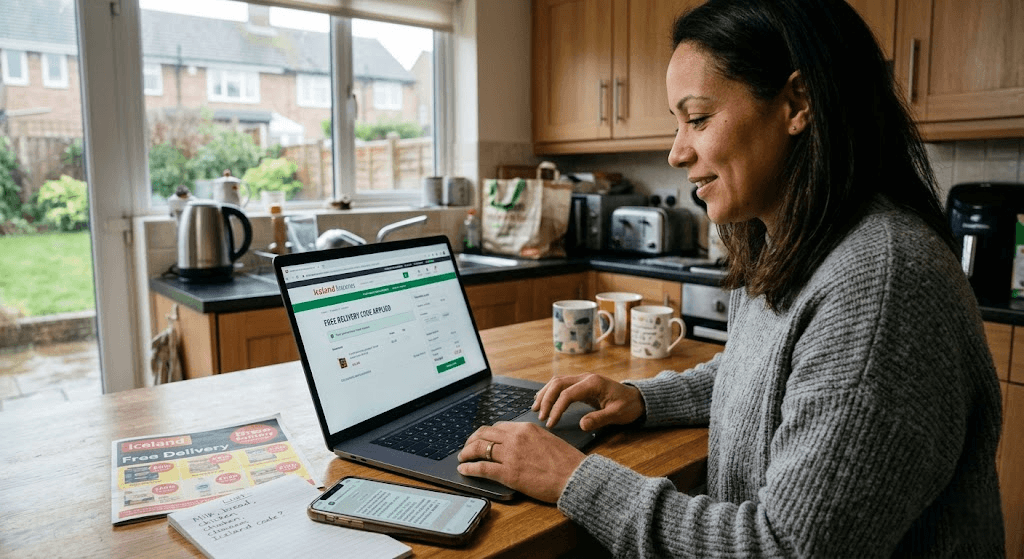
The most reliable way to secure free delivery at Iceland requires zero promotional codes, zero voucher hunting, and zero newsletter sign-ups. It is hardcoded into their standard digital checkout: spend £40 or more, and your next-day delivery slot is completely free.
To understand why this is such a strong proposition for the consumer, you have to look at the mechanics of the lower spending tiers:
- Under £25: You cannot check out. Iceland enforces a strict £25 minimum order value for online home delivery.
- Between £25.00 and £39.99: You will be charged a standard delivery fee, usually priced at £3.00 (though some peak two-hour weekend windows can nudge up to £4.00).
- £40.00 and above: The delivery fee automatically ticks down to £0.00 at the final billing screen.
Because frozen food has an effectively infinite shelf life compared to fresh dairy or meat, treating the £40 mark as a hard barrier is the easiest mental adjustment an Iceland shopper can make. If your basket is sitting at £36.50, paying a £3.50 delivery fee means you have handed over £40.00 for £36.50 worth of sustenance. By adding a £3.50 bag of frozen raw king prawns or a few boxes of long-life oat milk, you spend the exact same amount of cash, but you get to keep the food.
2. The “Tactical Top-Up” Strategy: Best Items to Cross the £40 Line
When you are hovering at the £37 or £38 mark, the worst thing you can do is throw a highly perishable item into your virtual trolley just to tip the scales. If you buy a bag of fresh spinach you didn’t actually plan a meal for, it will turn into brown liquid in the back of your fridge within four days, meaning you effectively paid the delivery fee anyway.
Keep a mental list of “Tactical Top-Ups”—high-value, non-perishable, or deeply frozen staples that take up very little physical freezer space but hold their quality for months:
- Frozen Chopped Garlic or Ginger (£1.50 – £2.00): These tiny bags sit in the door of your freezer. You snap off a frozen cube straight into the frying pan; they never spoil and eliminate prep time.
- The 10-for-£10 Multi-buy selection: Iceland almost permanently runs a mix-and-match offer on frozen ready meals, pizzas, and sides. Adding two or three items from this section to round off a basket is economically airtight.
- Toilet Roll and Household Foil: Non-food items count towards your £40 delivery threshold. Bulk-buying your kitchen roll or bleach through Iceland to tip your total over the magic line keeps your dry storage stocked at zero loss.
3. First-Time Shopper Codes (The £5 off £45 Loophole)
If you have never ordered from Iceland online before, you are in the strongest possible bargaining position. Iceland runs a perpetual, rolling series of introductory voucher codes designed to poach digital customers from Asda and Tesco.
While the exact sequence of letters changes every few months (historically featuring variations like ICEFIVE, ICELAND5, HIGHFIVE, or NEWJOINER), the mathematical offer remains stubbornly consistent: £5 off your first shop when you spend £45 or more.
Because £45 sits comfortably above the £40 free delivery threshold, using this code triggers a double financial win:
You put £45 worth of groceries in your trolley. The standard automated system waives the £3.00 delivery fee because you passed £40. You then apply the promo code, dropping the cost of the food itself down to £40. You have effectively bought £45 worth of food, had it brought to your kitchen, and paid a grand total of £40.00.
Pro-Tip for multi-person households: Supermarkets track “First Time Shoppers” via a combination of the registered email address, the payment card number, and the physical delivery postcode. If one partner has exhausted their first-time discount, setting up an account in the other partner’s name with a different debit card is a legally sound, widely practiced method of resetting the introductory clock.
4. The “Trolley Drop” Trick: Free Home Delivery from £25
This is arguably the most under-utilised supermarket service in the United Kingdom. It is officially called “Shop in Store, We Deliver”, but high street veterans call it the Trolley Drop.
For shoppers who despise the digital interface—or those who insist on visually inspecting their fresh produce and checking the expiration dates on their chicken blocks personally—Iceland offers a hybrid solution:
- You walk into a physical Iceland or The Food Warehouse store.
- You do your shopping with a standard physical trolley.
- You take your goods to the standard checkout and tell the cashier: “I would like this delivered home, please.”
- You pay for your goods. The minimum spend required to trigger this service is just £25.00 (a whole £15 lower than the online threshold).
- The cashier packs your shopping into designated transport crates, rolls them into the back-room walk-in freezer, and books you into the next available neighborhood delivery van. You walk home empty-handed; your frozen food arrives at your door a few hours later.
This is an astonishingly useful loophole for the elderly, people without access to a car, or parents wrestling with two toddlers on a Saturday morning who cannot physically carry four heavy carrier bags onto a local bus.
5. The Bonus Card App: The Secret Garden of Flash Codes
Historically, the “Iceland Bonus Card” was a flimsy piece of red plastic you showed to a cashier to save 50p on a tub of Ben & Jerry’s. Today, the digital iOS and Android version of the Bonus Card app is the main distribution hub for Iceland’s secret, targeted free delivery codes.
Once you download the app and link it to your online shopping profile, two distinct free-delivery pathways open up:
The “Check Your Wallet” Drops
Iceland’s marketing algorithm hates dormant accounts. If you open an account, do one shop, and then don’t log in for five or six weeks, the app will frequently push a silent digital voucher directly into the “My Bonuses” tab of your application. These are usually phrased as: “We miss you! Here is Free Next Day Delivery on any spend over £25.” Unlike public codes found on voucher scraping websites, these are tied to your unique customer ID and work 100% of the time.
The £20 Saving Top-Up Bonus
The Bonus Card doubles as a pre-pay digital piggy bank. For every £20 you load onto the card in advance, Iceland hands you £1.00 of free cash. If you know you are going to spend £80 at Iceland over the course of a month, pre-loading that £80 gives you £4.00 of store credit for free. When you combine that £4.00 injection with a £40 free-delivery shop, you are actively draining the supermarket’s profit margins.
6. Bypassing the Main Site via Delivery Aggregators
What happens if it is 5:30 PM on a rainy Tuesday, you need four specific items to make dinner, your basket total is £14.00, and you refuse to pay Iceland’s sub-£25 rejection fee? You bypass Iceland.co.uk entirely and open Uber Eats, Deliveroo, or Just Eat.
All three major UK delivery aggregators have integrated local Iceland stores into their “Grocery” tabs. While the base prices of individual items on these apps are sometimes marked up by 5% to 10% to cover the platform’s commission, the platform’s *own* promotional codes frequently negate this entirely:
- Uber Eats Grocery Vouchers: Uber Eats issues aggressive, high-frequency push notifications offering “40% off your next grocery order (up to £15 off)”. Applying this to an Iceland storefront allows you to get a £20 basket of frozen food delivered to your door in twenty minutes for roughly £13, including the driver’s tip.
- Deliveroo Plus: If you have an Amazon Prime account, you are entitled to a free Deliveroo Plus Silver membership. This grants you automatically free delivery on any grocery order over £25.
- Just Eat “Free Delivery” Days: Just Eat regularly runs localized promotions where specific postcodes enjoy zero-fee grocery runs from local partner stores to drive afternoon traffic.
7. Niche Demographics: The Student and Over-60s Advantages
Supermarkets operate on razor-thin margins, meaning they rarely offer blanket lifestyle discounts. Iceland is the glaring exception to this rule, targeting two specific ends of the age spectrum.
The Student UNiDAYS Stack
Iceland maintains a permanent partnership with the student verification platform UNiDAYS. Verified UK university students can generate a unique code for £5 off a £45 online spend. Crucially, because UNiDAYS codes are uniquely generated per user rather than being a single generic word, the Iceland checkout system treats them as legitimate cash equivalents, meaning they stack effortlessly on top of the automated £40 Free Delivery rule.
The Tuesday Over-60s In-Store Link
Every Tuesday, anyone aged 60 or over gets a blanket 10% off their entire shop at physical Iceland checkouts when showing proof of age (a driving licence, senior bus pass, or railcard). While this 10% cannot be applied directly to the website, wise shoppers combine it with the **Trolley Drop** mentioned in Section 4. A pensioner can walk in on a Tuesday, buy £27.80 worth of food, get it reduced to £25.02 at the till, and have it delivered to their bungalow for free.
8. Troubleshooting: Why Did Your Free Delivery Code Just Fail?
There is a unique type of mild domestic rage reserved for typing a promo code into a website, watching the little spinning wheel of hope, and receiving the red text: “Sorry, this voucher code is invalid or has expired.”
If an Iceland free delivery code fails, it is almost always down to one of five hidden system tripwires:
Tripwire A: The Scottish and Welsh Alcohol Trap
If you live in Scotland or Wales and your £41.00 basket contains a £7.00 bottle of Pinot Grigio, your voucher code will likely trigger an error. Under strict Minimum Unit Pricing (MUP) legislation in the devolved nations, supermarkets are legally prohibited from allowing promotional vouchers to discount the cost of alcohol. If the system calculates that your voucher would effectively make the booze cheaper than the legal threshold, it will kick the whole voucher out. Fix: Remove the alcohol, push the food spend back over the threshold, and buy your drinks separately.
Tripwire B: The Infant Formula Exemption
By UK law, it is illegal to advertise, discount, or apply promotional vouchers to Stage 1 Infant Formula (baby milk from birth to 6 months). If you have a £42 basket that includes a £14 tub of Cow & Gate, the checkout views your “discountable” spend as only £28. It will deny you your free delivery voucher. Fix: Baby milk must sit on top of the £40 mark, never inside it.
Tripwire C: The Carrier Bag Miscalculation
When you check out, Iceland will add a placeholder charge for plastic bags (usually around £1.00 to £1.50). This charge does not count towards your £40 qualifying limit. If your food comes to £39.10, and the bag charge pushes the total display to £40.30, the system will still read your basket as £39.10 and slap you with a £3.00 delivery fee. Always look at the itemised “Subtotal”, never the “Estimated Total”.
Tripwire D: The Ghost Session Cookie
If you put an introductory voucher code into your basket on a Tuesday, closed your laptop, and came back on Friday to finish the order, the checkout will frequently reject the code as “already redeemed”. The site’s cache remembered you looking at the discount and marked it as consumed. Fix: Open an “Incognito” or “Private Browsing” window, log back in, and apply it fresh.
9. The “Bagless Delivery” Hidden Tax Cut
While not strictly a delivery fee, the cost of the plastic bags used to transport your shopping has become a secondary delivery tax across the UK. At 20p to 30p per heavy-duty bag, a large family shop can easily accumulate £1.80 in bag charges.
Iceland is one of the few grocers that allows you to tick a box at checkout labeled “Pack without bags”. When the driver arrives, they will carry the raw, green plastic logistics crates directly to your front door. You stand there for two minutes and transfer the frozen goods directly into your own reusable canvas bags or straight into your hallway.
Over the course of a year of bi-weekly shops, opting for bagless delivery saves a household roughly £45 in wasted plastic—which is the exact equivalent of getting fifteen standard £3.00 delivery runs for free.
The Ultimate Pre-Checkout Checklist
Before you ever press “Place Order” on the Iceland portal, run your basket through this 15-second mental audit:
- Is the pure food subtotal (excluding bags and infant milk) strictly £40.00 or higher? If no, go grab a £1.50 bag of frozen sweetcorn.
- Are you a first-time online user? If yes, have you entered the current £5 off £45 new-joiner code?
- Is your Bonus Card linked? Check your app notifications right now to see if a custom £0 delivery pass was silently dropped into your wallet this morning.
- Are you buying less than £25 worth of stuff? Close the tab, open Uber Eats, and check their grocery promo banners.