 savingsspot.co.uk
 There is a distinct rhythm to the British car buying experience. It usually begins with a thought in the shower or a grumble as your current vehicle fails to start on a damp Tuesday morning. Suddenly, you are no longer a happy motorist; you are a hunter. You open your laptop or grab your mobile and type in those four fateful words: car sales near me.
What follows can be an overwhelming cascade of glossy photos, aggressive financing offers, and an alphabet soup of acronyms like PCP, HP, and FSH. But finding a vehicle locally isn’t just about convenience; it is a strategic move that can save you money, time, and significant headaches down the road. Whether you are looking for a ULEZ-compliant runaround for the city or a sturdy estate for weekends in the Peak District, keeping your search local changes the dynamic of the purchase.
This article dives deep into the ecosystem of local car sales in the UK. We aren’t just looking at how to find a car; we are exploring how to navigate the local market, understand the different types of sellers on your doorstep, and walk away with a set of keys and peace of mind.
The Geography of the Deal: Why “Local” Trumps “National”
In the digital age, it is tempting to cast a net across the entire United Kingdom. You might spot a bargain in Leeds while sitting on a sofa in Bristol. However, the “car sales near me” approach holds intrinsic value that goes beyond saving fuel on the drive home.
The Logistics of Recourse
The primary argument for buying locally is the post-sale relationship. Under the Consumer Rights Act 2015, you have specific protections when buying from a trader. If a fault develops within the first 30 days, you can reject the vehicle. If a fault appears within six months, the dealer has one chance to repair or replace it.
Imagine exercising these rights when the dealership is 200 miles away. The logistics of returning a non-running vehicle to a distant seller can be a nightmare of recovery trucks and train fares. When you buy from a garage three miles down the road, resolving a warranty issue is a matter of a quick drive or a local tow. The “near me” factor is your insurance policy against logistical chaos.
Understanding Regional Pricing
Car prices in the UK are not uniform. A convertible might command a premium in Brighton during the summer but sit gathering dust on a forecourt in the Scottish Highlands. Conversely, 4x4s hold their value aggressively in rural areas but may be cheaper in urban centres where parking is tight and emission zones are strict.
When you search for car sales near you, you are engaging with your specific micro-economy. Understanding this allows you to spot outliers. If you live in a city with a Clean Air Zone (CAZ) or the Ultra Low Emission Zone (ULEZ), non-compliant diesels will be cheap. If you rarely drive into the zone, this could be a bargain. However, if you need compliance, you must be vigilant, as local dealers will be pushing “compliant” stock at a premium.
Decoding the Sellers: Who is actually “Near Me”?
When you hit search, the results serve up a mixed platter of sellers. Understanding the motivation and legal standing of each is vital.
1. The Franchise Dealership (The Main Agents)
These are the glass palaces representing Ford, BMW, Audi, and the like. They are usually clustered in “motor parks” on the outskirts of towns.
- The Draw: They generally keep the best stock—usually vehicles under three years old returned from lease deals. They offer “Approved Used” schemes which often include 12-month warranties and roadside assistance.
- The Reality: You pay for the coffee machine and the shiny floor tiles. Prices here are the highest, and room for negotiation is often slim because their margins are tied to corporate targets. However, for a nearly-new car, they offer the safest route.
2. The Independent Specialist
These are often family-run businesses or enthusiasts who focus on specific marques. You might find a “German Car Specialist” or a “Land Rover Expert” in your local industrial estate.
- The Draw: Knowledge. These sellers often know the specific quirks of the models they sell better than the main dealers. They rely heavily on local reputation. A bad review in a small town travels fast, so they are often more motivated to resolve issues.
- The Reality: Stock can vary wildly. You need to verify their warranty provider. Some use third-party warranty insurance which can be difficult to claim against, unlike an in-house guarantee.
3. The Car Supermarket
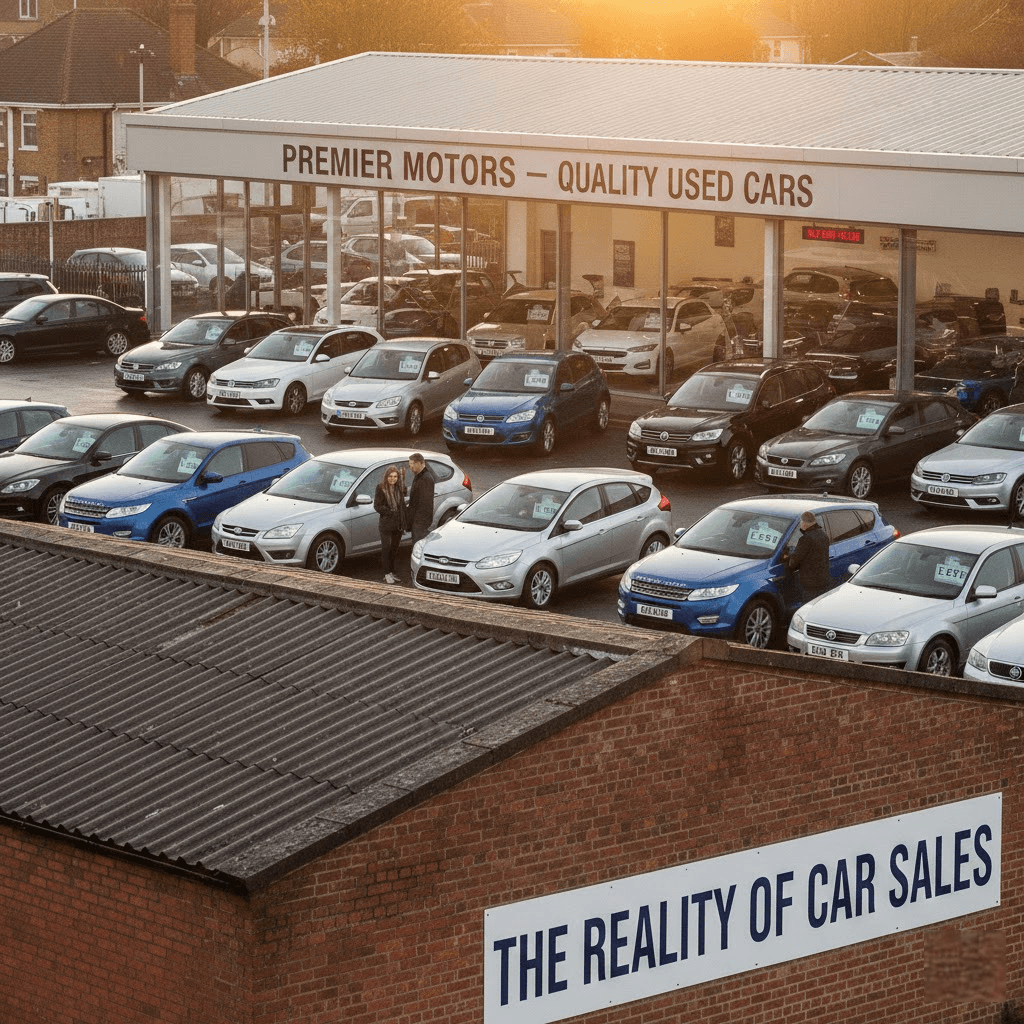
High volume, low margin. These are vast lots often located near major motorway junctions.
- The Draw: Choice and price. They stack ’em high and sell ’em cheap. If you want a standard Ford Focus or Vauxhall Corsa, they will have fifty of them.
- The Reality: It is a factory line experience. Test drives might be limited to a spin around the car park. The “hard sell” on extras like paint protection and GAP insurance is intense, as this is where they make their real profit.
4. The Private Seller
Found via Gumtree, Facebook Marketplace, or Autotrader private ads. This is Bob down the road selling his old Astra.
- The Draw: Price. You are cutting out the middleman’s profit margin. You also get to meet the person who lived with the car. A fastidious owner who kept a folder of receipts is worth their weight in gold.
- The Reality: Caveat Emptor—Buyer Beware. You have very few legal rights. If the engine falls out ten minutes after you hand over the cash, it is your problem (unless they misrepresented the car).
The Inspection: How to “Kick Tyres” Like a Pro
Once you have identified a promising candidate in your local area, you need to view it. Do not be wooed by a freshly valeted interior. A clean car can still be a mechanical wreck. Bring a torch, some paper towels, and a skeptical attitude.
The Exterior Walkaround
Stand at each corner of the car and look down the flanks. You are looking for ripples in the reflection which indicate bodywork repairs. Check the panel gaps—the space between the door and the wing, or the bonnet and the bumper. They should be uniform. If the gap is tight at the top and wide at the bottom, that panel has been replaced or realigned, possibly due to a crash.
Check the tyres. In the UK, the legal limit is 1.6mm across the central three-quarters. Use the “20p test”—insert a 20p coin into the tread grooves. If the outer band of the coin is obscured, the tread is likely above the legal limit. Also, look for mismatched brands. A car wearing four premium tyres (Michelin, Pirelli, Continental) suggests an owner who didn’t scrimp. A performance car with “Ditchfinder 5000s” on the rear suggests maintenance on a budget.
Under the Bonnet
You don’t need to be a mechanic to spot neglect. Ensure the engine is cold when you arrive. Touch the bonnet. If it’s warm, the seller has pre-warmed it to hide cold-start issues like rattles or smoke.
Check the fluids. Unscrew the oil filler cap. You are looking for “mayonnaise”—a thick, creamy emulsified sludge. This indicates coolant mixing with oil, often pointing to a failed head gasket, a repair bill that can easily exceed £1,000.
The Test Drive
Turn the radio off. You are listening for clunks, whines, and rattles.
The Clutch: In a manual car, find a hill. Drive up it in a high gear (like 4th) and floor the accelerator. If the revs rise but the speed doesn’t, the clutch is slipping.
The Brakes: On a straight, clear road, brake firmly (warn your passengers). Does the car pull to one side? Does the steering wheel judder? Juddering suggests warped discs.
The Suspension: Aim for a few bumps or potholes (easy enough on UK roads). Clunking sounds usually mean worn bushes or drop links.
The Paperwork: The V5C and History Check
In the UK, the paperwork is as important as the metal. Never buy a car without the V5C (logbook). Check the Vehicle Identification Number (VIN) on the V5C matches the one stamped on the car’s chassis (usually visible through the bottom of the windscreen).
The HPI Check
Before you even view the car, spend a few pounds on a history check (HPI check). This will tell you:
Outstanding Finance: If the previous owner owes money on the car, the finance company legally owns it, not you. They can repossess it.
Write-off Status: Is it a Category S (structural damage repaired) or Category N (non-structural) write-off? These cars are cheaper for a reason and harder to insure.
Mileage Discrepancies: It checks against the National Mileage Register to ensure the car hasn’t been “clocked” (had its mileage wound back).
Service History
A “Full Service History” (FSH) is the holy grail. It means the car was serviced on schedule every year. Check the stamps in the book or the digital printout. A gap of three years or 30,000 miles without an oil change is a ticking time bomb for modern engines.
The EV Shift: Buying Electric Locally
The search for “car sales near me” is increasingly turning up electric vehicles (EVs). Buying a used EV requires a different mindset. You are less concerned with clutches and exhausts and more concerned with State of Health (SoH).
Batteries degrade. Most modern EVs have excellent battery management, but you should ask to see the battery health report. If buying from a dealer, ask them to run a diagnostic. If the battery capacity is below 80% of its original figure, the range will be noticeably reduced. Also, check the charging cables are present. A missing “granny cable” (3-pin plug charger) or Type 2 cable can set you back £200 to buy separately.
Negotiation: The British Art of Polite Haggling
British people often find haggling excruciating, but it is expected in car sales. The price in the window is rarely the final price.
Do your homework: If a local dealer has a car up for £8,000, but Autotrader shows three similar models within 50 miles for £7,500, use that. “I really like this car, but there is another one down the road for £500 less. I’d prefer to buy from you; can you match it?”
The “Walk Away” Power: The strongest tool you have is your feet. If the deal doesn’t feel right, or the numbers don’t add up, politely decline and leave. Often, you will receive a call a few hours later with a better offer. If not, you avoided a car you weren’t 100% happy with.
Avoiding Scams in the Local Market
Searching locally usually feels safer, but scammers operate everywhere. Be wary of:
- The “Virtual” Car: A car advertised at a bargain price, but the seller makes excuses why you can’t see it (they are abroad, working on an oil rig, etc.) and asks for a deposit to “hold” it. Never transfer money for a car you haven’t touched.
- Cloned Cars: Criminals steal a car and put number plates on it from an identical, legitimate car. The HPI check will look clean because it’s checking the plates, not the stolen car. Always check the VIN on the chassis matches the V5C.
- Driveway Robbery: When selling or buying privately, try to meet in a safe, public place or at a home address that matches the V5C. Avoid meeting in dimly lit car parks at night.
Financing Your Local Purchase
While cash was once king, most UK car sales now involve finance. When buying from a local dealer, they will offer their own packages.
PCP (Personal Contract Purchase): Lower monthly payments, but you don’t own the car at the end unless you pay a large “balloon payment.” Good if you like changing cars every three years.
HP (Hire Purchase): Higher monthly payments, but you own the car automatically after the final payment.
Bank Loan: Often the cheapest option. You borrow the cash from your bank, buy the car outright, and pay the bank back. This makes you a “cash buyer” in the eyes of the dealer, which can sometimes (though less often nowadays) help with negotiation.
The Final Handover
You have found the car, checked the history, kicked the tyres, and agreed on a price. Before you drive away:
Ensure you have taxed the vehicle. Road tax is not transferable in the UK anymore. You must tax it online or at the Post Office using the V5C new keeper slip (green slip) before you drive off. Ensure your insurance starts from the exact time you pick up the car.
Finding the right car sales near you is a journey. It requires patience and a bit of diligence. But there is a distinct satisfaction in driving past a local garage, seeing the empty space where your car used to sit, and knowing you secured a solid machine that will serve you well on the British roads. Happy hunting.