savingsspot.co.uk
 It is a headline that has sent ripples through the British property market and the heritage community alike: Ripley Castle, the ancestral seat of the Ingilby family for over seven centuries, is for sale. For the first time in 28 generations, this jewel of North Yorkshire—steeped in history, intrigue, and architectural splendour—is looking for a new custodian. The sale of the Ripley Castle Estate is not merely a property transaction; it marks the closing of a chapter that began in the 1300s, offering a once-in-a-millennium opportunity for a buyer to acquire a piece of living history.
The term “estate sale” often conjures images of furniture auctions and antique fairs—events that Ripley has indeed hosted with great success. However, the current buzz surrounds the sale of the estate itself. With a guide price that has seen dramatic shifts to court the realities of the modern market, the listing has become one of the most talked-about real estate events in the United Kingdom. From the ghost of “Trooper Jane” to the bullet holes of the Civil War, Ripley Castle is a home where the walls don’t just have ears; they have stories that span the entirety of modern British history.
A 700-Year Legacy on the Market
To understand the magnitude of this sale, one must appreciate the continuity of ownership that is being broken. The Ingilby family has held Ripley Castle since 1309, when Sir Thomas Ingilby married the heiress Edeline Thwenge. It is rare in the 21st century to find a property that has remained in the same bloodline for such an immense stretch of time. Through the Wars of the Roses, the Reformation, the Gunpowder Plot, and the English Civil War, the Ingilbys held fast to their North Yorkshire stronghold.
Sir Thomas Ingilby (the current baronet) and Lady Emma Ingilby have been the stewards of this legacy for over 50 years. Their decision to sell was not taken lightly. In recent interviews, they have cited the desire to retire and, perhaps more poignantly, the wish to free their children from the colossal responsibility that comes with maintaining a Grade I listed historic monument. Managing an estate of this magnitude is less of a lifestyle and more of a relentless, seven-day-a-week job. By placing the estate on the market, they are effectively choosing to end their watch on their own terms, ensuring the castle can transition smoothly into a new era.
The Property: What is on Offer?
The Ripley Castle Estate is being marketed by Carter Jonas, and the offering is as complex as it is magnificent. Originally launched with a guide price in the region of £21 million for the whole, the estate has recently seen a strategic price adjustment, with the castle itself (Lot 1) being offered at a significantly reduced figure—reported in late 2024 and early 2025 to be around £7.5 million. This price correction reflects a cooling in the super-prime country house market, where buyers for such unique, high-maintenance assets are few and discerning.
The estate is available as a whole or in separate lots, allowing for a variety of potential futures. The key components include:
- The Castle (Lot 1): The heart of the estate. A Grade I listed 14th-century fortified manor house that has evolved over hundreds of years. It includes the peel tower (the oldest surviving section), the Tudor tower, and the Georgian wings. The interiors are a masterclass in English design history, featuring the Knights Chamber, the Tower Room with its 16th-century ceiling, and the extensive library.
- The Grounds: The castle sits within approximately 445 acres of parkland, lakes, and woodland. The landscape was significantly shaped by “Capability” Brown’s style, featuring a large serpentine lake and a deer park that provides a quintessential English backdrop.
- Commercial Enterprises: Unlike a silent country home, Ripley is a bustling business. The sale encompasses the successful commercial elements that keep the estate viable. This includes the Boar’s Head Hotel (a historic coaching inn with 23 bedrooms), the Grindhus Coffee Shop, and the village tea room.
- The Village: The estate is inextricably linked to the village of Ripley, a model village largely rebuilt in the 1820s by Sir William Amcotts Ingilby. The sale includes various residential and commercial properties within this picturesque settlement, making the buyer not just a homeowner, but a key stakeholder in the local community.
Tales from the Tower: The History You Can Buy
Any prospective buyer is purchasing more than bricks and mortar; they are acquiring a narrative. The history of Ripley Castle is colourful, occasionally violent, and deeply woven into the fabric of the nation.
One of the most enduring legends concerns the family crest—a boar’s head. It is said that in the 14th century, King Edward III was hunting in the nearby Forest of Knaresborough when he was charged by a wild boar. Sir Thomas Ingilby intervened, spearing the beast and saving the monarch’s life. In gratitude, the King knighted him and granted the family the crest that adorns the castle to this day.
The castle’s involvement in religious and political strife is equally fascinating. The Ingilbys were staunch Catholics during a time when it was dangerous to be so. The castle contains a “priest hole”—a secret hiding place used to conceal Catholic clergy from the authorities. In 1605, the family was implicated in the Gunpowder Plot; nine of the conspirators were close relations or associates of the Ingilbys, though the immediate family managed to escape execution.
Perhaps the most famous story involves “Trooper Jane” Ingilby. After the Royalist defeat at the Battle of Marston Moor in 1644, Sir William Ingilby fled back to Ripley, with Oliver Cromwell in hot pursuit. Sir William hid in the priest hole while his sister, Jane, faced the Parliamentarian leader. It is said she held Cromwell at pistol point in the castle library for the entire night to ensure he did not search the house. The next morning, Cromwell departed, and the castle was saved from destruction—a rare feat when many other Royalist strongholds were razed to the ground.
The Market Reality: Why the Price Drop?
The news that the asking price for the castle section had been slashed by nearly 50% created a stir in the property world. This adjustment serves as a stark commentary on the current state of the British heritage property market. While the allure of owning a castle is timeless, the practicalities are daunting.
In 2025 and 2026, the market for “trophy assets” has faced headwinds. High interest rates, increased running costs (particularly energy for heating draughty stone halls), and a smaller pool of ultra-high-net-worth individuals willing to take on renovation projects have softened demand. Grade I listing status, while prestigious, imposes strict limitations on what a new owner can alter, making modernisation a costly and bureaucratic hurdle.
By lowering the price to £7.5 million for the main castle lot, the agents are widening the net. It brings this historic pile into the price bracket of a large London townhouse, posing a tempting question to wealthy buyers: would you prefer a terraced house in Chelsea or a 700-year-old castle with a deer park in Yorkshire?
The Visitor Experience and the Future
For the public, the sale has raised questions about access. Under the Ingilbys, Ripley Castle has been a beloved local attraction, hosting weddings, guided tours, and the popular Christmas Fair. The estate gardens, famous for their National Hyacinth Collection and magnificent herbaceous borders, draw thousands of horticultural enthusiasts annually.
Currently, the estate remains open for business. The Ingilby family has assured staff and the community that operations will continue as normal during the marketing period. However, the future access depends entirely on the new owner. A private buyer could theoretically close the gates, turning Ripley back into a strictly private residence. Alternatively, a commercial investor might expand the hospitality side, perhaps turning the castle into a luxury hotel or spa, capitalizing on the established brand of the Boar’s Head and the wedding venue.
Conservation groups and locals are watching closely. The village of Ripley is unusual in that it is an “estate village,” where the castle owner historically acts as a benevolent landlord for much of the housing and commercial stock. A change in ownership is a seismic shift for the tenants and the community dynamic.
An Architectural Patchwork
Architecturally, the castle is a fascinating patchwork that reflects the fortunes of the family over centuries. The Gatehouse, built around 1450, is one of the few remaining examples of its kind, complete with original oak gates. The main block of the house was substantially remodelled in the 1780s by Sir John Ingilby, who, ironically, had to flee to the continent shortly after due to debts—a reminder that financial struggles with the estate are nothing new.
The interior design spans eras. The Old Tower houses the library and the morning room, spaces that feel intimate despite their grandeur. The Knights Chamber, with its dark wood panelling, evokes the Tudor era, while the brighter Georgian rooms speak of a time when the castle was being transformed into a gentleman’s country residence. The sale includes the potential to acquire some of the contents, although many heirlooms may be retained by the family or sold via separate auction—a common practice in such major “unbundling” events.
The “Chattels” and Contents Auctions
While the term “Ripley Castle Estate Sale” primarily refers to the real estate, it is worth noting that the transition of such a property often triggers secondary sales of “chattels”—the furniture, art, and ephemera that have gathered over centuries. In the world of antiques, provenance is king. An item that can be traced back to the Ripley Castle inventory carries a premium.
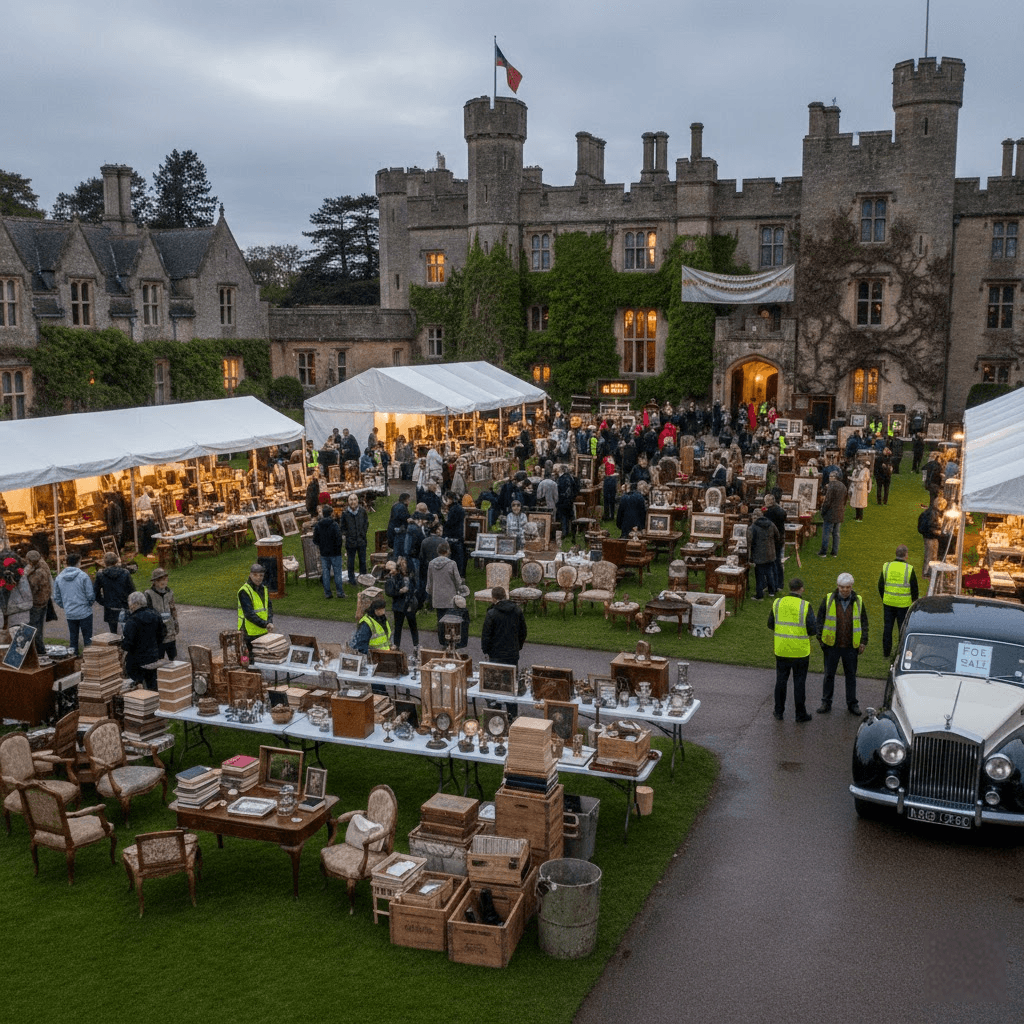
There have been smaller auctions and fairs held on the grounds, such as the Arthur Swallow Decorative Home & Salvage Shows, which use the castle as a dramatic backdrop. However, serious collectors are watching to see if a dedicated “Contents of Ripley Castle” auction will be announced by a major house like Sotheby’s or Christie’s. If such a sale occurs, it would likely feature items ranging from Civil War armour to Georgian silver, offering the public a chance to own a smaller, more portable piece of the Ingilby legacy.
Conclusion: The Final Curtain on an Ancient Line
The sale of Ripley Castle is a poignant reminder of the changing tides of history. For 700 years, the Ingilby family has weathered storms, fought in battles, and hosted monarchs. They have been the constants in a changing world. By passing the baton now, they are ensuring the survival of the estate, acknowledging that the best way to preserve the past is sometimes to let go of it.
For the potential buyer, this is the opportunity of a lifetime. It is a chance to not just own a home, but to become a character in a story that started in the Middle Ages. Whether it remains a family home, becomes a luxury hotel, or transforms into a charitable trust, Ripley Castle will undoubtedly continue to dominate the landscape and the imagination of North Yorkshire.
As the “For Sale” sign hangs metaphorically over the battlements, one can only wonder who the next castellan of Ripley will be. Will they be a captain of modern industry, an international investor, or perhaps a heritage organization? Only time will tell, but one thing is certain: the sale of the Ripley Castle Estate is a historic event that will be referenced for generations to come.